Initia is documented as an Interwoven Rollup Network: a design that separates a coordination Layer 1, application-specific rollups, and the Interwoven Stack used to build and operate them. For readers searching initia crypto, the useful starting point is not a token narrative but a clear map of these layers, the separate Enshrined Liquidity mechanism, and the documented role of INIT.
What Is Initia?
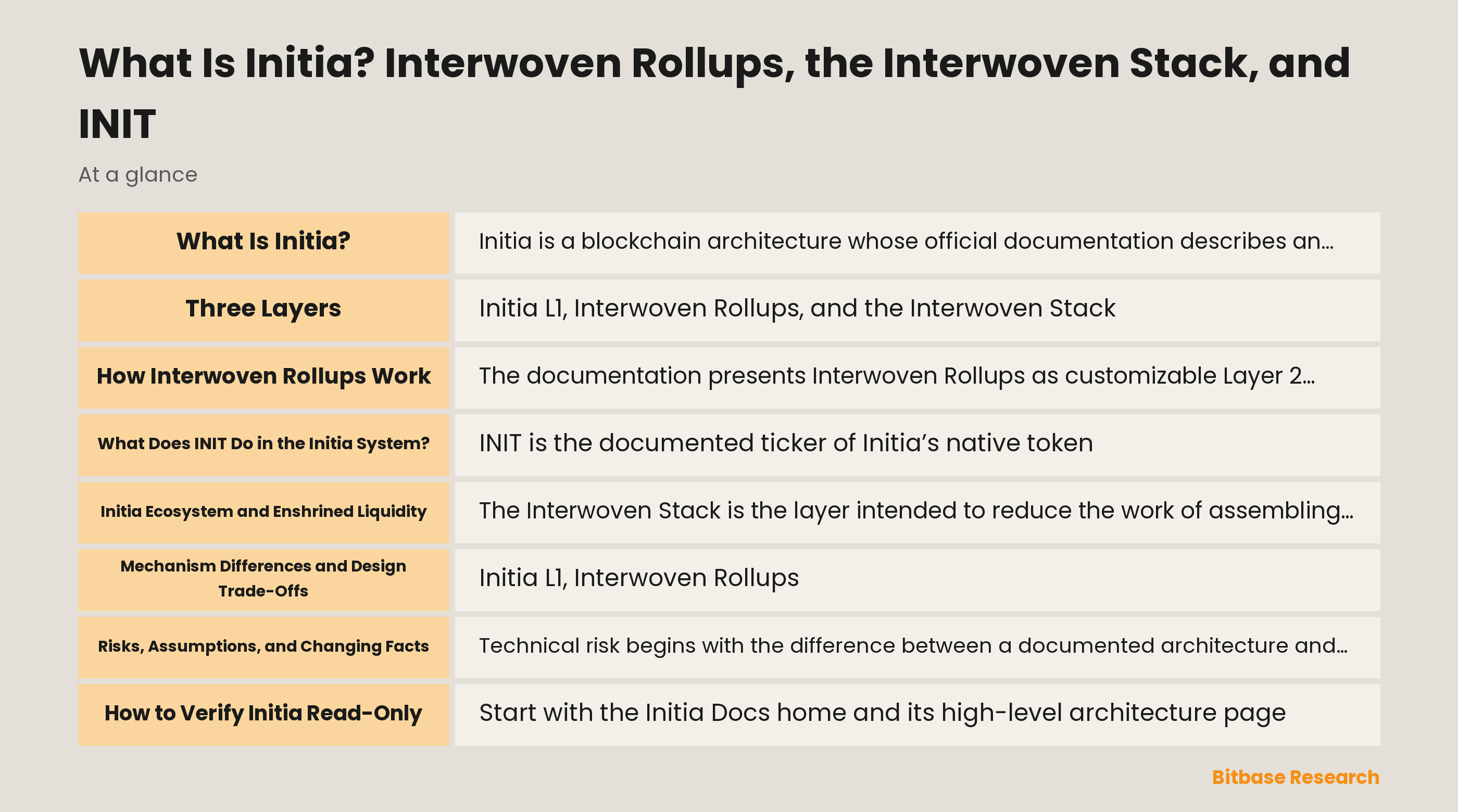
Initia is a blockchain architecture whose official documentation describes an ecosystem built around Initia L1 and Interwoven Rollups. The project frames the L1 as a coordination layer and central liquidity hub, while rollups can be tailored for applications. This is an architectural description, not a promise about the behavior, availability, or security of every application that may use the framework.
The name also refers to more than one thing in casual discussion. It can mean the L1, the surrounding rollup ecosystem, the Interwoven Stack, or the native token ticker INIT. Those are related, but they answer different questions. A project profile is clearest when it identifies which layer is being discussed rather than treating every component as a single product.
Initia’s documentation emphasizes making infrastructure choices around areas such as data availability, interoperability, and oracles. That stated goal explains the project’s preference for an integrated stack. It does not remove the need to inspect the actual configuration, contracts, and operating assumptions of a particular network or application.
Three Layers: Initia L1, Interwoven Rollups, and the Interwoven Stack
The first layer is Initia L1. Official high-level documentation describes it as the base chain and a coordination and liquidity hub for the rollup ecosystem. It is the layer associated with shared services such as network security, governance, liquidity solutions, and interoperability. These are system roles, not evidence that any individual use case automatically inherits a particular outcome.
The second layer is the set of Interwoven Rollups. Official materials describe these as Layer 2 rollups built with the Interwoven Stack and situated around Initia L1. A rollup is an application-oriented execution environment; it is not simply another label for the L1. Its code, virtual machine, gas configuration, ordering design, permissions, and connections need to be examined separately.
The third layer is the Interwoven Stack. It is a framework and product suite for building and operating rollups and applications. Keeping the three categories separate prevents a common error: saying that a feature of the developer stack is automatically a property of every rollup, or that an economic rule of the L1 is the same as a rollup’s execution rule.
How Interwoven Rollups Work
The documentation presents Interwoven Rollups as customizable Layer 2 environments. Teams can select a virtual machine from the documented EVM, Move, or Wasm options according to the application they intend to build. A virtual machine determines how smart-contract code is expressed and executed; it is not a blanket statement about a project’s audit status, compatibility with every tool, or the safety of a deployed contract.
Official materials also say a rollup can choose its gas token and transaction-cost structure, and can implement its own transaction-ordering mechanism where needed. That means the word “Interwoven” should not be read as a claim that all rollups use the same token, the same execution environment, or the same ordering policy. A reader must identify the exact rollup and current configuration before inferring how a transaction or application behaves.
The design creates a relationship between custom execution environments and shared coordination services, but the relationship has boundaries. A rollup’s application logic, external dependencies, upgrade controls, and user interfaces remain specific to that rollup. Architecture documentation describes the intended framework; deployed code and current network records establish what is actually live at a particular moment.
What Does INIT Do in the Initia System?
INIT is the documented ticker of Initia’s native token. The official tokenomics page states a fixed supply of 1 billion INIT and presents a current allocation and release schedule across eight categories. Those figures are published documentation data, not a value judgment, a forecast, or a reason to take an action. They should be re-checked against the live official page before any publication that relies on them.
Within the documentation, INIT is connected to the native L1 and to economic and governance-related mechanisms. It also appears in the description of Enshrined Liquidity, while the rollup documentation says individual rollups can choose INIT, a stablecoin, a native token, or multiple tokens for their own gas configuration. The existence of that choice means INIT’s role at the L1 level must not be mistaken for a rule that every rollup always uses INIT in the same way.
Supply, distribution labels, and release schedules describe protocol information at a point in time. They do not establish circulating supply, ownership, market conditions, or a recommended action. The responsible way to use those fields in a project introduction is to label them as current official documentation and leave verification to read-only sources.
Initia Ecosystem and Enshrined Liquidity
The Interwoven Stack is the layer intended to reduce the work of assembling common rollup infrastructure from unrelated pieces. The official description names a multi-VM-compatible framework and integrated components for areas such as interoperability, wallets, explorers, bridges, and external services. This is a description of a framework’s scope, not an instruction to use any interface or connect any account.
The stack’s central idea is an opinionated integration of infrastructure choices. For a builder, that can mean fewer independent decisions at the starting point. For an analyst, it means that the source of a feature matters: some behavior may arise from Initia L1, some from stack tooling, and some from a particular rollup’s own implementation.
An integrated design does not eliminate dependencies. A component can have version changes, contract permissions, service assumptions, or third-party relationships. The useful question is therefore not whether the stack sounds comprehensive, but which named component, repository, contract, and configuration govern the specific behavior being evaluated.
Enshrined Liquidity is neither another name for an Interwoven Rollup nor a synonym for the Interwoven Stack. The official documentation presents it as an economic mechanism intended to address the relationship between network security, liquidity, and capital use. It sits alongside the architectural layers rather than replacing their execution or developer-tooling functions.
Under the documentation’s current description, governance-whitelisted InitiaDEX INIT-token liquidity positions may be used as validator-related assets in addition to the native INIT token. This explains why the mechanism is discussed in connection with security and liquidity. It should not be simplified into a claim that every liquidity position qualifies, that conditions are permanent, or that a participant will obtain any particular result.
The distinction is important. A rollup is an execution environment, the stack is a development framework, and Enshrined Liquidity is an economic mechanism with parameters and governance dependencies. Confusing them can turn a high-level overview into an inaccurate statement about a token, a smart contract, or a specific application.
Mechanism Differences and Design Trade-Offs
Initia L1, Interwoven Rollups, the Interwoven Stack, and Enshrined Liquidity solve different types of problems. The L1 is described as a shared coordination layer. A rollup is a customizable application environment. The stack packages development and operations components. Enshrined Liquidity is a separate mechanism concerning how certain liquidity positions may relate to economic security under current rules.
That separation can make an ecosystem easier to reason about, but it also creates interfaces that must be checked. A claim about a rollup’s virtual machine does not prove anything about an economic parameter. A claim about a framework component does not prove that a deployed application has no administrative control. A description of an L1 mechanism does not replace review of the contracts that implement it.
The relevant trade-off is not a universal ranking. More customization can create more configuration choices; more integration can create dependencies on shared tooling; and an economic mechanism can depend on governance rules and eligibility conditions. These are analytical boundaries, not conclusions about relative quality.
Risks, Assumptions, and Changing Facts
Technical risk begins with the difference between a documented architecture and a live deployment. Contracts can contain bugs, permissions can be upgraded, bridges and external services can introduce dependencies, and a chosen virtual machine can have its own tooling assumptions. A high-level architecture page cannot establish the security properties of every contract or application that uses the stack.
There are also governance and parameter risks. The set of eligible liquidity positions, allocation rules, token-release information, rollup configuration, software versions, and public roadmaps can change. A statement that accurately reflected a documentation page on one date may be incomplete or obsolete later. Readers should treat these as facts to verify, not as permanent features.
Finally, terminology can obscure scope. “Interwoven” does not tell a reader which chain, contract, or interface is involved. Token symbols can be copied by unrelated assets, and user interfaces can point to different networks. A reliable review keeps the official project context, the exact network, and the exact deployed component aligned before drawing any conclusion.
How to Verify Initia Read-Only
Start with the Initia Docs home and its high-level architecture page. Confirm that the current documentation still distinguishes Initia L1, Interwoven Rollups, and the Interwoven Stack in the same way described here. Then read the rollup and Enshrined Liquidity concept pages to determine whether the capability or economic mechanism relevant to the question is still documented and under what conditions.
For INIT-related information, read the current official tokenomics page rather than relying on a copied supply table or an old social post. Check the page date, category labels, and release language, and distinguish protocol documentation from market data. If a contract or explorer is needed, first reach it through a current official source, verify the network and address, and remain in read-only inspection mode.
If a source makes an unexpected request to connect a wallet, sign a message, provide credentials, or move assets, stop rather than treating that request as part of verification. The safe outcome of this process is a better-understood architecture and a current source trail, not a transaction, participation decision, or assurance about future behavior.
Conclusion
Initia can be read as a layered design that combines an L1, application-specific rollups, and economic mechanisms. Assess a particular deployment by checking its current documentation, network context, and contract or asset identifier through the stated read-only sources.
Related market pages
- INIT: View price · Perpetual market
Disclaimer: This article is educational content from Bitbase Academy, provided for information only. It explains what a project does and what role its token plays in that system; it does not constitute investment, trading, tax, or financial advice, and it is neither a recommendation nor an endorsement of any project or token. Bitbase has not carried out due diligence on the project described here, and mentioning it does not mean Bitbase lists or supports the asset. Crypto assets carry significant risk, including price volatility, thin liquidity, smart-contract failure, regulatory uncertainty, and the possible loss of their entire value. Written as of August 2026; a project's status, tokenomics, team, and contracts can change at any time. Verify everything yourself through official channels, the contract address, and a block explorer, and beware of imitation sites and phishing links.
References
[1] Welcome to Initia (official documentation) docs.initia.xyz
[2] High Level Architecture (official documentation) docs.initia.xyz
[3] Interwoven Rollups Introduction (official documentation) docs.initia.xyz
[4] Interwoven Stack Introduction (official documentation) docs.initia.xyz
[5] Enshrined Liquidity Introduction (official documentation) docs.initia.xyz
[6] INIT Tokenomics (official documentation) docs.initia.xyz