Irys is presented in its official material as a programmable datachain: a Layer 1 design intended to bring data storage, verifiability, and execution into one protocol. For readers asking “what is irys crypto,” the useful starting point is not a market label but the documented relationship between data ledgers and execution. The phrase “irys crypto” can refer to the project or its IRYS ticker, yet neither label proves a network state, an external interface, or the status of a particular record.
What Is Irys?
Irys describes itself as a programmable datachain rather than a general-purpose execution chain with an added storage feature. Its official whitepaper and documentation frame the system around data that can be retained, checked, and used by an execution environment within the same protocol. That framing explains the project’s intended design; it does not establish the state or properties of every service using the Irys name.
The word datachain is important because it emphasizes data as a first-class part of the protocol. A record has a lifecycle, a retention context, and evidence associated with its availability. This differs from treating storage as an incidental payload next to unrelated execution, although the practical behavior of any specific application still depends on the software, configuration, and network conditions in use.
Official materials also use several network labels for different Irys surfaces. Those labels should be read with their date and scope, not collapsed into a single claim that every Irys component has the same release status. This profile therefore explains the documented model and leaves changing network facts to current official records.
What Problem Does Irys Aim to Address?
Many data-dependent systems need more than a place where bytes can remain. They may need to establish whether a record is available, link that record to application rules, and reason about how long it is intended to be retained. When storage, verification, and execution are separated across unrelated systems, the relationship between them must be reconstructed by each application.
Irys documents a design that tries to make that relationship native to the protocol. Its materials describe data ledgers for retention and verification alongside IrysVM for execution. The goal is conceptual integration: an application can reason about data and execution through one documented architecture rather than treating the data layer as an opaque external dependency.
That goal should not be converted into an unconditional claim of reliability, speed, or suitability. The state of an application, the availability of a particular record, and the behavior of an implementation remain separate questions. A project description explains what components are meant to do; technical evidence and current source material are needed for a specific deployment.
How Does Irys Work?
At a high level, Irys documentation describes a multi-ledger approach. Incoming data is described as beginning in a temporary Submit Ledger, where the protocol establishes evidence about its presence and replication. Material that meets the stated conditions can be promoted to a Publish Ledger, which the documentation describes as having permanent status.
This separation matters because temporary and permanent are not merely labels for the same storage outcome. A temporary stage concerns an early or limited retention context, while the published stage concerns data that has completed the protocol’s documented promotion process. Additional term-ledger concepts are also discussed in official material, but their current scope and availability must be checked at the time of review.
IrysVM is the execution side of this design. Official material describes it as an environment intended to let smart-contract logic interact with Irys data ledgers directly. The point is not that data acts by itself, but that pre-defined execution logic can use documented data properties within the protocol. That is an architectural explanation, not a statement that every proposed function is active or suitable for a particular use.
What Does IRYS Do in the Irys System?
IRYS is the ticker used in Irys’s official tokenomics material for the network’s native asset. That material describes IRYS in connection with the Irys Data Layer and IrysVM. This identifies a documented protocol role; it does not authenticate similarly named assets, provide a contract address, or establish the current condition of a network deployment.
The question “what is irys crypto” is therefore best separated into two layers. Irys is the project and architecture described by the official materials, while IRYS is the ticker the project uses for its native asset. A ticker alone is not a technical identifier. Network-specific records, token role details, and the source date must all be checked before treating an external label as relevant.
The phrase “irys tokenomics and use cases” also needs a narrow reading. Official material describes protocol-level functions and a model intended to connect data retention with execution, but it does not validate every service, integration, or claimed application. The token’s current role, parameters, and any related technical records are changeable facts, so this article does not turn them into a durable guarantee.
Irys Ecosystem and Use Cases: What the Documents Describe
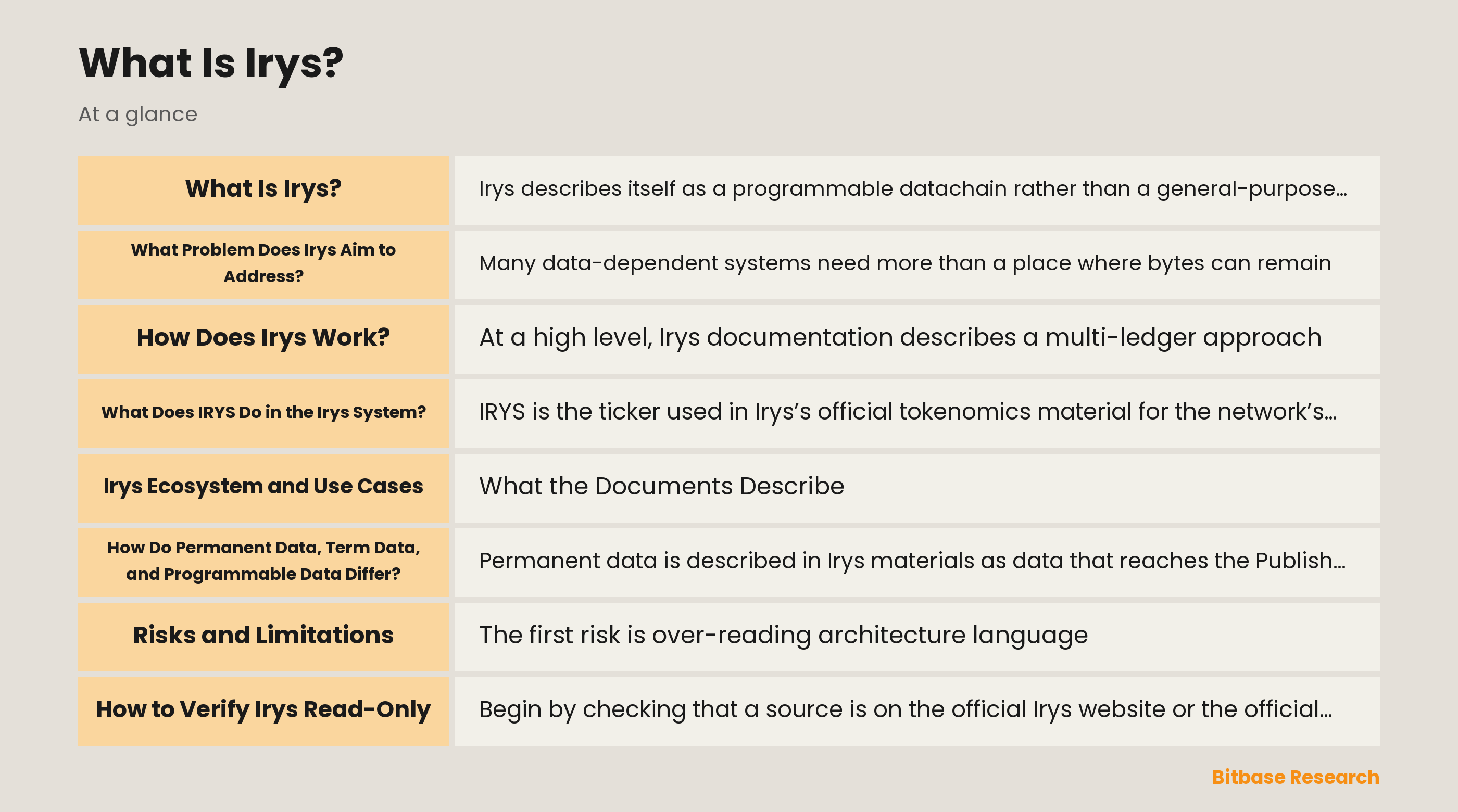
The Irys ecosystem can be understood as the set of data-dependent applications and infrastructure that may use the protocol’s documented storage and execution model. The whitepaper presents AI, DePIN, and other data-centric categories as areas the architecture is designed to address. Categories are not proof that a given product is live, secure, or appropriate for a particular purpose.
For a use case, the key question is which documented property is relevant. A record that must remain inspectable over time raises a data-retention and verifiability question. A record whose properties must be used by defined logic raises an execution question. Keeping those questions distinct makes the explanation more precise than treating an ecosystem label as a blanket capability claim.
Ecosystems also change. Applications, integrations, permissions, and supported functions can appear, change, or disappear. This profile does not direct a reader to interact with any application. It simply distinguishes the architecture’s stated scope from a claim about an external service or a current deployment.
How Do Permanent Data, Term Data, and Programmable Data Differ?
Permanent data is described in Irys materials as data that reaches the Publish Ledger after the protocol’s stated checks. The word permanent describes the intended status in the documented ledger model. It should not be read as an absolute promise that removes the need to review the protocol version, the relevant records, and the conditions under which a particular statement is being made.
Term data describes a different retention idea: information may be associated with a defined duration rather than the permanent ledger. Official materials discuss the expansion of such ledger options as the network evolves. The important distinction is semantic. A duration-based record and a record with permanent status answer different retention questions, even when both are discussed within the same datachain.
Programmable data concerns the link between a data record and pre-defined execution logic. Irys describes IrysVM as making this direct relationship possible inside the protocol, so data can be checked or used by smart-contract logic rather than remaining only passive storage. That description does not guarantee a result from any code, nor does it remove the need to inspect the current scope and implementation of a particular application.
Risks and Limitations
The first risk is over-reading architecture language. A datachain, a ledger, a proof, and an execution environment refer to different roles. A statement that data has a documented retention status does not audit application logic. A statement about an execution environment does not prove that a particular record is available. A statement about an ecosystem does not authenticate an external interface.
The second risk is time sensitivity. Official pages can describe different network surfaces, stages, and future-oriented features. Software releases, implementation scope, protocol parameters, token roles, and technical records may change. A careful reader should preserve the date and wording of a source instead of assuming that an earlier design description proves the current state.
There is also a verification boundary. This article does not identify a contract address, assess code, certify record retention, or make an audit conclusion. It does not promise data recovery, security, or application behavior. When such claims matter, they require current official material and matching read-only technical evidence for the relevant network.
How to Verify Irys Read-Only
Begin by checking that a source is on the official Irys website or the official `docs.irys.xyz` documentation domain, then read its title, date context, and stated scope. Compare the whitepaper’s broad design framing with the ledger and IrysVM pages, rather than using a short social post or an unrelated label as evidence of a technical property.
Next, distinguish the network terms used in current official documentation. A page about a Bundler service, a development environment, or an L1 test context may support different statements. If the wording is forward-looking or the source date is unclear, treat it as a reason to pause and obtain updated official clarification instead of filling the gap with an assumption.
For IRYS, first confirm the ticker and its documented role in current official tokenomics material. Do not infer a contract address from a search result. If an official source later identifies a network-specific address, compare it read-only with the matching block explorer, including the network name and visible technical relationship. No transaction or interactive authorization is needed for that comparison.
The Bottom Line
Irys is best understood through its documented datachain model: separate retention contexts for data, evidence intended to support verifiability, and IrysVM as an execution environment connected to those data ledgers. This makes permanent, term-based, and programmable data distinct concepts rather than interchangeable slogans.
IRYS is the official ticker for the project’s native asset in the cited tokenomics material, but its current role and technical records remain date-sensitive. The sound next step for any specific claim is a read-only comparison of the current official source with the matching network evidence, not an interaction with an external service.
Related market pages
- IRYS: View price · Perpetual market
Disclaimer: This article is educational content from Bitbase Academy, provided for information only. It explains what a project does and what role its token plays in that system; it does not constitute investment, trading, tax, or financial advice, and it is neither a recommendation nor an endorsement of any project or token. Bitbase has not carried out due diligence on the project described here, and mentioning it does not mean Bitbase lists or supports the asset. Crypto assets carry significant risk, including price volatility, thin liquidity, smart-contract failure, regulatory uncertainty, and the possible loss of their entire value. Written as of August 2026; a project's status, tokenomics, team, and contracts can change at any time. Verify everything yourself through official channels, the contract address, and a block explorer, and beware of imitation sites and phishing links.
References
[1] Irys Whitepaper (official) irys.xyz
[2] What Irys Is (official documentation) docs.irys.xyz
[3] Ledgers Overview (official documentation) docs.irys.xyz
[4] Why IrysVM (official documentation) docs.irys.xyz
[5] Why Programmable Data (official documentation) docs.irys.xyz
[6] Networks (official documentation) docs.irys.xyz
[7] Introducing $IRYS Tokenomics (official blog) irys.xyz