Jambo is documented as a mobile-focused on-chain infrastructure project whose materials distinguish JamboPhone, Jambo OS, Jambo App, a wallet layer, the Jambo ecosystem, and the token identified by ticker J.
Jambo is presented in official material as mobile infrastructure for an on-chain economy. The name can refer to the project-level effort, while its documentation separately names JamboPhone, Jambo OS, Jambo App, a wallet component, the Jambo ecosystem, and the J token. Readers searching Jambo J tokenomics and use cases, what is Jambo J token, or jambo token need that separation first. It prevents a project description from treating a device, an operating system, an application, a wallet component, and a token as the same object.
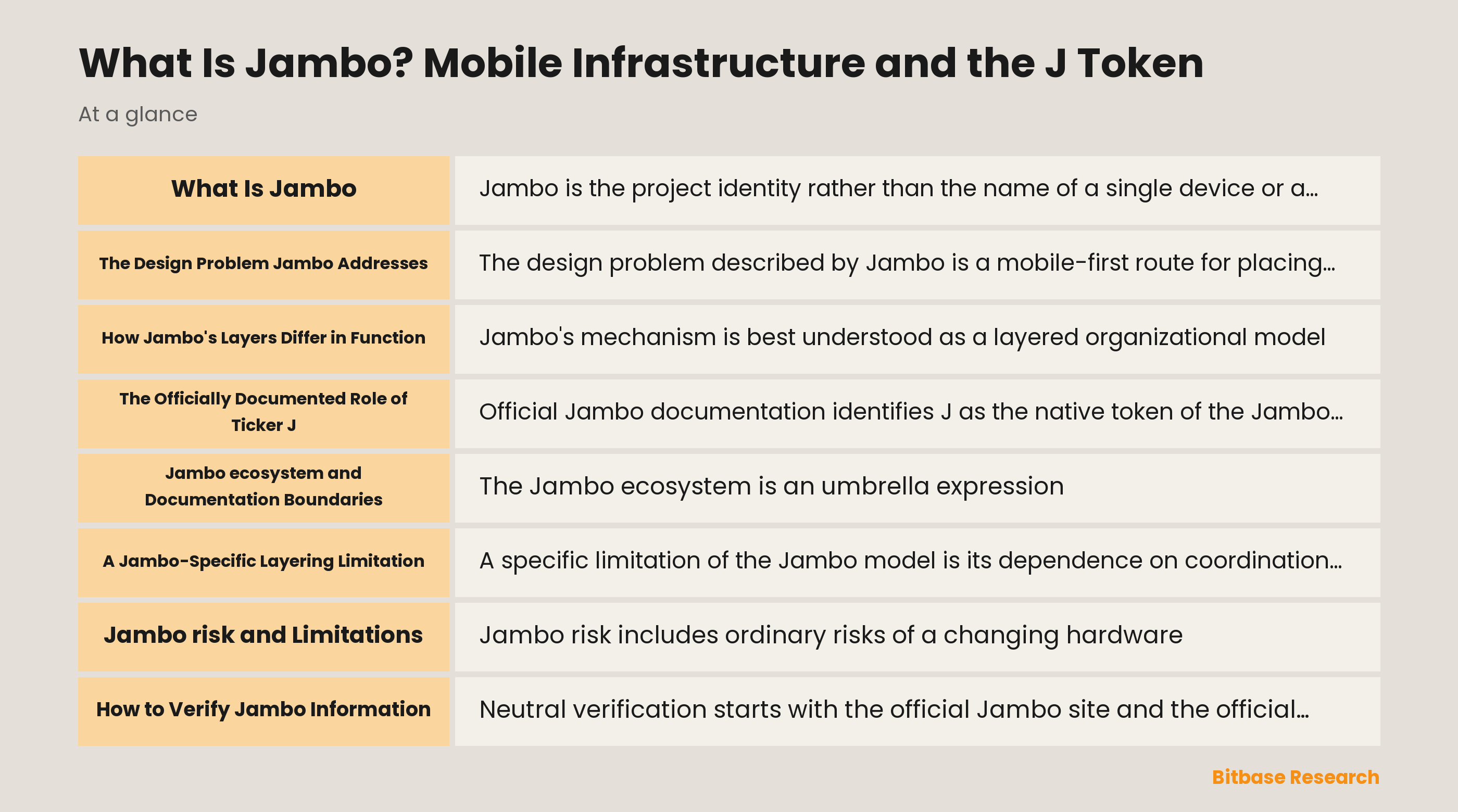
What Is Jambo
Jambo is the project identity rather than the name of a single device or a single software screen. Its official site frames the project around mobile infrastructure, and its whitepaper arranges the explanation around named product layers. That framing identifies the intended scope of the project. It does not prove that a particular feature, external relationship, regional condition, or implementation state remains unchanged after the page was published.
JamboPhone is the named hardware layer in the documentation. Jambo OS is described as a mobile operating-system layer, and Jambo App is a separately named application layer. A wallet component may be referred to by the materials, but it remains different from the project identity and from ticker J. Device status, software version, application behavior, and wallet capability are therefore separate facts that require current first-party confirmation.
The Design Problem Jambo Addresses
The design problem described by Jambo is a mobile-first route for placing on-chain services and communities in a phone-centered environment. At a high level, the project presents hardware, system software, and an application layer as a way to organize an ecosystem. This is an architectural objective. It is not evidence that every service is available to every person, or that each layer carries the same technical, security, or legal properties.
A mobile-focused model also creates a coordination problem. Hardware, an operating system, application software, external services, and token documentation can evolve at different speeds and under different controls. Jambo's documents give these layers names, but naming a layer does not make it interchangeable with another one. A careful profile keeps each statement tied to the source and the layer that actually support it.
How Jambo's Layers Differ in Function
Jambo's mechanism is best understood as a layered organizational model. JamboPhone identifies a device category, Jambo OS identifies an operating-system layer, Jambo App identifies an application layer, and the Jambo ecosystem names the broader context in which the official materials place them. The official site and whitepaper can explain this relationship. They should not be treated as a permanent inventory of every connected service, technical capability, or external organization.
This model differs from a claim that a token determines every device state, or that a phone proves a token-related status. Hardware concerns a device, an operating system concerns system software, an app concerns an application layer, and a token has the role documented for that token. Keeping these differences visible avoids category errors when a project-level description is turned into a claim about a specific technical or economic term.
The Officially Documented Role of Ticker J
Official Jambo documentation identifies J as the native token of the Jambo ecosystem. This is the factual ticker role used in this profile. It says how the project labels the token in its own material. It does not say that JamboPhone ownership, Jambo OS availability, Jambo App access, or the presence of a wallet component automatically creates any token right, control, compensation, or other benefit.
The whitepaper also contains dedicated material on J token mechanics and tokenomics. That establishes a documentation boundary for questions about J, but it does not justify copying supply figures, allocation claims, contract identifiers, distribution terms, or other time-sensitive information without a publication-date check. A durable introduction can name J as the ecosystem's documented native token while leaving dynamic token facts to current official material.
Jambo ecosystem and Documentation Boundaries
The Jambo ecosystem is an umbrella expression, not another name for a device, operating system, application, wallet, or the J token. Official sources connect the project to mobile infrastructure and distinguish JamboPhone, Jambo OS, and Jambo App. That supports a high-level ecosystem description. It does not establish that every mentioned service, organization, integration, or feature is active, available, or applicable in every circumstance.
Each document has a limited evidentiary scope. The JamboPhone page supports a hardware-layer description, the Jambo OS page supports an operating-system-layer description, and the Jambo App page supports an application-layer description. A general whitepaper overview may connect these names to the project vision and J. It should not be stretched into proof of current device specifications, current software behavior, current external relationships, or the status of a particular service.
A Jambo-Specific Layering Limitation
A specific limitation of the Jambo model is its dependence on coordination between distinct layers. A hardware description does not settle the current state of system software. A Jambo OS description does not settle the current state of Jambo App. An app description does not settle the properties of a wallet component or token terms. This is not unique to Jambo; it is a reason to match every assertion with the layer and source that actually support it.
The project pages use a mobile and ecosystem framing, but the concrete implementation can change. Device models, software releases, supported networks, regional availability, external relationships, security features, and documentation wording are all publication-date questions. The same caution applies to J. A documented ticker role does not freeze contract information, supply, allocation, governance arrangements, or the state of any related feature.
Jambo risk and Limitations
Jambo risk includes ordinary risks of a changing hardware, software, and on-chain ecosystem. A product page can become dated, an implementation can contain defects, a third-party dependency can change, and a public description can be narrower than a reader assumes. Security risks may arise at device, operating-system, application, wallet, network, or external-service layers. No overview should be read as a guarantee that a given layer is secure, active, or appropriate for a particular situation.
There is also a category risk in confusing the project's components. Treating a hardware layer as proof of token rights, treating an application layer as proof of wallet protections, or treating an official ticker label as proof of an economic outcome would all exceed the documented facts. Contract information, supply and allocation statements, audit scope, governance status, integration claims, regional limits, and legal effects can change and require current primary evidence with a matching scope.
How to Verify Jambo Information
Neutral verification starts with the official Jambo site and the official whitepaper, while keeping the cited page's scope in view. When an official contract address is relevant to a factual check, compare it with the official documentation and public on-chain records, then recheck it on the publication date. This is a record-comparison principle, not an instruction to interact with a wallet, a token, or an application.
A publication review should separately reconfirm the project name, ticker J, official domains, current documentation version, and the distinction among JamboPhone, Jambo OS, Jambo App, any wallet component, the ecosystem, and the token. It should also reconfirm a current contract identifier, supply or allocation statement, audit claim, governance description, supported-network claim, product availability, regional condition, and external relationship before presenting any such fact as current.
Conclusion
Jambo is most accurately presented as a project with a mobile-infrastructure framing and several documented layers. JamboPhone, Jambo OS, and Jambo App name different parts of that framing. The Jambo ecosystem names the broader context, while J identifies the token that the whitepaper labels as native to that ecosystem. This vocabulary is more precise than using Jambo as shorthand for every device, service, or token-related assertion.
The central interpretive rule is separation. Hardware or application availability does not establish token rights or compensation. A token label does not establish the current function of a phone, operating system, app, wallet component, or third-party service. The sources can explain the intended structure, but present availability, technical status, security, and legal effect each need their own current evidence.
For a publication-ready profile, state Jambo's project identity, named product layers, ecosystem framing, and ticker J in distinct sentences. Use first-party material to describe what each source actually covers, and treat changing information as a publication-date verification item. That approach explains the project without turning dynamic documentation into a promise about hardware, software, token terms, or external services.
Related market pages
- J: View price
Disclaimer: This article is educational content from Bitbase Academy, provided for information only. It explains what a project does and what role its token plays in that system; it does not constitute investment, trading, tax, or financial advice, and it is neither a recommendation nor an endorsement of any project or token. Bitbase has not carried out due diligence on the project described here, and mentioning it does not mean Bitbase lists or supports the asset. Crypto assets carry significant risk, including price volatility, thin liquidity, smart-contract failure, regulatory uncertainty, and the possible loss of their entire value. Written as of August 2026; a project's status, tokenomics, team, and contracts can change at any time. Verify everything yourself through official channels, the contract address, and a block explorer, and beware of imitation sites and phishing links.
References
[1] Jambo Technology official website www.jambo.technology
[2] About Jambo, Jambo Whitepaper jambo.gitbook.io
[3] About the JamboPhone, Jambo Whitepaper jambo.gitbook.io
[4] About the Jambo OS, Jambo Whitepaper jambo.gitbook.io
[5] About the Jambo App, Jambo Whitepaper jambo.gitbook.io