
JPM Coin is J.P. Morgan product terminology for a bank-issued USD deposit-token model. JPMD is the documented ticker for its USD deposit-token form, not evidence of a universally available consumer crypto asset.
This article explains the documented concept conservatively. It keeps the public product name, the ticker, the bank relationship, and present-day availability separate. Access, legal treatment, balances, technical identifiers, and implementation status are publication-day facts that need confirmation in current first-party material.
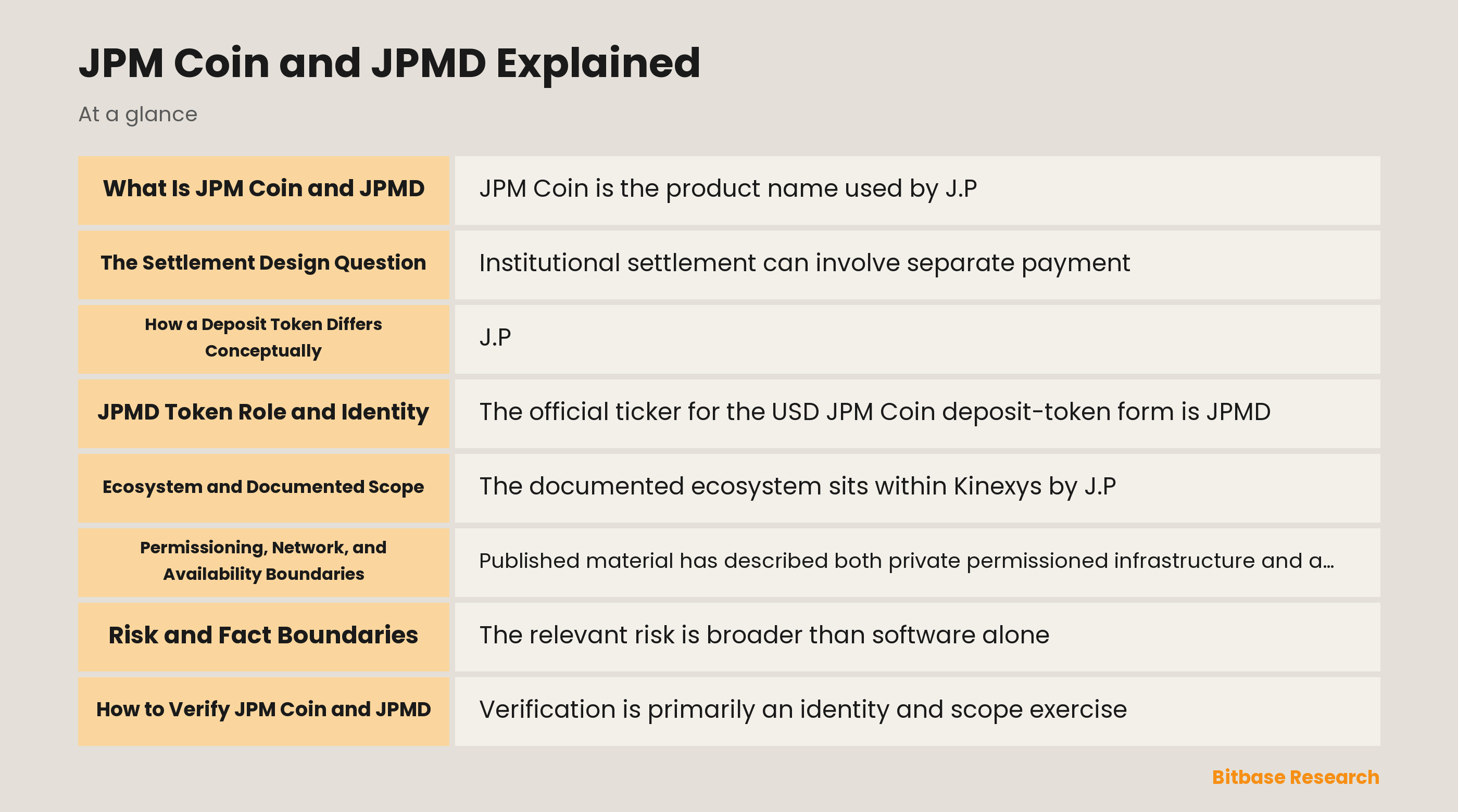
What Is JPM Coin and JPMD
JPM Coin is the product name used by J.P. Morgan for a USD-denominated deposit-token approach in Kinexys materials. A deposit token is presented as a digital representation of a deposit held with a commercial bank, expressed on blockchain rails rather than as an independently issued public cryptocurrency.
The labels have different jobs in careful writing. JPM Coin is the product and historical naming context used in issuer material, while JPMD is the documented ticker attached to the USD deposit-token form. A similar name or symbol elsewhere does not establish affiliation, issuer status, eligibility, or legal rights.
The Settlement Design Question
Institutional settlement can involve separate payment, reconciliation, and timing processes. The stated design question behind a tokenized deposit is whether a bank deposit can be represented in a format that participates in shared-ledger workflows while retaining its relationship to the issuing bank's deposit framework.
That question is about representation and coordination, not about creating a new public monetary system. A ledger entry can carry information about a bank-linked claim, but the ledger format alone does not define the claim's terms. The relevant account relationship, counterparty exposure, governing documents, and jurisdiction remain part of the explanation.
How a Deposit Token Differs Conceptually
J.P. Morgan describes JPM Coin as a deposit token rather than a cryptocurrency or stablecoin. In that model, the token is intended to represent a USD deposit with the issuing bank; the bank relationship and its governing terms remain central to understanding what the representation means.
This distinction is useful because similar technical vocabulary can describe very different economic arrangements. A token can be a digital form for recording a bank-linked position without becoming a public bearer asset with identical rights for every holder. Technical visibility, a recognizable label, or a blockchain record does not by itself settle questions of ownership, permission, or legal characterization.
JPMD Token Role and Identity
The official ticker for the USD JPM Coin deposit-token form is JPMD. It is the defensible identifier for this section because J.P. Morgan explicitly associates JPMD with that USD form; JPM Coin itself should not be treated as a separate universal public ticker.
Queries such as “jpm coin jpmd tokenomics and use cases,” “what is jpm coin jpmd crypto,” and “jpmd coin” can blur that distinction. The published issuer framing concerns a bank-issued, USD-denominated deposit token for institutional contexts, not a published public tokenomics model, a general distribution schedule, or an ordinary consumer asset.
Ecosystem and Documented Scope
The documented ecosystem sits within Kinexys by J.P. Morgan and its banking and digital-payments context. Issuer material discusses Blockchain Deposit Accounts, a USD deposit-token representation, and institutional settlement or programmable-workflow concepts at a high level.
An ecosystem description is not a catalogue of current integrations or an assertion that a named arrangement is available to every reader. Participant coverage, product connections, technical settings, custody arrangements, and regional scope can change. They belong in a publication-day review, rather than in a permanent claim drawn from a product label.
Permissioning, Network, and Availability Boundaries
Published material has described both private permissioned infrastructure and a public-chain-facing USD deposit-token context. Those are related documentation contexts, not grounds to collapse every historical JPM Coin reference into one identical implementation or one unchanged availability statement.
Eligibility is a substantive boundary. Official information frames access around approved institutional clients and can be subject to the bank's determination, due diligence, applicable law, regulatory conditions, and geography. In this setting, an institutional category is more than a descriptive label. It can depend on an entity's legal form, its relationship with the issuer, the jurisdiction in which a service is permitted, compliance controls, technical participation requirements, and the particular service documents available to that client. None of those filters can be inferred from a product page, a recognizable name, or an asset-like symbol. They are also not necessarily static: a client classification, a regional scope, and a technical rollout can each change independently as legal requirements, issuer policies, or supported infrastructure change. For editorial purposes, it helps to keep four separate questions in view. Who is identified as the issuer or service provider? What type of bank-linked representation is actually described? Which institutional category and legal geography does the current first-party material name? What important conditions, limitations, or unresolved details does that material leave to binding documents or publication-day confirmation? Separating those questions prevents a branding term from becoming an implied promise of access, a technical deployment from becoming a global availability claim, or a ticker from becoming proof of identical rights in every network context. It also avoids importing expectations associated with public crypto markets into a controlled institutional product. A reader can understand the stated role of JPMD without assuming that its label identifies a permissionless asset, a standardized public contract, or a product with fixed terms for every participant. The existence of an identifier such as JPMD does not imply retail access, unrestricted circulation, or an automatic one-for-one legal outcome.
Risk and Fact Boundaries
The relevant risk is broader than software alone. A reader needs to consider issuer and bank credit exposure, the deposit-account relationship, permissions, compliance controls, operational dependencies, smart-contract and chain dependencies, legal characterization, and the possibility that a product changes its terms or scope.
No account balance, reserve or deposit composition, contract address, supply, distribution, audit scope, chain parameter, conversion condition, or regional entitlement is asserted here. Such details can be material, but they require current official material and binding client documentation on the publication date. A concise explainer should not turn an unverified identifier into a claim about present legal or operational status.
How to Verify JPM Coin and JPMD
Verification is primarily an identity and scope exercise. A sound publication record distinguishes the J.P. Morgan product name from the JPMD ticker, identifies the issuer language, preserves the stated client category, and notes whether the primary material describes a deposit token rather than a public cryptocurrency.
Any technical identifier disclosed by an issuer is time-sensitive context, not a substitute for the underlying banking documentation. A name match, a ticker match, or a record on a ledger does not on its own establish affiliation, eligibility, legal rights, or current availability. The publication date, source date, jurisdiction, and stated client scope should remain visible in the editorial review.
Conclusion
JPM Coin is J.P. Morgan's product terminology for a bank-issued deposit-token approach, and JPMD is the documented ticker for its USD deposit-token form. The careful short description is institutional, permissioned settlement infrastructure tied to a bank deposit relationship, not a freely available consumer crypto asset.
The distinction matters because token language can obscure the underlying legal and operational boundaries. The issuer, client eligibility, jurisdiction, technical context, custody or deposit treatment, and product status should all be rechecked on the day an article is published.
Mechanism and status should remain separate. Published issuer material can explain the intended model, while only current first-party information and the relevant binding documents can support a statement about what is offered, to whom, and under which conditions at that time.
Related market pages
- JPMD: View price
Disclaimer: This article is educational content from Bitbase Academy, provided for information only. It explains what a project does and what role its token plays in that system; it does not constitute investment, trading, tax, or financial advice, and it is neither a recommendation nor an endorsement of any project or token. Bitbase has not carried out due diligence on the project described here, and mentioning it does not mean Bitbase lists or supports the asset. Crypto assets carry significant risk, including price volatility, thin liquidity, smart-contract failure, regulatory uncertainty, and the possible loss of their entire value. Written as of August 2026; a project's status, tokenomics, team, and contracts can change at any time. Verify everything yourself through official channels, the contract address, and a block explorer, and beware of imitation sites and phishing links.
References
[1] J.P. Morgan, JPM Coin USD Deposit Token Available for Institutional Clients jpmorgan.com
[2] J.P. Morgan Kinexys, JPM Coin jpmorgan.com
[3] J.P. Morgan Kinexys, Blockchain Deposit Accounts jpmorgan.com
[4] J.P. Morgan, Kinexys across public and private chains jpmorgan.com