Kamino is documented as a Solana protocol with a peer-to-pool credit market and automated concentrated-liquidity modules. KMNO is the protocol's stated native token, while current parameters, program identifiers, and product availability must be checked again on the publication date.
What Is Kamino on Solana?
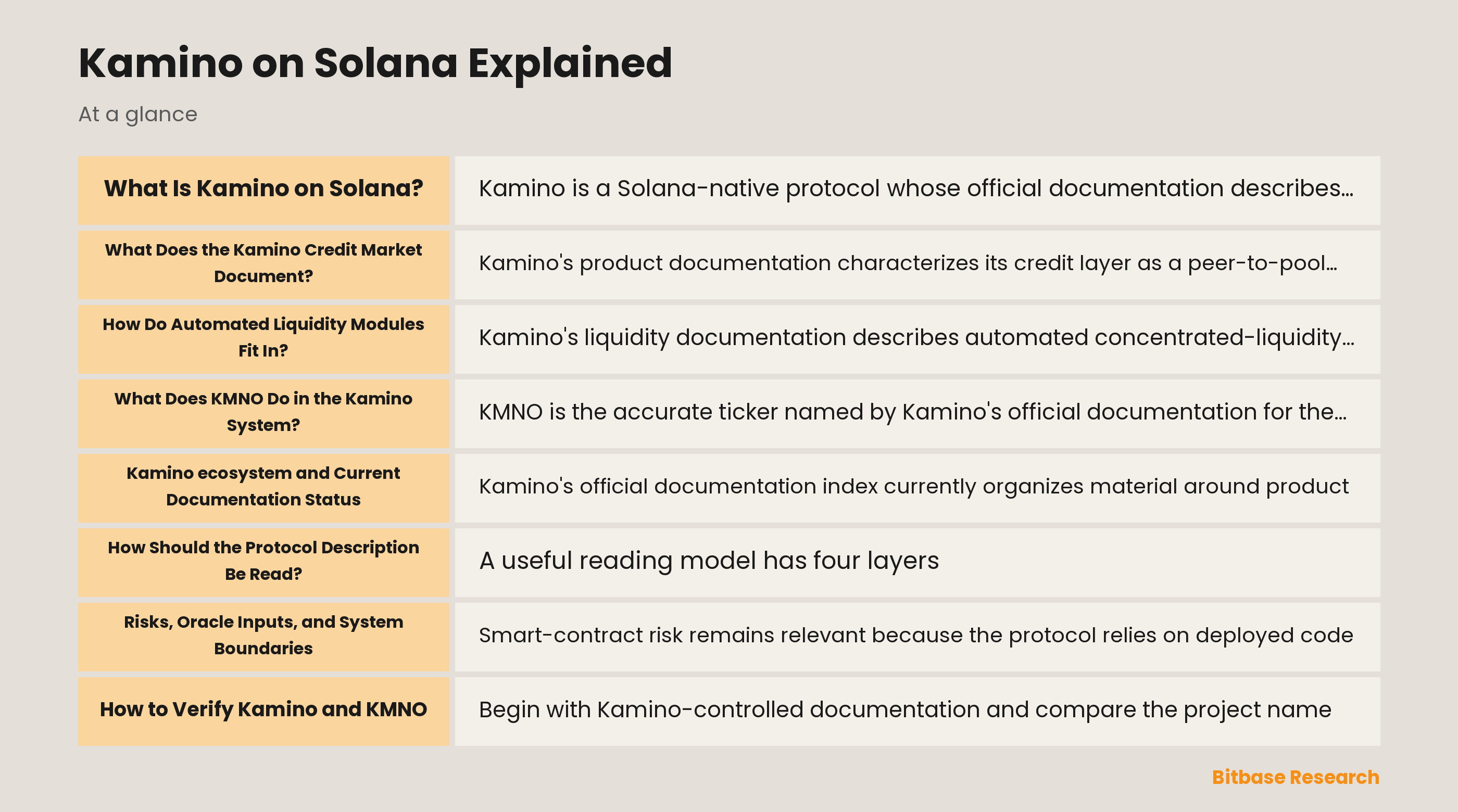
Kamino is a Solana-native protocol whose official documentation describes several connected financial mechanisms rather than one single product. Its core public materials cover a peer-to-pool credit market, automated concentrated liquidity, leverage-related products, risk controls, oracle architecture, and the KMNO token. This profile treats those materials as a description of system design and documented scope, not as evidence that every component has the same current status.
The phrase Kamino on Solana matters because the protocol's smart-contract programs, token identifiers, oracle inputs, and market configuration are specific to that environment. A project name alone does not identify a canonical program or token. Official publication context, the cited documentation, and a release-day check of onchain identifiers are all needed before a current-state claim is made.
For readers asking what is kamino crypto, the shortest useful answer separates the protocol from the token. Kamino is the protocol and its documented modules; KMNO is its stated native token. That separation avoids treating a ticker, a web page, an interface, and a smart-contract deployment as interchangeable things.
What Does the Kamino Credit Market Document?
Kamino's product documentation characterizes its credit layer as a peer-to-pool market. At the architectural level, shared reserves account for assets within a market, while collateralized debt positions are measured against programmed health conditions. The model is different from a system that depends on a named bilateral counterparty for each position.
The documentation also describes markets and reserves as risk-scoped structures. A market can have its own reserve set, collateral treatment, oracle configuration, caps, and thresholds. Those settings are important context, but they are not timeless facts: asset coverage, caps, loan-to-value thresholds, and liquidation settings can change as documentation and governance decisions change.
Liquidation is part of that design. When a debt position no longer satisfies the protocol's health conditions, the mechanism can reduce the position under its configured rules. This is a descriptive account of the system, not a guide to opening, changing, or closing any position. It also shows why credit-market claims depend on oracle inputs, liquidity conditions, smart contracts, and the behavior of automated liquidation infrastructure.
How Do Automated Liquidity Modules Fit In?
Kamino's liquidity documentation describes automated concentrated-liquidity vaults for Solana pools. Concentrated liquidity means that capital is represented within a selected price range instead of being uniformly represented across every possible price. The design makes range management a central part of how the module behaves when market conditions change.
The official feature pages use the terms auto-swap, auto-compound, and auto-rebalance. In this profile, those labels identify documented automation functions: the system can reconcile an asset composition, process accrued components, and shift a range according to a strategy. They do not establish a fixed result, a permanent in-range state, or a uniform outcome across all pools and market conditions.
Automation changes who performs some management tasks, not the underlying exposure. A position can move outside its configured range, its asset mix can change with the market, and a rebalance can introduce execution, timing, and liquidity considerations. The documented mechanism therefore needs to be read alongside the risks of concentrated liquidity rather than as a substitute for them.
What Does KMNO Do in the Kamino System?
KMNO is the accurate ticker named by Kamino's official documentation for the protocol's native token. Its token page identifies the token and its Solana context. The documented token role is distinct from an ownership interest in a company, a fixed claim on protocol activity, or a statement about any future outcome.
Searches for kamino crypto, what is kamino crypto, and kamino tokenomics and use cases are best read as requests to distinguish the protocol, its token, and time-sensitive token information. The official KMNO page is the primary place to check the ticker and its stated role. Supply, circulation, allocation, vesting, contract or mint identifiers, and governance arrangements are dynamic topics and are intentionally not repeated as permanent facts here.
The word utility should be kept narrow. A documented utility role explains how the project presents a token within an ecosystem; it does not by itself establish demand, legal treatment, security, liquidity, availability, or a particular result. Publication should follow a fresh check of the official KMNO material and any formally announced identifier.
Kamino ecosystem and Current Documentation Status
Kamino's official documentation index currently organizes material around product, security and risk, developer, and curator areas. Its product materials include the credit-market and liquidity topics discussed here, while related pages describe leverage-oriented mechanisms and RWA-related categories. That ecosystem map is useful for orientation, but a documentation menu is not proof that every feature is live, unchanged, or available in every context.
RWA language needs a separate reading. A tokenized representation can add issuer, custody, legal-rights, settlement, counterparty, price-data, and jurisdictional questions to the protocol-level mechanics. The presence of an RWA category, an asset mention, or a market label does not resolve those questions or establish the current terms for a specific asset.
Current documentation status is therefore a publication-day fact. Confirm the date, scope, and project-controlled source for any named market, reserve, strategy, asset, risk setting, security report, or program identifier. Older materials can remain useful background while no longer describing the exact current configuration.
How Should the Protocol Description Be Read?
A useful reading model has four layers: the credit-market mechanism, automated liquidity modules, oracle and risk controls, and the KMNO token. Each layer has different assumptions and can change on a different timetable. A token page cannot confirm a market parameter, an interface page cannot prove an oracle mapping, and an older research paper cannot establish a current program deployment.
Official documentation is evidence of what Kamino says it documents. It is not a universal finding about the safety, legal status, liquidity, performance, or availability of every component. That distinction is especially important when a page uses broad terms such as automated, protected, institutional, or RWA.
Risks, Oracle Inputs, and System Boundaries
Smart-contract risk remains relevant because the protocol relies on deployed code, upgrades, dependencies, and configuration. A review, test, or audit report is evidence about a stated scope and point in time; it does not make every version, integration, dependency, or future change risk-free. The current source, scope, and date of a security record should be checked before it is characterized.
Oracle risk matters because collateral and debt health calculations depend on external price data and the rules that select, validate, and update it. Delayed, unavailable, stale, disrupted, or unsuitable inputs can affect a system's interpretation of a position. Multiple sources, smoothing, validation rules, or fallback design can be safeguards, but they do not remove every failure mode.
Liquidation risk is explicit in the credit design. A position can become eligible for liquidation when its configured health conditions are breached, and stressed conditions can make execution more difficult. Liquidity risk is connected: limited market depth, rapid price movement, or correlated stress can complicate the conversion of collateral and can worsen the conditions under which a liquidation mechanism operates.
Leverage risk also deserves its own boundary. Leverage can amplify both favorable and unfavorable changes and can make the distance to a liquidation condition smaller. RWA-related exposure can add issuer, custody, legal, settlement, and counterparty risk on top of protocol, oracle, liquidity, and smart-contract risk.
Automated liquidity has separate range, asset-composition, timing, and impermanent-loss risks. Rebalancing can be useful as a documented function without ensuring that a strategy remains in range, avoids losses, has sufficient liquidity, or behaves predictably in market stress. No automation layer removes the need to understand the conditions it relies upon.
How to Verify Kamino and KMNO
Begin with Kamino-controlled documentation and compare the project name, domain, publication context, and stated product scope across more than one official page. A copied article, social-media image, search advertisement, or similarly named account is not a substitute for a project-controlled record. Treat differences between official pages as a signal to look for a dated clarification rather than filling the gap with inference.
If an official notice identifies a program or token, compare the stated contract address or Solana mint address with the corresponding official block explorer record. Check that the network, project name, ticker, and publication context agree. A value copied from an unaffiliated post, an old screen capture, or a lookalike site should not be treated as canonical.
On the publication date, re-check dynamic matters separately: market and reserve status, collateral and liquidation parameters, caps, oracle mappings, program deployments, token information, security-report scope, and any RWA-related terms. This is a research-verification method, not a sequence for using a product or authorizing anything.
Conclusion
Kamino on Solana is best described from first-party documentation as a protocol combining a peer-to-pool credit market with automated concentrated-liquidity modules and related risk infrastructure. KMNO is documented as its native token. The most accurate short explanation keeps those layers distinct instead of collapsing them into a single claim about a token or an interface.
The durable lesson is to separate stable architecture from time-sensitive configuration. Liquidation, oracle, smart-contract, liquidity, leverage, and RWA-related risks are central to a careful reading. Before publication, the current official documents and any contract address or block-explorer record should be checked again.
Related market pages
- KMNO: View price · Perpetual market
Disclaimer: This article is educational content from Bitbase Academy, provided for information only. It explains what a project does and what role its token plays in that system; it does not constitute investment, trading, tax, or financial advice, and it is neither a recommendation nor an endorsement of any project or token. Bitbase has not carried out due diligence on the project described here, and mentioning it does not mean Bitbase lists or supports the asset. Crypto assets carry significant risk, including price volatility, thin liquidity, smart-contract failure, regulatory uncertainty, and the possible loss of their entire value. Written as of August 2026; a project's status, tokenomics, team, and contracts can change at any time. Verify everything yourself through official channels, the contract address, and a block explorer, and beware of imitation sites and phishing links.
References
[1] Kamino Docs: Borrow kamino.com
[2] Kamino Docs: Liquidity kamino.com
[3] Kamino Docs: Liquidity Features kamino.com
[4] Kamino Docs: KMNO kamino.com
[5] Kamino Docs: Security kamino.com
[6] Kamino Docs: Multiply Risks kamino.com
[7] Kamino Docs: Market Risk Overview kamino.com
[8] Kamino Documentation Index kamino.com