Maple Finance documents an onchain credit architecture for institutional borrowers, while SYRUP is its governance token and is distinct from Maple pools, loan positions, and syrupUSDC, syrupUSDT, or syrupUSDG assets.
People researching `Maple Finance SYRUP tokenomics and use cases`, asking `what is Maple Finance SYRUP`, or searching `syrup crypto` need to separate a protocol description from a token identity. This profile explains the documented roles, boundaries, and verification questions without giving instructions for acquiring an asset, operating a credit product, or authorizing an onchain action.
What Is Maple Finance and SYRUP?
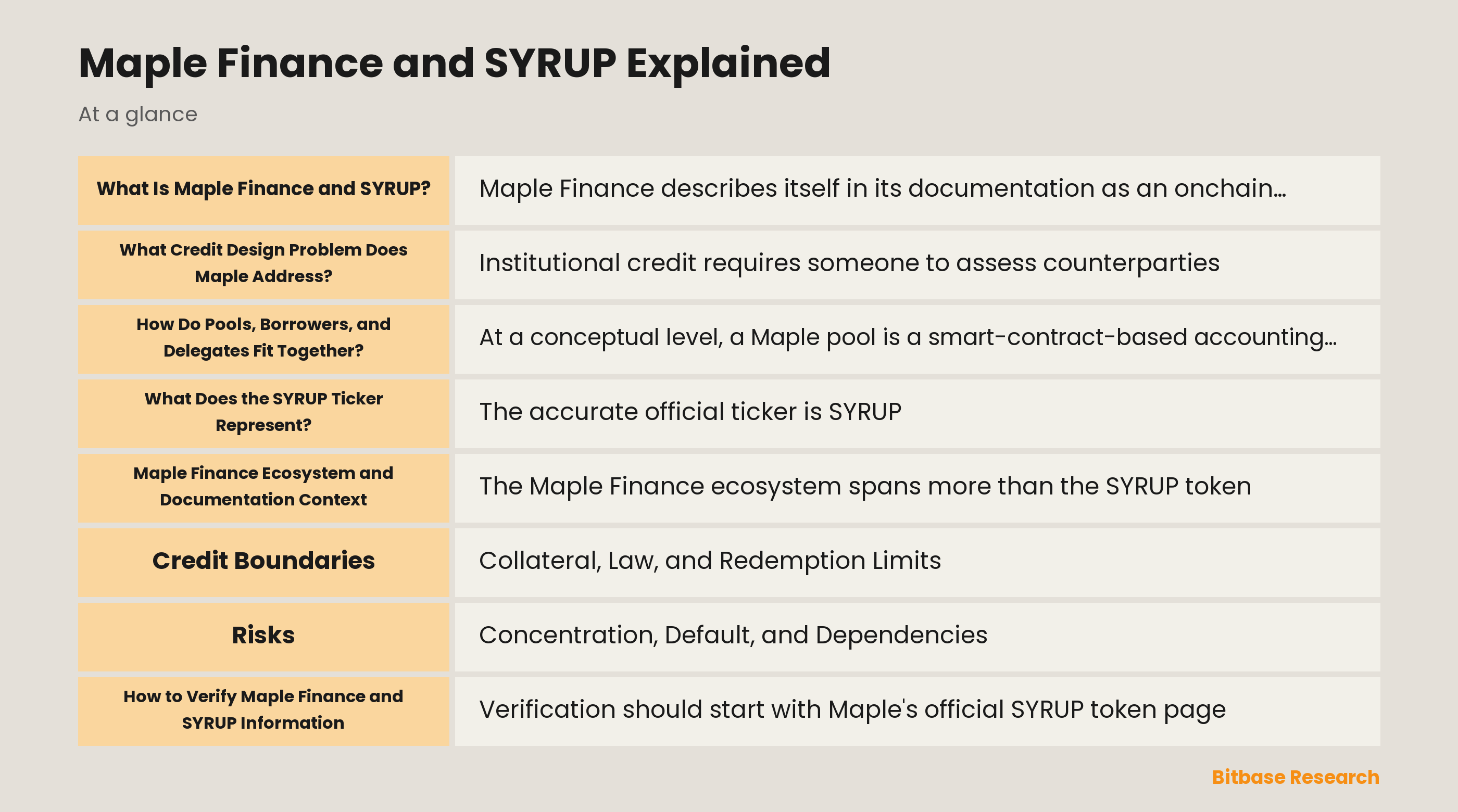
Maple Finance describes itself in its documentation as an onchain corporate-credit market. Its materials describe pools, loan contracts, borrower relationships, and administrative roles that coordinate credit terms and related onchain accounting. The system is a structure for arranging credit activity, not a single token or a single pool. Within that structure, SYRUP is the documented governance and utility token. It is not the same thing as a pool share, a loan receivable, collateral, or a dollar-labelled Syrup asset. A reference to a Maple pool concerns a separate pool configuration and its underlying credit exposures; a reference to a loan concerns an agreement and its terms; neither statement defines SYRUP itself.
The official token material says that the former MPL and xMPL roles were transitioned to SYRUP and stSYRUP, and that the conversion program later closed. That historical transition is useful for identity research, but it should not be treated as a current operational pathway or as evidence about a token's value, legal treatment, or future role.
What Credit Design Problem Does Maple Address?
Institutional credit requires someone to assess counterparties, establish terms, monitor collateral, and respond when obligations are not met. Onchain records can make some pool accounting and loan-state information observable, but they do not replace all of the offchain work involved in credit analysis, contractual interpretation, or enforcement. Maple's documentation presents pools as organized capital structures and borrowers as entities associated with loans under agreed terms. Pool Delegates are described as administering pools and performing underwriting, due diligence, risk management, and liquidity management within their roles. This allocation of responsibility is a design choice that introduces reliance on people, entities, permissions, and documentation as well as software.
The word institutional does not eliminate uncertainty. A borrower can have corporate, market, operational, and jurisdictional dependencies that are not fully visible from a token name or an onchain transaction. Likewise, an onchain entry can show that an event was recorded without settling whether an offchain representation, collateral right, or legal remedy has the scope a reader assumes.
How Do Pools, Borrowers, and Delegates Fit Together?
At a conceptual level, a Maple pool is a smart-contract-based accounting environment configured around a funds asset, managers, and one or more credit arrangements. The pool is not synonymous with Maple Finance as a whole, and no single pool should be assumed to represent another pool's borrower mix, terms, collateral arrangements, or permissions. A borrower is the entity associated with a particular loan agreement. Official glossary material describes a loan as an agreement between pools and borrowers with an agreed schedule and terms. The loan relationship is therefore more specific than a general claim that a project provides credit, and its risk cannot be inferred from the SYRUP ticker.
The Pool Delegate role is especially important. Official technical material states that this role can administer a pool, configure permitted parameters, and handle loan administration, while Maple documentation describes the delegate as responsible for underwriting and due diligence. Delegation can create expertise and accountability structures, but it also creates concentration of judgment, role-permission, and operational risks.
What Does the SYRUP Ticker Represent?
The accurate official ticker is SYRUP. Maple's token page calls SYRUP the native governance token of Maple Finance, and the token-holder documentation describes SYRUP as the successor governance and utility token after the MPL transition. Its governance role concerns the Maple ecosystem's token layer rather than a direct identity with every credit position. SYRUP is separate from Maple pools and loans. A pool can contain defined assets and credit exposures; a loan can have a borrower, collateral terms, and a payment schedule; those records are not interchangeable with the governance token. Treating all three as one asset category would obscure where the relevant risks and rights may sit.
SYRUP is also distinct from similarly named Maple assets such as syrupUSDC, syrupUSDT, and syrupUSDG. The official SYRUP page explicitly distinguishes SYRUP from the dollar-labelled Syrup assets. Similar naming can be useful for brand context but is not sufficient evidence of identical contract logic, risk, legal characterization, network, or availability.
Maple Finance Ecosystem and Documentation Context
The Maple Finance ecosystem spans more than the SYRUP token. First-party documentation separately organizes token-holder material, protocol-overview material, pool and loan technical resources, and product-specific information. The separation is meaningful: a tokenomics page may explain an issuance history, while a protocol-actor page explains responsibilities in a credit arrangement.
The documented architecture also includes concepts such as PoolManager, loan managers, withdrawal managers, collateral, impairment, and default. These names describe components and states rather than universal guarantees. A configuration, module, or document can change, and a statement about one part of the architecture should not be generalized to all Maple deployments.
Current-state claims deserve special care. Pool composition, legal entities, collateral arrangements, parameter settings, token supply details, supported networks, and interface availability are publication-day facts. This article intentionally avoids time-sensitive counts and does not turn a documentation overview into a claim about access, liquidity, outcome, or service status.
Credit Boundaries: Collateral, Law, and Redemption Limits
Collateral is a risk-mitigation mechanism, not an automatic answer to credit loss. Its value can change, its custody and enforceability can depend on facts outside a smart contract, and liquidation can produce less than an assumed amount. Official Maple material describes collateral and liquidation in relation to loan and default processes, but such descriptions do not establish a complete recovery in a particular case. Legal boundaries matter because a loan may involve borrower entities, contractual terms, custodians, collateral arrangements, and more than one jurisdiction. An onchain state can be part of an operational record while rights and remedies may still depend on agreements, applicable law, insolvency treatment, and the parties responsible for performance. Readers should avoid equating technical visibility with a complete legal characterization.
Redemption-limit boundaries are another reason not to treat a pool record as a cash-equivalent promise. The protocol documentation includes withdrawal-management concepts and describes impairments and defaults as conditions that can affect pool accounting and loss allocation. The exact conditions, queues, permissions, and legal or operational limits are specific to the relevant documentation and may change.
Risks: Concentration, Default, and Dependencies
Credit concentration can arise by borrower, delegate, collateral type, sector, jurisdiction, asset, or service provider. A pool may have a narrower exposure than its general name suggests. Concentration can amplify the effect of a single borrower problem, collateral event, valuation dispute, or operational failure. Default risk remains central. Maple's official documentation describes a default as following non-payment after a grace period and says that it reduces pool value by outstanding principal and accrued interest, with collateral handling described separately. It also describes impairment as a potential pre-default state. These mechanisms recognize loss and recovery uncertainty; they do not guarantee that collateral, restructuring, or legal action will make a pool whole.
Other risks include smart-contract faults, oracle or valuation dependencies, governance and permission changes, data latency, cyber and operational incidents, entity or custody failures, and confusing names or copied token records. Documentation can identify a mechanism, but it cannot independently prove every deployed contract, every offchain representation, or every future behavior.
How to Verify Maple Finance and SYRUP Information
Verification should start with Maple's official SYRUP token page, tokenomics documentation, migration-status documentation, protocol-actor material, glossary, and defaults-and-impairments documentation. Cross-check whether the sources consistently distinguish SYRUP from MPL, pool positions, loans, and dollar-labelled Syrup assets rather than relying on a search result, logo, or ticker alone. Check the date, page scope, and whether an item is historical, current, or planned. Token supply schedules, governance arrangements, pool parameters, participants, collateral terms, legal documents, and network support can change. A historical token-migration page cannot on its own prove a current contract, available feature, or present legal status.
When official materials identify a contract address, verify that address in the matching official context and compare it with the corresponding block explorer record for the stated network. A block explorer can show public onchain data, but it cannot by itself prove that an address represents the intended project, that an offchain agreement is enforceable, or that a pool's terms are unchanged.
Conclusion
Maple Finance is best understood here as documented onchain credit infrastructure organized around pools, borrowers, loan terms, and delegate administration. SYRUP is the separate official governance ticker, not a substitute name for the pools, loans, collateral, or dollar-labelled Syrup assets associated with the broader ecosystem.
The decisive distinction is between an explanatory architecture and a verified current condition. Credit concentration, default handling, collateral, legal rights, and redemption limits require context-specific review. Before publication, re-check the official sources, the precise network and contract record, and any current legal or product documentation without converting this profile into a product-use guide.
Related market pages
- SYRUP: View price · Spot market · Perpetual market
Disclaimer: This article is educational content from Bitbase Academy, provided for information only. It explains what a project does and what role its token plays in that system; it does not constitute investment, trading, tax, or financial advice, and it is neither a recommendation nor an endorsement of any project or token. Bitbase has not carried out due diligence on the project described here, and mentioning it does not mean Bitbase lists or supports the asset. Crypto assets carry significant risk, including price volatility, thin liquidity, smart-contract failure, regulatory uncertainty, and the possible loss of their entire value. Written as of August 2026; a project's status, tokenomics, team, and contracts can change at any time. Verify everything yourself through official channels, the contract address, and a block explorer, and beware of imitation sites and phishing links.
References
[1] Maple Finance, SYRUP token page maple.finance
[2] Maple Docs, SYRUP Tokenomics docs.maple.finance
[3] Maple Docs, MPL to SYRUP Conversion docs.maple.finance
[4] Maple Docs, Protocol Actors docs.maple.finance
[5] Maple Docs, Glossary docs.maple.finance
[6] Maple Docs, Defaults and Impairments docs.maple.finance