For readers asking what is MegaETH or searching mega eth, MegaETH is presented as an Ethereum Layer 2 built around rapid execution feedback. This guide explains the MegaETH ecosystem and use cases through its documented architecture, rather than treating low latency as a promise of instant finality.
What Is MegaETH?
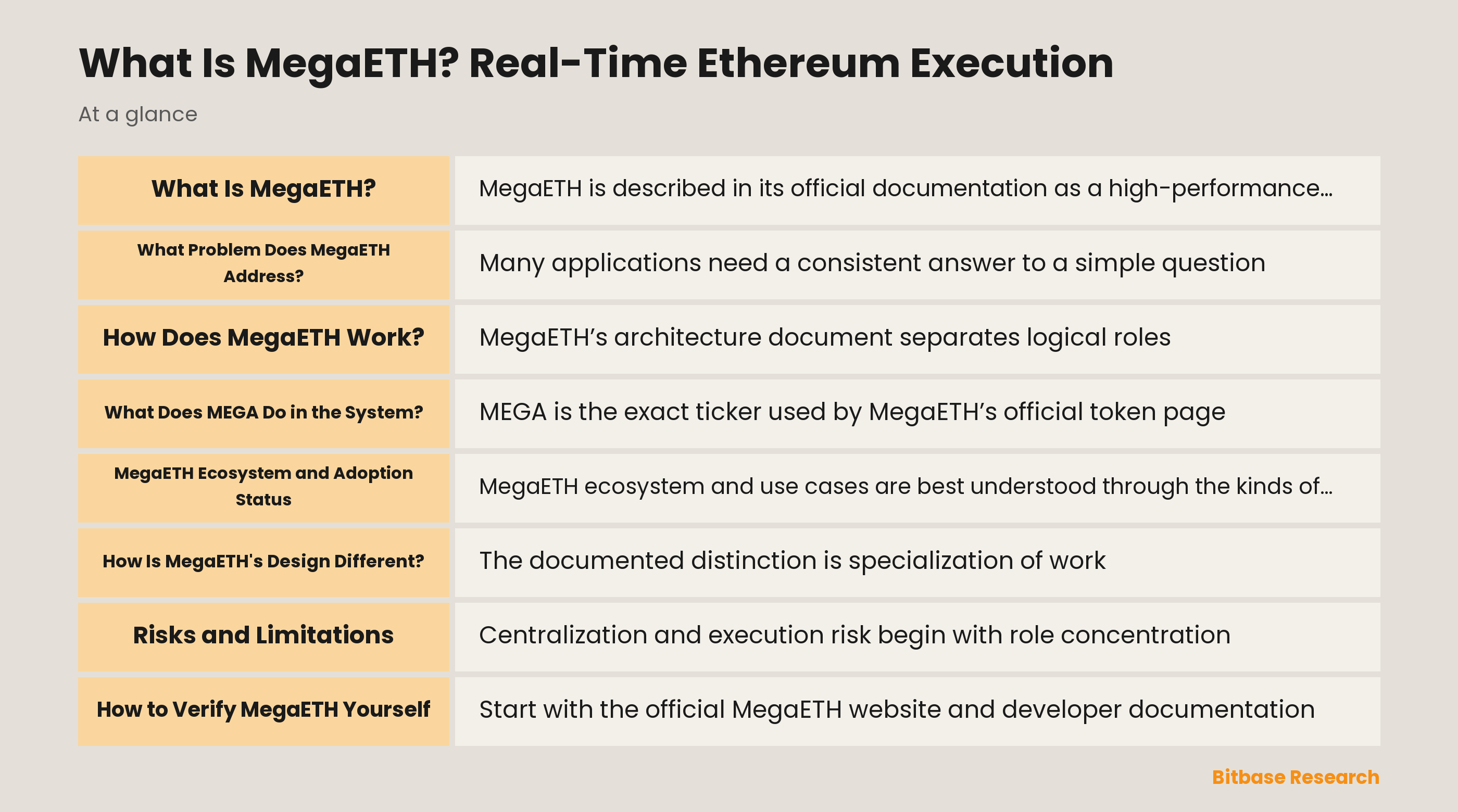
MegaETH is described in its official documentation as a high-performance Ethereum Layer 2. Its central idea is to make execution results visible quickly while retaining a relationship with Ethereum for settlement. That description is architectural: it identifies how transactions, state, node roles, and data move through the system. It does not mean that every fast response has the same security meaning as a finalized Ethereum transaction.
The phrase real-time execution refers to the interval between a transaction reaching the sequencer and applications receiving a result. MegaETH documents mini-blocks and a Realtime API for exposing receipts, state changes, and logs with low latency. A useful distinction is therefore between an application seeing a provisional execution result quickly and the network reaching the finality condition described by its L1 settlement path.
The name MegaETH should also be separated from the ticker MEGA and from Ether. The official token page identifies MEGA as the native token powering the protocol, while the official testnet documentation identifies Ether as the native and gas token for that testnet. Those labels describe different roles and should not be merged into an assumed token contract, fee role, or entitlement.
What Problem Does MegaETH Address?
Many applications need a consistent answer to a simple question: after an action reaches the execution environment, what did it do to the current state? Waiting for a slower block cadence or repeatedly checking for a receipt can make interfaces feel delayed. MegaETH’s design documents frame the problem as reducing that feedback interval while keeping execution ordered and state changes observable.
That goal is not only about showing a result earlier. A low-latency environment also needs applications, RPC services, indexers, and users to agree about what state they are reading and what level of commitment that state carries. The design therefore makes room for a fast execution stream and a more conventional EVM-block representation, rather than pretending that one label covers every stage of transaction processing.
How Does MegaETH Work?
MegaETH’s architecture document separates logical roles. A sequencer receives write requests, executes transactions, assembles executed transactions into blocks, disseminates results such as receipts and state changes, and submits blocks to L1 for finality. Read replicas keep copies of state and recent history for read requests; full nodes re-execute received blocks; provers are described as re-executing blocks and producing proofs according to how the chain operates. A data-availability service is intended to make required block data available to those downstream roles.
The mini-block documentation describes a second timing layer inside that flow. The sequencer continuously executes incoming transactions, seals results into mini-blocks at roughly ten-millisecond intervals, and streams receipts, state changes, and event logs to RPC nodes. It then groups those transactions into standard-format EVM blocks at a longer cadence. In the documentation, every transaction belongs to one mini-block and one EVM block, so the fast stream and the standard representation are related rather than competing ledgers.
What Does MEGA Do in the System?
MEGA is the exact ticker used by MegaETH’s official token page, which calls it the native token powering the protocol. That naming does not make MEGA interchangeable with ETH on every network context. In particular, the official testnet page labels Ether as the native and gas token for its documented testnet configuration, so a reader should check the relevant network and official documentation before assigning a fee or contract role to MEGA.
The token page describes an economic and governance narrative that includes KPI-related distributions and a staged governance roadmap. It also labels Proximity Markets and Sequencer Rotation as planned. Those labels matter: a planned mechanism is a documented proposal or roadmap item, not evidence that every access rule, operator role, locking condition, or governance function is already available. This article therefore uses MEGA to identify the documented protocol token, not to imply an instruction or a guaranteed function.
MegaETH Ecosystem and Adoption Status
MegaETH ecosystem and use cases are best understood through the kinds of coordination its documents emphasize: applications that benefit from quick visibility into ordered execution, RPC services that relay state changes, and tools that can distinguish mini-block feedback from later settlement. A real-time interface can be useful for responsive applications, but suitability still depends on an application’s tolerance for preconfirmation, rollback, data availability, and dependency on the sequencer.
Status needs a date and a source. The official documentation distinguishes testnet support from planned mainnet support in several places and provides an official testnet block explorer route. The official website also presents Mainnet navigation and a 2026 token announcement. This draft does not turn those pages into a numeric adoption claim, a list of verified integrations, or a statement that every listed tool has the same status on every network.
How Is MegaETH's Design Different?
The documented distinction is specialization of work, not a claim that every participant performs every function. The sequencer is associated with execution and dissemination; replica nodes may apply execution results without locally validating them; full nodes are described as re-executing blocks; and provers have a proof-production role depending on the operating mode. This division helps explain why reading a replica, independently re-executing blocks, and relying on a proof are different verification experiences.
Another difference is the explicit treatment of mini-block visibility. The Realtime API is documented to query the latest mini-block for relevant methods and to surface execution information quickly. Standard EVM blocks remain the compatibility-oriented format described by the documentation. An application should preserve the distinction between a sequencer preconfirmation, an execution receipt, an EVM block, and L1 finality instead of collapsing them into a single word such as confirmed.
Risks and Limitations
Centralization and execution risk begin with role concentration. MegaETH’s architecture page describes the then-current testnet phase as having one sequencer and MegaETH-maintained replica nodes, while listing multiple sequencers and permissionless node roles as upcoming testnet phases. That phase-specific statement supports a cautious inference: during a single-sequencer configuration, ordering, availability, and fast feedback depend materially on that operator. It should not be rewritten as a timeless claim about every future network phase.
Preconfirmation has its own limit. The Realtime API documentation says mini-block results fall under the sequencer’s preconfirmation guarantee and describes the API as evolving. A fast receipt can therefore be valuable operational information without being identical to L1 finality. Applications that act on the fastest state need to define how they handle delayed blocks, changed assumptions, unavailable endpoints, or a difference between an early result and later settlement.
The official testnet page also says maintenance may interrupt RPC endpoints and that contracts and state can be rolled back in rare cases; it calls the testnet experimental. That warning is specifically about the testnet, but it illustrates why status, network name, explorer data, and current documentation should be checked together. Hardware requirements, software changes, data-availability dependencies, and external infrastructure can all affect execution quality without changing the simple label real-time.
How to Verify MegaETH Yourself
Start with the official MegaETH website and developer documentation, then note the publication or update date and whether a statement names testnet, mainnet, or a planned phase. Compare the architecture, Mini-Blocks, and Realtime API documents to see whether a claim concerns execution feedback, standard EVM blocks, or L1 finality. This is a read-only review and does not require connecting a wallet or submitting a transaction.
For network-specific facts, use the official documentation to obtain the relevant chain information and block explorer route. Check a contract address only after locating it in an official registry or official project material, then compare the exact address and chain in the block explorer and inspect verified source or protocol specifications where available. Do not infer identity from a similar name, a ticker alone, an unsolicited message, or a page that asks for wallet permissions.
Conclusion
MegaETH is best read as a documented execution architecture: a sequencer processes writes, fast mini-blocks distribute early state information, other node roles maintain or verify state, and L1 settlement supplies a separate finality path. MEGA is the official ticker for the protocol token, while documented testnet ETH gas usage and planned token mechanisms show why token labels must be read in context.
The durable questions are not whether a low-latency label sounds attractive, but who produces the result, how other parties receive or verify state, what the result means at that moment, and which parts are documented as planned. Keeping those questions separate makes real-time Ethereum execution easier to understand without turning a roadmap, a testnet snapshot, or a quick response into a broader guarantee.
Related market pages
- MEGA: View price · Spot market · Perpetual market
Disclaimer: This article is educational content from Bitbase Academy, provided for information only. It explains what a project does and what role its token plays in that system; it does not constitute investment, trading, tax, or financial advice, and it is neither a recommendation nor an endorsement of any project or token. Bitbase has not carried out due diligence on the project described here, and mentioning it does not mean Bitbase lists or supports the asset. Crypto assets carry significant risk, including price volatility, thin liquidity, smart-contract failure, regulatory uncertainty, and the possible loss of their entire value. Written as of August 2026; a project's status, tokenomics, team, and contracts can change at any time. Verify everything yourself through official channels, the contract address, and a block explorer, and beware of imitation sites and phishing links.
References
[1] MegaETH Docs – Architecture docs.megaeth.com
[2] MegaETH Docs – Realtime API docs.megaeth.com
[3] MegaETH Docs – Mini-Blocks docs.megaeth.com
[4] MegaETH Docs – Testnet docs.megaeth.com
[5] MEGA | MegaETH www.megaeth.com
[6] $MEGA is Live | MegaETH www.megaeth.com