Merlin Chain is described by its official documentation as a Bitcoin Layer 2 project whose design brings together a ZK-Rollup network, a decentralized oracle network, data availability, and a Bitcoin-based fraud-proof path. “What is merlin chain” is therefore an architecture question before it is a token question: the useful task is to distinguish the documented roles of those modules from a claim about a current deployment or an external interface.
What Is Merlin Chain?
Merlin Chain’s official overview presents the project as a Bitcoin Layer 2 solution. In that framing, the project is intended to extend the ways Bitcoin-related assets, protocols, and products can be represented or used through a Layer 2 environment. That broad description is useful context, but it does not demonstrate the state, permissions, or technical properties of every application, contract, or service carrying the Merlin name.
The same official material lists a ZK-Rollup network, a decentralized oracle network, data availability, and on-chain BTC fraud-proof modules. Those terms refer to separate jobs. A rollup concerns the grouping and representation of activity; an oracle network concerns how information is collected and published; data availability concerns whether data needed for inspection can be obtained; and a fraud-proof design concerns how an incorrect claim could be challenged under stated rules.
Keeping these functions separate avoids an overbroad conclusion. A project-level description may tell readers what the architecture intends to connect, yet the current state of each component still depends on software versions, published records, configuration, and operational conditions. In this article, “documented” means that a statement is tied to the project’s official material, not that it proves a universal technical outcome.
What Problem Does Merlin Chain Aim to Address?
Bitcoin’s base layer follows its own rules and security model. A Layer 2 design can seek to create another environment for grouped activity, application logic, or representations of assets while retaining a relationship to the Bitcoin ecosystem. Merlin Chain’s official overview describes its direction as enhancing Bitcoin-native assets, protocols, and products rather than replacing Bitcoin.
The ZK-Rollup page describes a design in which transaction-related information is aggregated and compressed into batches. It also describes zero-knowledge proofs and a Taproot-oriented path for submitting proofs and rollup data to Bitcoin. This explains the role that compact evidence can play in a Layer 2 architecture. It does not establish that an individual record has a particular finality, recovery outcome, or security property.
The other named modules address different dependencies. The oracle material describes the handling and compilation of information related to batch processing. The data-availability material concerns the possibility of accessing information needed to inspect state. The fraud-proof material outlines a challenge-and-response path. Together, they describe an intended division of labor; they do not remove the need to review the current implementation behind each claim.
How Does Merlin Chain Work?
The direct answer to “how does merlin chain work” starts with the documented rollup flow. The official ZK-Rollup page describes nodes, a zkProver, and storage-related components working with transaction data. In that model, transaction-related information is collected into batches, while the zkProver produces zero-knowledge proofs associated with validity and correctness claims. The exact software and configuration still matter, so this is not a substitute for a deployment-specific review.
The same documentation presents a Taproot-oriented record path for aggregated proofs and rollup data. One way to read the design is as a compact-commitment model: a larger body of activity can be represented by smaller records or proofs, while other components retain or serve material needed for inspection. A proof alone does not answer every availability question, which is why the documentation treats data availability as a separate module.
Merlin Chain’s decentralized oracle page adds an information-flow layer. It describes sequencer nodes collecting and batch-processing transactions, then producing compressed transaction data, state roots, and proofs. The documented oracle network compiles relevant information and publishes records through Bitcoin Taproot, while raw data and state-root records have distinct handling roles. This is a description of responsibilities, not a guarantee about every operator, signature arrangement, or endpoint.
Data availability is an additional condition for meaningful inspection. The official DA page uses future-oriented language when discussing public availability and an optimized solution. That wording should remain visible in any careful account: the exact DA design, providers, data-publication process, and present status need to be checked against the current official sources rather than assumed from an earlier architecture page.
What Does MERL Do in the Merlin Chain System?
MERL is the ticker used in Merlin Chain’s official tokenomics documentation for the ecosystem’s native token. That source describes roles involving governance, security, and the broader development of the ecosystem. These are documented roles in the project’s own framing. They do not establish a fixed set of capabilities across every application, user interface, or version of the network.
The tokenomics material also describes a prospective transaction-fee role for Layer3 networks, which is explicitly forward-looking. A separate official user-documentation page records a MERL-as-gas selection in a specific AA Wallet context. The careful interpretation is limited: official materials describe particular roles and contexts, and their current scope must be checked before any factual statement is carried into a later publication.
MERL is not a universal label for every asset or application related to Merlin Chain. An ecosystem may include native tokens, representations of other assets, application-specific contracts, and external integrations with different rules. The ticker identifies the native token in official documentation; it does not identify a contract address, validate an external interface, or reveal the permissions of a particular deployment.
Merlin Chain Ecosystem and Use Cases: What the Documentation Shows
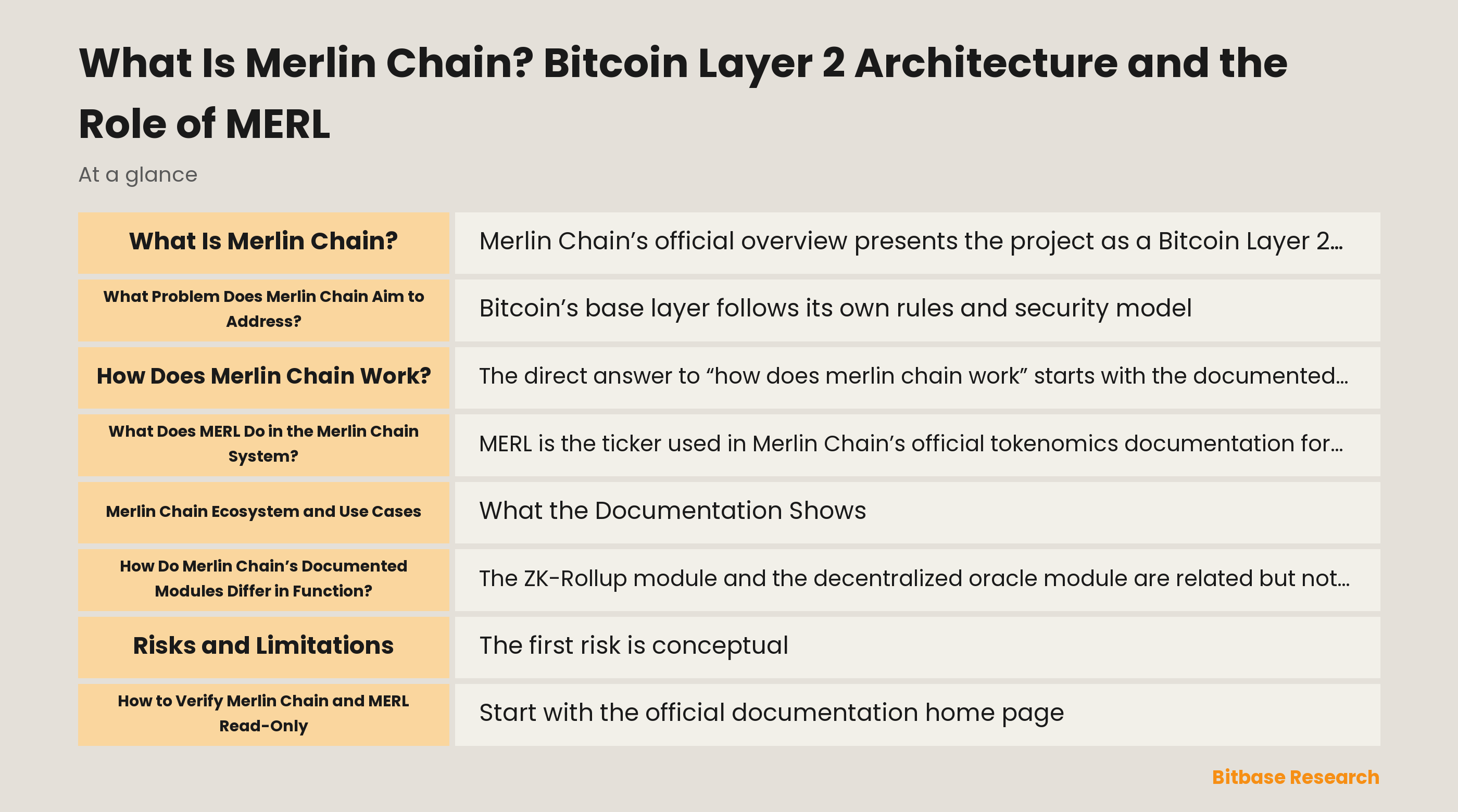
The phrase “merlin chain ecosystem and use cases” is most useful as a scope question. Official material presents a Layer 2 environment intended to relate to Bitcoin-native assets, protocols, and products, while developer-facing material describes a setting for smart-contract work. This helps explain why applications and infrastructure may exist around the chain. It does not establish the code quality, custody design, availability, or permissions of any particular application.
An ecosystem reference is not an adoption measurement. The number and nature of applications, assets, integrations, or users can change, and none is treated here as a durable fact. Nor is a category of infrastructure or application logic an instruction to interact with it. The purpose of this profile is to explain the documented architecture while leaving deployment-specific review to current official records and read-only technical evidence.
This section also avoids ranking Merlin Chain against another network or declaring a preferred use. The narrower question is more informative: which documented module is expected to support a stated behavior, and which current source supports that assertion? That approach separates an architectural explanation from a claim about performance, suitability, or the state of an individual service.
How Do Merlin Chain’s Documented Modules Differ in Function?
The ZK-Rollup module and the decentralized oracle module are related but not interchangeable. The rollup page focuses on aggregation, proof generation, nodes, the zkProver, and storage-related components. The oracle page focuses on compiling and publishing information related to batch processing and state roots. Calling both a single “security layer” would obscure the distinct computation, communication, and record-handling functions the official documentation assigns to them.
Data availability has another task: it concerns whether information needed to inspect or reconstruct state can be obtained. A cryptographic proof can support a claim under defined rules, but inspection also depends on the availability of the data to which that claim relates. Since the official DA page contains planned-language wording, the appropriate conclusion is conditional: verify the current design and service status directly from an updated official source.
The Bitcoin-based fraud-proof page describes a different proposed path. It outlines Prover and Verifier roles, pre-signed transactions, a binary-circuit representation, a Merkle root committed to a Taproot address, and a challenge-and-response process. The page says the project “will introduce” this mechanism. That wording means it should be presented as a documented design path, not as proof that every stated property is active at all times.
Risks and Limitations
The first risk is conceptual. “Bitcoin Layer 2,” “ZK-Rollup,” “oracle,” “data availability,” and “fraud proof” designate different ideas. A correct statement about one module does not automatically establish the behavior of another. For example, a documented proof path does not verify application code; a DA description does not demonstrate that a particular historical record can be retrieved; and an ecosystem mention does not authenticate an external interface.
Implementation and governance conditions create further risks. Software releases, contracts, access controls, upgrade procedures, operator arrangements, third-party dependencies, and published parameters can change. A high-level documentation page cannot reveal every permission or implementation decision applying to a given deployment. When an exact contract address, code record, or audit scope matters, it should be compared with current official information and the matching network’s read-only records.
The future-oriented wording on the official DA and fraud-proof pages is a material limitation in its own right. It should not be converted into a completed-feature claim, and no architecture label establishes absolute Bitcoin security. This article makes no audit conclusion, no assertion about data recovery, and no statement about the condition of assets. A later editorial review should re-check the date, scope, and status of every official source used.
How to Verify Merlin Chain and MERL Read-Only
Start with the official documentation home page, then compare the key-modules overview with the detailed ZK-Rollup, oracle, data-availability, fraud-proof, and tokenomics pages. Check the domain, page title, date context, and whether a sentence is descriptive, historical, or forward-looking. This helps distinguish a project-controlled source from an unverified repost, a similarly named asset, or an outdated statement.
For MERL, confirm the ticker and documented role in the current official tokenomics material before treating an external label as relevant. Do not infer a contract address from a search result or a social post. If a current official source identifies a network-specific address, compare it read-only with the relevant block explorer, including the network name, visible code-verification information when available, and any disclosed proxy or implementation relationship. No wallet connection or interactive approval is needed for that comparison.
For an architectural statement, match the statement with the source that supports that particular module. The ZK-Rollup page supports the batch-and-proof description, the oracle page supports the information-flow description, and the DA and fraud-proof pages require special attention because their wording is forward-looking. A domain, date, network, or scope mismatch is a reason to stop and obtain current clarification rather than fill the gap with an assumption.
The Bottom Line
Merlin Chain is most clearly described by separating the functions in its official material: a Bitcoin Layer 2 framing, a ZK-Rollup design for batched records and proofs, a decentralized oracle network for documented information handling, a data-availability component, and a proposed Bitcoin-based fraud-proof path. That separation makes it possible to explain the architecture without treating one technical statement as a general guarantee.
MERL is the official ticker for the ecosystem’s native token, with roles documented around governance, security, and ecosystem development. Those roles remain subject to the current protocol and documentation. The appropriate next step is a read-only source review of the exact official page and matching technical record relevant to a specific claim, rather than an interaction with a service.
Disclaimer: This article is educational content from Bitbase Academy, provided for information only. It explains what a project does and what role its token plays in that system; it does not constitute investment, trading, tax, or financial advice, and it is neither a recommendation nor an endorsement of any project or token. Bitbase has not carried out due diligence on the project described here, and mentioning it does not mean Bitbase lists or supports the asset. Crypto assets carry significant risk, including price volatility, thin liquidity, smart-contract failure, regulatory uncertainty, and the possible loss of their entire value. Written as of August 2026; a project's status, tokenomics, team, and contracts can change at any time. Verify everything yourself through official channels, the contract address, and a block explorer, and beware of imitation sites and phishing links.
References
[1] About Merlin (official documentation) docs.merlinchain.io
[2] Key Modules (official documentation) docs.merlinchain.io
[3] ZK-Rollup Network (official documentation) docs.merlinchain.io
[4] Decentralized Oracle Network (official documentation) docs.merlinchain.io
[5] Data Availability (official documentation) docs.merlinchain.io
[6] Fraud Proofs Based on Bitcoin (official documentation) docs.merlinchain.io
[7] Tokenomics (official documentation) docs.merlinchain.io
[8] MERL as Gas (official documentation) docs.merlinchain.io