Meteora is documented as a Solana-native liquidity infrastructure project whose DLMM design organizes liquidity in discrete price bins and can use a variable fee model linked to observed bin movement.
The search phrases meteora tokenomics and use cases, meteora crypto, and what is meteora crypto commonly point to a need for an identity-first explanation. They should lead to the documented project, its terminology, and the scope of its public materials, rather than to a claim about a token outcome or a present condition of every named component.
What Is Meteora?
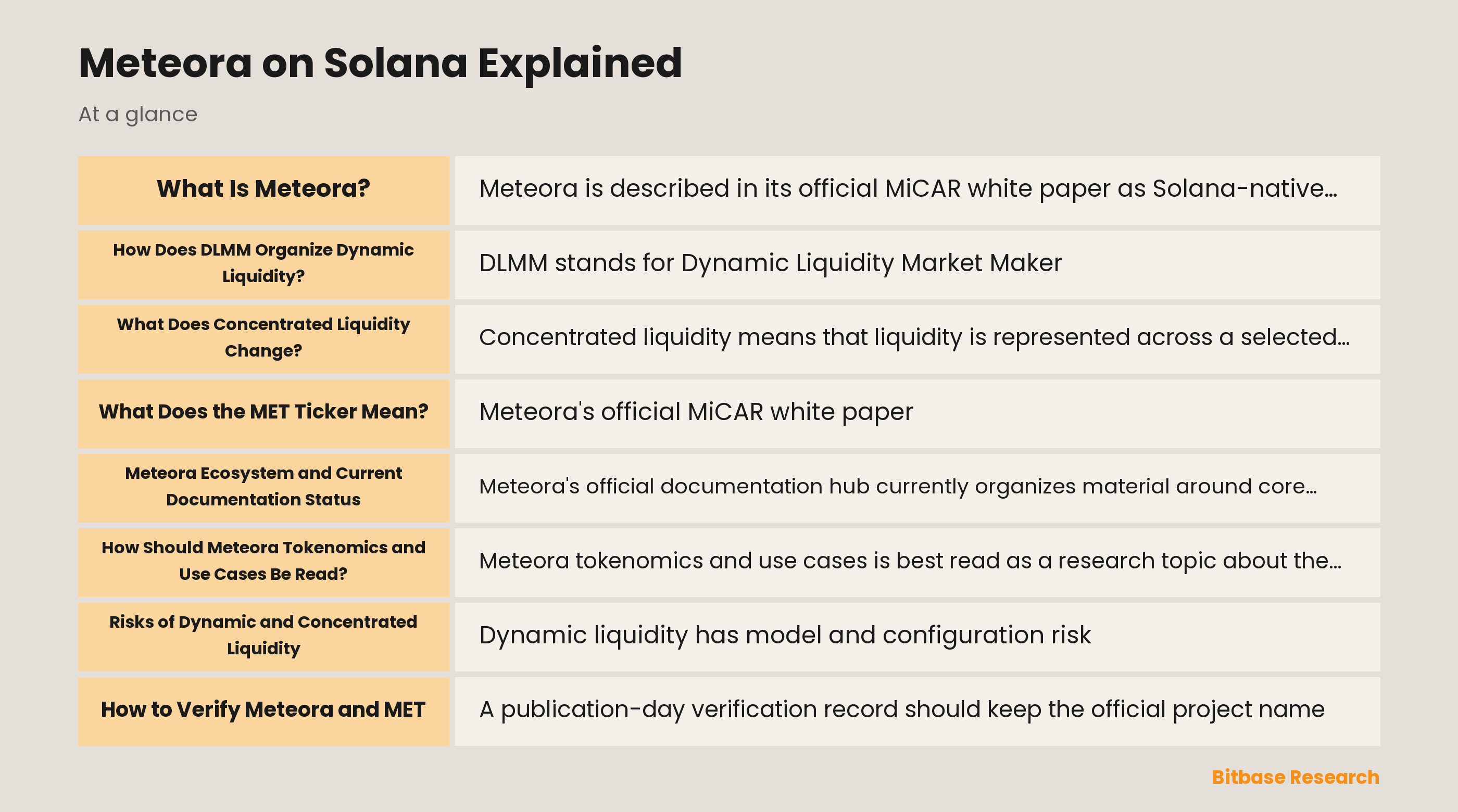
Meteora is described in its official MiCAR white paper as Solana-native liquidity infrastructure. Its documentation presents a collection of liquidity-oriented programs and records DLMM, or Dynamic Liquidity Market Maker, as one of the core documented product families.
That description is about architecture and project vocabulary. It identifies a system intended to organize liquidity on Solana, but it does not establish a performance result, legal conclusion, or current condition for a particular pool, token, or participant.
The useful distinction is between a documented mechanism and an observed outcome. Public materials can explain how a program is designed to represent liquidity, prices, and fees. They cannot turn that design into a prediction about market movement, token behavior, software behavior, or individual circumstances.
How Does DLMM Organize Dynamic Liquidity?
DLMM stands for Dynamic Liquidity Market Maker. Meteora's DLMM documentation describes liquidity as a sequence of discrete price bins, with each bin corresponding to a price point for a token pair. This bin structure is the central architectural idea behind the term dynamic liquidity in this context.
At a given point, the documentation calls one bin active. As available amounts in that bin are consumed by market activity, the active location can move through the bin ladder. A bin step defines the spacing between neighboring bin prices, so the documented structure ties price movement to a set of discrete intervals rather than one undifferentiated reserve.
The same documentation describes a base fee and an optional variable fee. The formulas page presents the variable portion as linked to a volatility accumulator that responds to bin movement and decays after quieter periods. This is a documented calculation model, not a forecast of volatility, a statement about a live configuration, or a promise about future fees.
What Does Concentrated Liquidity Change?
Concentrated liquidity means that liquidity is represented across a selected interval of price bins instead of being described as equally present at every possible price. In Meteora's DLMM materials, concentration is therefore a placement concept: it specifies where liquidity is represented within the documented bin structure.
This concentration can make the relationship between a position and a chosen price interval more specific. It does not make the interval permanent, correct, or suitable for every condition. A narrow interval and a wide interval describe different exposures to changing active bins, not a universal hierarchy of outcomes.
If the active location moves outside a represented interval, the liquidity associated with that interval is no longer active in the same way. The composition associated with a position can also differ materially from its starting composition as movement proceeds through bins. These are structural features and risks of concentration, not a result that documentation can resolve in advance.
What Does the MET Ticker Mean?
Meteora's official MiCAR white paper, dated October 2025, identifies the crypto-asset project as Meteora and gives both the crypto-asset name and abbreviation as MET. The ticker in this profile is therefore written as MET, without assigning a market value, allocation figure, or current circulation claim to it.
The same white paper describes MET as native to the Solana blockchain and presents it within the Meteora protocol ecosystem. Its discussion of coordination, access, and participation is a statement of documented role and scope, not a statement that every described function is active, uniform, or available in every context.
Token functions, permissions, contract records, legal treatment, and project communications can change. For that reason, a ticker identifies a documented asset label; it does not by itself establish ownership rights, service access, compliance status, liquidity, or any financial result.
Meteora Ecosystem and Current Documentation Status
Meteora's official documentation hub currently organizes material around core entries such as DLMM, DAMM v2, and Dynamic Bonding Curve, along with helper and legacy product families. This article uses those names only as documentation labels that help readers locate the project's stated architecture.
An ecosystem map is not the same thing as a statement that each label has one current operational condition. Documentation can be revised, a page can describe a historical or planned phase, and the scope of a named component can differ from the scope of a separate page. Publication-day wording and dates matter whenever a description is converted into present tense.
The official resources area also indexes audit reports by product family. Such an index records the existence and scope of published materials; it does not settle every implementation risk, later change, dependency, or unknown condition. The date, version, target, and remediation context of any report remain material.
How Should Meteora Tokenomics and Use Cases Be Read?
Meteora tokenomics and use cases is best read as a research topic about the documented role of MET and the contexts in which Meteora describes its programs. It is not a shortcut to quantities, a value conclusion, or an expectation about a future result. This profile intentionally leaves out time-sensitive token figures and distribution narratives.
The phrase meteora crypto can refer to the project, the MET asset label, or a broader category of Solana liquidity discussions. What is meteora crypto is therefore answered most clearly by separating the project identity, the DLMM design, and the MET ticker instead of treating them as interchangeable.
A use case in project documentation describes a potential functional setting. It does not establish that a feature is enabled at a given time, that it is appropriate for a reader, or that it will produce a particular effect. The same boundary applies to tokenomics language, which should be read with its date, source, and stated scope.
Risks of Dynamic and Concentrated Liquidity
Dynamic liquidity has model and configuration risk. Bin movement may be rapid, and the variable-fee logic described in the formulas depends on parameters and recorded movement. Neither the design of the accumulator nor the presence of a dynamic-fee page predicts how a particular market condition will develop.
Concentrated liquidity has range and composition risk. A movement beyond a represented interval can leave a position inactive relative to the active bin, while the amounts associated with that position can change as the bin ladder is traversed. These characteristics can be material even when the underlying documentation is clear.
Software changes, permission changes, smart-contract dependencies, data interpretation, document staleness, and identity confusion are additional risks. Project names, logos, copied documents, social posts, and unaffiliated pages can create false confidence. Audit materials and public documentation are evidence to read critically, not proof that risk has been removed.
How to Verify Meteora and MET
A publication-day verification record should keep the official project name, official domain, document title, document date, and claim scope together. A source that names Meteora and MET in one context is stronger identity evidence than an isolated name or ticker copied without provenance.
For time-sensitive identifiers, a contract address stated in an official project record should be read alongside the corresponding block explorer record, the named network, and the date of the official material. A contract address or block explorer entry is identity data to compare, not a conclusion about an asset's status, safety, liquidity, or legality.
The same publication-day check should revisit the MET ticker, official documentation map, program versions, stated functions, audit report versions, and any legal or regional language. Conflicting or undated material should be treated as unresolved information rather than silently converted into a current claim.
Conclusion
Meteora is most accurately introduced from its first-party materials as Solana liquidity infrastructure with a documented DLMM design based on discrete price bins, concentrated liquidity, and a volatility-aware dynamic-fee model. MET is the documented ticker named in the project's official MiCAR white paper.
The important editorial boundary is between design and outcome. Dynamic liquidity, concentrated liquidity, token functions, documentation status, audit records, and public identifiers all need source, date, and scope. None of them alone establishes a guarantee about security, compliance, liquidity, availability, or a result for any reader.
Related market pages
- MET: View price · Perpetual market
Disclaimer: This article is educational content from Bitbase Academy, provided for information only. It explains what a project does and what role its token plays in that system; it does not constitute investment, trading, tax, or financial advice, and it is neither a recommendation nor an endorsement of any project or token. Bitbase has not carried out due diligence on the project described here, and mentioning it does not mean Bitbase lists or supports the asset. Crypto assets carry significant risk, including price volatility, thin liquidity, smart-contract failure, regulatory uncertainty, and the possible loss of their entire value. Written as of August 2026; a project's status, tokenomics, team, and contracts can change at any time. Verify everything yourself through official channels, the contract address, and a block explorer, and beware of imitation sites and phishing links.
References
[1] What is DLMM?, Meteora Documentation docs.meteora.ag
[2] DLMM Formulas, Meteora Documentation docs.meteora.ag
[3] Meteora documentation home and product map docs.meteora.ag
[4] Meteora audit report index docs.meteora.ag
[5] MET Token MiCAR White Paper, version 1.1 static.meteora.ag
[6] Staying Safe, Meteora Documentation docs.meteora.ag