Monad is an EVM-compatible Layer-1 network whose documentation describes a design that combines linearly ordered blocks with optimistic parallel execution and a slightly delayed execution pipeline. Understanding that separation is more useful than treating throughput figures as a universal promise: it explains what stays compatible, what changes, and where the design has limits.
What Is Monad?
Monad is a Layer-1 blockchain with an execution environment designed to be compatible with Ethereum’s EVM at the bytecode level. Its official documentation says that a developer can redeploy EVM bytecode without recompilation and use Ethereum-style RPC interfaces, while the Monad client uses different consensus, execution, and storage architecture. The same documentation records that public mainnet launched on November 24, 2025; that is a dated documentary claim, not a statement that every feature or integration has the same status today.
The question what is monad crypto is therefore best answered at the network-architecture level first. Monad is not simply a new application or an interchangeable token label. It is a blockchain environment in which transactions, contracts, state, validators, and the native asset have separate roles. The familiar EVM interface is intended to reduce porting friction, but it does not erase the network’s own execution and transaction rules.
What Problem Is Monad Designed to Address?
On a conventional sequential EVM path, one transaction is executed after another even when their state accesses do not overlap. That makes ordering easy to reason about, but it can leave available processor cores underused when a block contains independent work. Monad’s documentation presents parallel execution, JIT compilation, a custom database, and pipelined consensus/execution as ways to improve the efficiency of that work.
This design target should not be confused with a claim that every transaction can run at the same time. Two calls that read or update the same account or storage slot can conflict. A workload dominated by shared state can expose less useful parallelism than one made up of independent operations. The project documentation’s performance figures are architecture targets and reported network parameters; the realized outcome depends on software, hardware, workload, network conditions, and the rules in force at the time.
How Monad Works: Parallel, Delayed, and Compatible Execution
Monad keeps the official ordering of a block linear. Nodes can begin work on more than one transaction before earlier transactions have completed, producing pending results that record the state inputs read and the state outputs written. Those results are then merged serially in the block’s official order. If an earlier committed result changed an input that a later pending result relied on, the later transaction is executed again using the correct state.
That optimistic approach aims to preserve the result that serial EVM execution would produce while using parallel hardware where dependencies permit. It is not a rule that contracts must predeclare every address they will touch. The client discovers the actual reads and writes during execution, and the serial merge is the checkpoint that detects an invalid speculative result. This is why “parallel EVM” does not mean that transaction ordering has become arbitrary.
The word delayed describes a second separation: consensus and execution run in different, overlapping stages. Monad’s documentation says validators agree on the official transaction ordering without first executing every transaction in the proposed block; execution follows in a slightly lagged lane. The delayed Merkle-root mechanism is an additional consistency check. The documentation retrieved for this article says its delay parameter is currently three blocks on mainnet and testnet, a value that should be rechecked rather than treated as permanent.
What Does MON Do in the Monad System?
The official ticker used here is MON. Official network material labels MON as the network token, and the documentation describes balances and gas accounting in MON. It also documents a protocol staking system in which MON weight is used to determine validator voting weights and an epoch’s leader schedule. These are network-function descriptions, not instructions for acquiring, delegating, or managing the asset.
Searches for monad tokenomics and use cases often blend two different questions: how the native asset participates in the protocol, and how supply, allocation, or release terms are documented. This article covers the former because it is supported by the cited technical material. It intentionally makes no supply, allocation, unlock, or distribution claim without a dated official token document. The informal phrase monad coin should likewise be read as referring to MON only after the network and asset representation have been checked.
Monad Ecosystem and Adoption: How to Read It
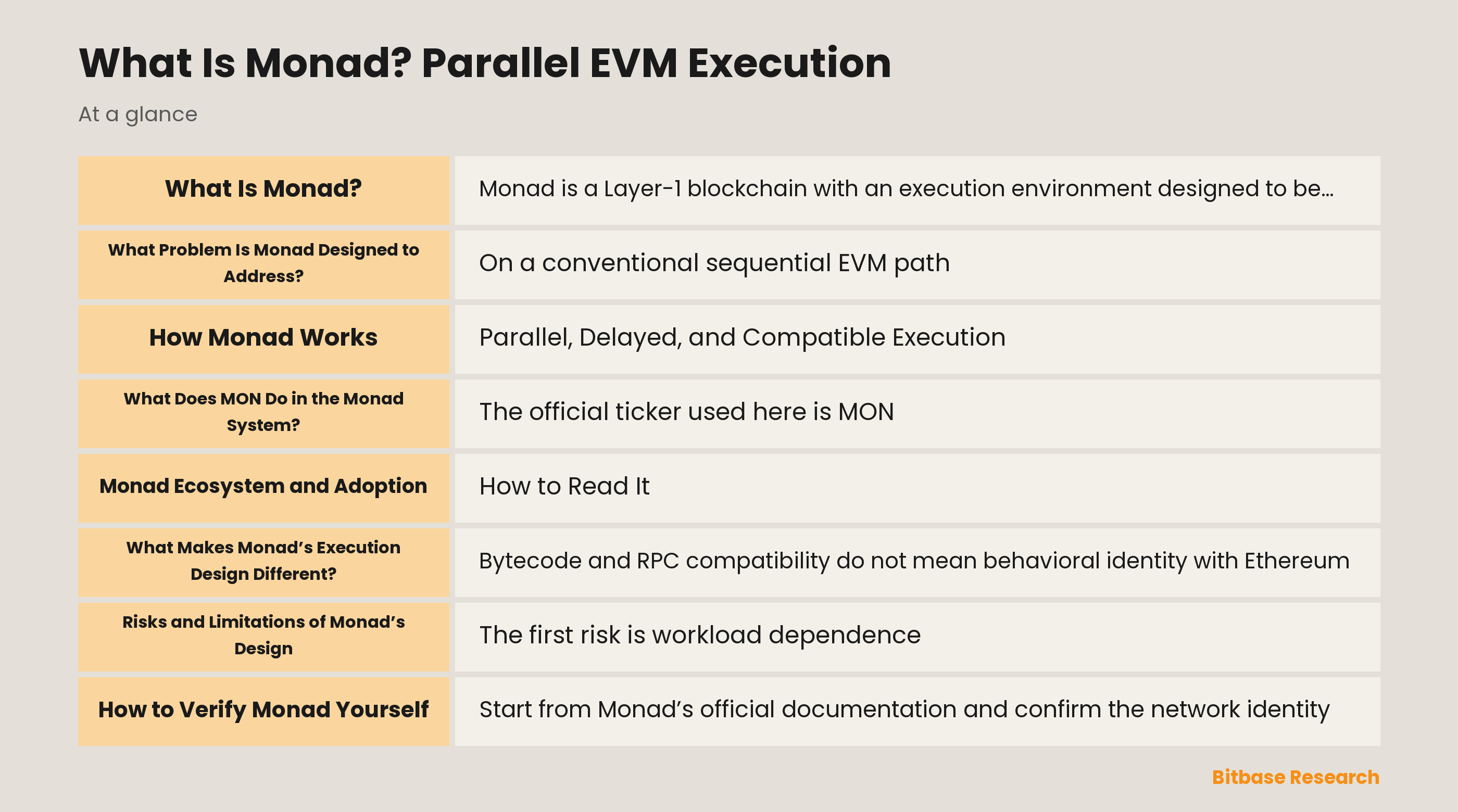
An ecosystem around an EVM-compatible network can include contracts, developer tools, infrastructure providers, explorers, wallets, and applications. Compatibility can make familiar bytecode and RPC tooling relevant, but an ecosystem label is not proof that a particular application is deployed, functioning, endorsed, secure, or suitable for a given purpose. The official documentation should be the starting point for checking a named integration or network endpoint.
It is more precise to describe adoption as something to verify than as a fixed score. This article does not use moving counts of users, applications, validators, transactions, or integrations. For an individual project, the useful questions are whether the contract is on the intended Monad network, whether code and addresses match official project records, and whether the interaction is governed by Monad-specific execution rules rather than assumed Ethereum behavior.
What Makes Monad’s Execution Design Different?
Bytecode and RPC compatibility do not mean behavioral identity with Ethereum. Monad’s developer documentation lists differences such as charging transactions according to the gas limit rather than actual gas used, a Reserve Balance mechanism associated with asynchronous execution, and no global mempool. These details can matter to an application even when its Solidity code does not need recompilation.
Delayed execution also changes how to think about state visibility. Documentation describes an official transaction ordering that is determined before execution has unveiled the resulting state, with delayed roots used to check eventual agreement. That arrangement is intended to expand the execution time budget, but it also requires developers and users of read interfaces to understand state stages, execution reversions, and the distinction between a submitted transaction and its completed result.
Risks and Limitations of Monad’s Design
The first risk is workload dependence. Optimistic parallel work can be invalidated by shared state, which causes re-execution at the serial merge stage. The mechanism can still preserve deterministic results, but contention can reduce the benefit expected from independent transactions. Application design, transaction patterns, and node implementation therefore matter as much as the word parallel.
The second risk is systems complexity. Pipelined consensus, speculative work, delayed Merkle roots, reserve-balance rules, custom storage, and native-code compilation introduce components that must operate consistently across nodes. Monad’s own documentation identifies operational differences from Ethereum, including historical-state availability boundaries and conditions under which a validly included transaction can later revert during execution. These are technical tradeoffs, not merely interface details.
The third risk is that protocol status and documentation can change. The official staking page retrieved on August 11, 2026 says automated in-protocol slashing is not currently implemented; that statement should be rechecked against the current documentation before relying on it. This article does not infer audit status, security quality, or future behavior from the sources. A source absence is not evidence of a positive or negative conclusion.
How to Verify Monad Yourself
Start from Monad’s official documentation and confirm the network identity, the current network information, and the official ticker MON. Then use an explorer linked by that documentation, such as MonadVision or Monadscan, only for read-only checks of an address, transaction, block, or verified contract. A block explorer can show what exists on a particular network; it does not by itself prove that a social-media post, token label, or application frontend is official.
For a contract representation, distinguish native MON from Wrapped MON and from similarly named assets on other chains. Check the official Network Information and Tokens and Bridges pages first, then compare the chain, contract address, verified source code, symbol, and decimals in the official explorer. If any of those fields conflict, stop at the discrepancy rather than assuming a matching name establishes identity.
Finally, compare time-sensitive claims with the official changelog and the relevant technical page. Performance figures, network parameters, validator rules, and supported tooling can be revised. Safe verification is evidence collection: read the project’s own materials, inspect the stated network through the official block explorer, and record the date of the check. It is not a substitute for executing a transaction or relying on an unverified prompt.
The Bottom Line
Monad is best understood as an EVM-compatible Layer-1 whose documented design keeps transaction ordering linear while attempting to execute independent work in parallel. Its delayed execution pipeline separates agreement on ordering from the completion of execution, and serial state merging is used to preserve deterministic outcomes when speculation conflicts with earlier state changes.
MON is the official ticker used for the network’s native asset and documented consensus-weight functions, while Monad’s compatibility claims coexist with important behavioral differences. The most durable reading of the project is architectural: check official documentation and official explorer records for the current state, attribute performance claims to the project, and keep native assets, wrapped representations, and unverified labels distinct.
Related market pages
- MON: View price · Spot market · Perpetual market
Disclaimer: This article is educational content from Bitbase Academy, provided for information only. It explains what a project does and what role its token plays in that system; it does not constitute investment, trading, tax, or financial advice, and it is neither a recommendation nor an endorsement of any project or token. Bitbase has not carried out due diligence on the project described here, and mentioning it does not mean Bitbase lists or supports the asset. Crypto assets carry significant risk, including price volatility, thin liquidity, smart-contract failure, regulatory uncertainty, and the possible loss of their entire value. Written as of August 2026; a project's status, tokenomics, team, and contracts can change at any time. Verify everything yourself through official channels, the contract address, and a block explorer, and beware of imitation sites and phishing links.
References
[1] Monad Documentation: Introduction docs.monad.xyz
[2] Monad Documentation: Parallel Execution docs.monad.xyz
[3] Monad Documentation: Asynchronous Execution docs.monad.xyz
[4] Monad Documentation: Differences between Monad and Ethereum docs.monad.xyz
[5] Monad Documentation: Staking docs.monad.xyz
[6] Monad Developer Portal: Network Specs developers.monad.xyz
[7] Monad Documentation: Network Information - Mainnet docs.monad.xyz
[8] Monad Documentation: Block Explorers docs.monad.xyz
[9] Monad Documentation: Tokens and Bridges docs.monad.xyz
[10] Monad official token-list repository github.com