
Movement is a name used for Move-oriented blockchain infrastructure and networks. Current official documentation presents M1 as a native Move Layer 1, while an earlier Move Stack whitepaper describes a modular framework for Move-based chains. A reliable answer to “what is movement crypto” separates the language, the execution environment, the current network description, and the documented role of MOVE instead of treating them as one permanent product claim.
What Is Movement?
Movement is a blockchain-infrastructure project built around the Move programming language and execution in the Move virtual machine. The current M1 documentation describes a native Layer 1 with its own consensus mechanism and validator set. It also distinguishes a production network from a test environment, so the name of the project should not be used as shorthand for every network stage or component discussed in its materials.
The same name appears in the Move Stack whitepaper. That dated document describes a modular framework for building configurable Move-based chains, including an execution layer and choices around surrounding services. It is useful for understanding a design vocabulary, but it is not by itself evidence that every conceptual component or route described there is active on the current M1 network.
This distinction is the starting point for a project profile. Move is a programming language; Move Stack is a framework described in a historical technical source; M1 is a network described in current documentation; and MOVE is the token ticker used in that documentation. These parts are related, but a fact about one part should not be silently carried over to the others.
What Problem Does Movement Aim to Address?
Smart-contract infrastructure has to coordinate more than contract code. It needs a runtime that evaluates programs, a way to represent and verify state, a consensus process that orders valid changes, networking that carries messages, and interfaces through which applications can query the system. When all of those concerns are compressed into a single label, it becomes difficult to identify what actually supplies a claimed property.
Movement's materials place Move's resource-oriented language model within that wider infrastructure problem. The intended value of resource rules, ownership semantics, and type checks is that a program can express asset-related constraints more explicitly. That is a property of a language and runtime model, not a conclusion that every application deployed with it has correct permissions, sound business logic, or safe integrations.
The Move Stack context adds a modular design question. A chain may have an execution engine while other functions involve architecture choices about data availability, sequencing, or settlement. The whitepaper explains why different sources can use different descriptions of Movement, but current status must be established from current official pages. A design route should never be presented as completed merely because it appears in a technical diagram.
How Does Movement Work?
The current M1 architecture documentation divides the system into API, execution, storage, consensus, and network layers. The API layer is where applications make queries and use published interfaces. The execution layer evaluates Move bytecode and applies permitted state changes. Storage maintains account and resource data in verifiable structures. Consensus coordinates final agreement on valid transitions, while the network layer distributes messages among participants.
The separation of these layers is practical rather than decorative. A statement about the virtual machine does not prove that an application module has correct business rules. A statement about consensus does not prove that an external data feed, interface, or indexer is accurate. Each layer has software versions, dependencies, and operational conditions that must be checked in its own context.
The documentation also discusses processing that can be parallelized when transaction read and write dependencies allow it. This should not be read as a promise that all activity executes at once. Conflicting operations still need a deterministic result. The useful mechanism is dependency-aware execution: operations without conflicts may be processed differently from operations that contend for the same state.
What Does MOVE Do in the Movement System?
MOVE is the ticker that current M1 documentation uses for the network's native token. The official materials associate it with transaction fees, validator security, governance, and network incentive mechanisms. These are protocol-level roles. They are not a direction to acquire, transfer, delegate, or take any other action with the token.
The token should be separated from the name of the technology. Move describes a resource-oriented programming model. M1 describes a particular network and its layered services. MOVE is the asset that the current documentation connects to certain system functions. None of those three categories, by itself, establishes what code a third-party application has deployed or which current parameter set it uses.
Token roles are also time-sensitive in their implementation. Fee rules, validator conditions, governance procedures, incentives, asset representations, and supported endpoints may change through software releases or governance processes. A general article can state the role an official source documents; current values and exact implementation details should be re-checked against current official records.
Movement Ecosystem and Adoption Context
The Movement ecosystem can refer to applications, developer tools, services, and other activity associated with the network and Move execution environment. The word “ecosystem” does not prove maturity, security, scale, or availability. A name in a project source is not evidence that a specific application is currently active, that its code is verified, or that its operation has been reviewed.
For that reason, adoption context needs to stay narrow. Official materials can describe the kinds of applications or infrastructure the network is intended to support. The state of any individual deployment has to be checked by identifying its network, its current code and permissions, and its published technical record. This profile does not turn a list of applications into counts, rankings, or a broad market conclusion.
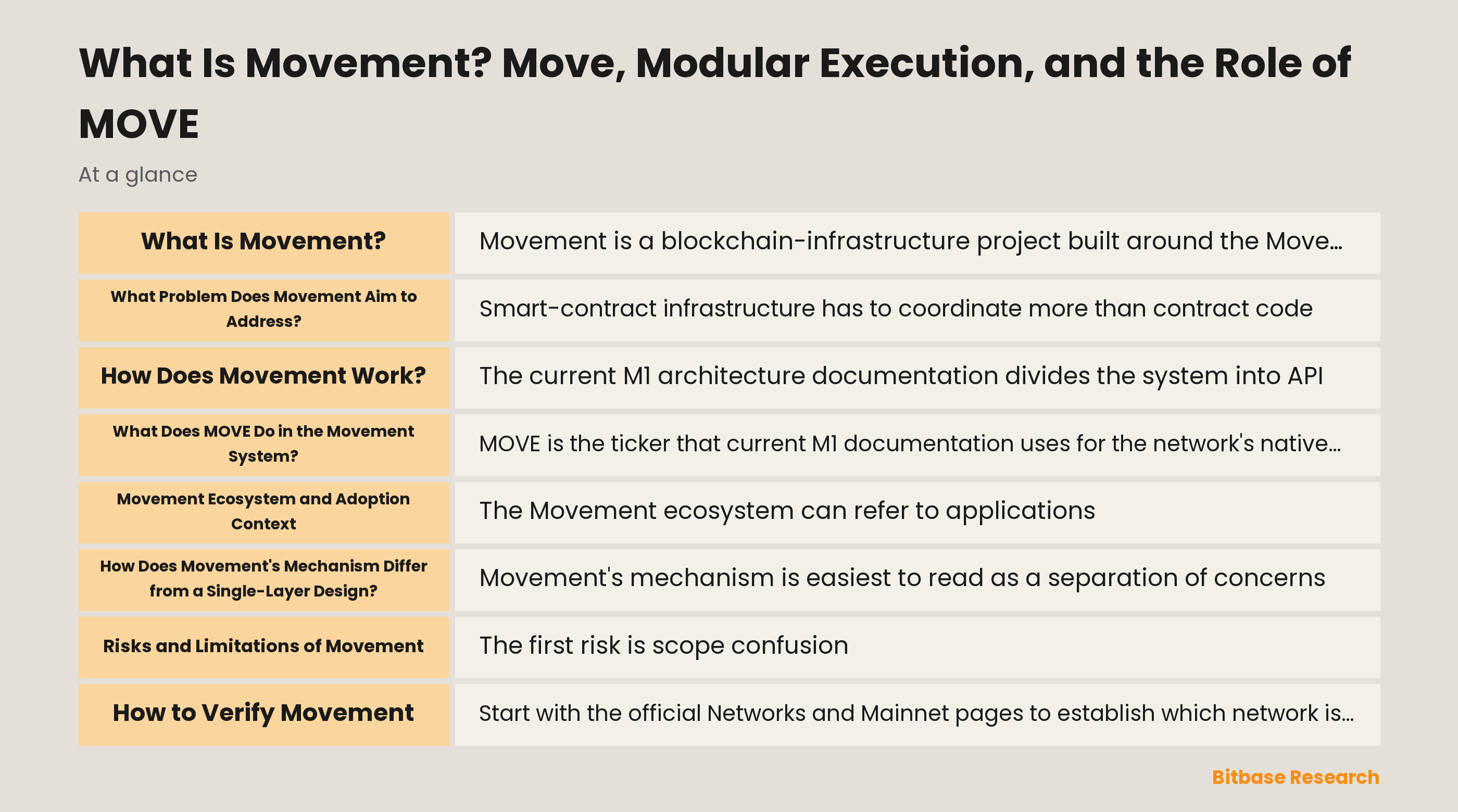
How Does Movement's Mechanism Differ from a Single-Layer Design?
Movement's mechanism is easiest to read as a separation of concerns. One question is how an application reads or submits data. Another is how the runtime evaluates a program. Others concern state commitment, consensus, and network propagation. M1 documentation assigns these functions to different layers instead of using “the chain processes transactions” as the whole explanation.
The Move Stack whitepaper introduces another mechanism distinction: components of a Move-based chain can be discussed as configurable modules. This does not mean that every possible configuration is enabled on M1, and it does not rank one design above another. It means readers should ask whether a statement applies to a general framework, a dated design source, a testing environment, or a current mainnet implementation.
The same discipline applies to movement tokenomics and use cases. The durable educational fact is the documented functional context of MOVE. Supply details, allocation structures, release conditions, feature availability, and application status are changeable facts. They should be verified in the relevant current source rather than copied from a general profile as if they were permanent.
Risks and Limitations of Movement
The first risk is scope confusion. “Movement,” “Move Stack,” “M1,” “mainnet,” and “testnet” may appear in related official sources yet identify different layers, documents, or stages. A dated whitepaper can explain a design intention without proving that every element shown is part of the present production network. Conversely, a current status page does not prove the state of every application built around it.
The second risk is deployment specificity. Move's resource model may help a developer express certain asset constraints, but it does not remove the possibility of errors in application logic, permissions, dependencies, interfaces, or upgrades. A token label or contract identifier needs the correct network, the current code or proxy context, and an official explanation of why the record is relevant.
The third risk is factual drift. Network endpoints, software versions, validator rules, governance outcomes, fee settings, token details, and feature availability can all change. This article deliberately does not freeze performance figures, supply or allocation figures, contract addresses, ecosystem totals, or roadmaps into permanent statements. Those items require a current source check whenever the exact fact matters.
How to Verify Movement
Start with the official Networks and Mainnet pages to establish which network is currently described as live and which is described for testing. Then read the current M1 overview and architecture materials to distinguish native Move execution, layered services, and the documented role of MOVE. Compare dates and wording because a current network-status page and a historical whitepaper answer different questions.
For a particular asset, application, or contract, use the project's stated registry and block explorer only as read-only cross-checks. Confirm the network label, the contract address or asset identifier, source-code or proxy information where it is available, and the date of the official page that supplied the identifier. If names, networks, or scopes do not align, stop and resolve the source chain before relying on the claim.
Conclusion
Movement is best understood as Move-oriented infrastructure with a layered network description: current documentation describes M1 as a native Move Layer 1, while Move Stack is a dated modular-framework source that needs separate treatment. MOVE is the documented native asset associated with specific system functions, not a substitute name for the whole technology.
The useful conclusion is therefore a verification rule. First identify which layer and stage a source addresses; then confirm the specific current fact through official documentation and read-only network records. This article is an architectural introduction, not a substitute for a current review of a particular deployment, asset, or software version.
Related market pages
- MOVE: View price · Perpetual market
Disclaimer: This article is educational content from Bitbase Academy, provided for information only. It explains what a project does and what role its token plays in that system; it does not constitute investment, trading, tax, or financial advice, and it is neither a recommendation nor an endorsement of any project or token. Bitbase has not carried out due diligence on the project described here, and mentioning it does not mean Bitbase lists or supports the asset. Crypto assets carry significant risk, including price volatility, thin liquidity, smart-contract failure, regulatory uncertainty, and the possible loss of their entire value. Written as of August 2026; a project's status, tokenomics, team, and contracts can change at any time. Verify everything yourself through official channels, the contract address, and a block explorer, and beware of imitation sites and phishing links.
References
[1] Movement Networks overview (official documentation) docs.movementnetwork.xyz
[2] Movement Mainnet (official documentation) docs.movementnetwork.xyz
[3] What is M1 (official documentation) docs.movementnetwork.xyz
[4] Move Language (official documentation) docs.movementnetwork.xyz
[5] M1 Architecture (official documentation) docs.movementnetwork.xyz
[6] M1 protocol specification (official documentation) docs.movementnetwork.xyz
[7] Movement Network Whitepaper v0.2.7 (official, dated 2025-01-23) movementnetwork.xyz