Naoris Protocol's own materials describe a decentralized cybersecurity and digital-trust architecture; NAORIS is identified there as the protocol's native utility token.
Readers looking for naoris ecosystem and use cases, naoris protocol, or asking how does naoris work should separate the project's documented design from a demonstrated security result. This educational profile explains the architecture and stated token role in first-party materials. It does not promise protection, quantum resistance, audit results, detection quality, or network availability.
What Is Naoris Protocol?
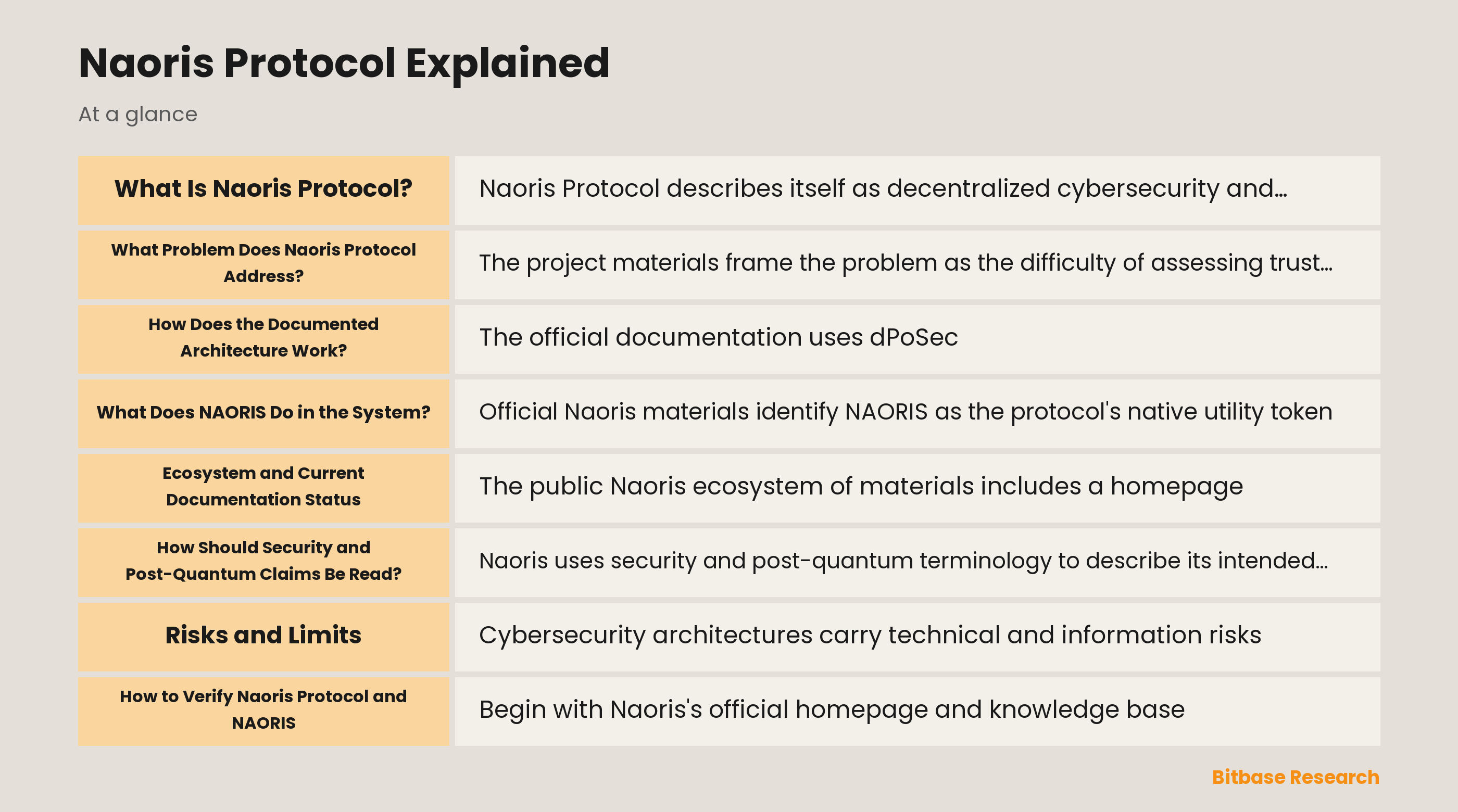
Naoris Protocol describes itself as decentralized cybersecurity and digital-trust infrastructure. Its public materials use the term Sub-Zero Layer for an architectural position intended to sit beneath conventional blockchain and application layers. The same materials also describe a Layer 1 design with protocol rules of its own. These labels show how the project frames the system; they are not independent proof that a security property has been achieved in every environment.
A useful reading starts by separating an architecture from an outcome. A design can explain how participants, devices, records, and validation roles are intended to relate to one another, while implementation scope and effectiveness still require evidence for a specific release and setting. This distinction matters especially for a cybersecurity project, where a technical description alone cannot establish that an incident will be prevented or that a system is safe.
What Problem Does Naoris Protocol Address?
The project materials frame the problem as the difficulty of assessing trust across connected digital systems without relying entirely on a central observer. They describe a model in which integrity-related information can be collected and shared among participating components, rather than treated as a single party's private assertion. That is the stated rationale for a decentralized trust-mesh approach.
However, distributed records and automated signals are not the same thing as a complete view of risk. Data may be incomplete, conditions may change, and an indicator can be misunderstood or applied outside its intended context. The problem statement therefore helps explain why Naoris presents a particular architecture; it does not demonstrate that every participant, device, application, or organization is protected from compromise.
How Does the Documented Architecture Work?
The official documentation uses dPoSec, short for Decentralized Proof of Security, to describe a consensus and validation model. It also refers to a decentralized trust mesh in which participating devices and validation roles produce or assess integrity-related evidence. At a high level, the documented purpose is to make trust-related observations available for protocol-level coordination rather than leave them solely within a centralized security process.
Naoris also uses the term Swarm AI for a distributed intelligence layer described in its materials. The article treats that term as the project's name for a proposed analytical component, not as proof that automated analysis can reliably identify every threat. Whether a particular configuration, device type, model, or implementation is active and suitable remains a publication-day question that calls for current official documentation and, where relevant, independent technical review.
What Does NAORIS Do in the System?
Official Naoris materials identify NAORIS as the protocol's native utility token. They associate it with the documented economic and coordination layer around dPoSec, trust-related activity records, and protocol-governance discussions. This profile uses that limited formulation: it reports the stated functional role of the ticker NAORIS without inferring a benefit, return, security result, or entitlement from merely holding a token.
The token description should also be kept separate from claims about the surrounding system. A token utility page may describe roles that are intended to support protocol participation, while the exact chain record, contract address, supply terms, allocation details, governance rules, and availability can change. None of those descriptions establishes that a particular security mechanism is deployed, effective, audited, or appropriate for a reader's circumstances.
Ecosystem and Current Documentation Status
The public Naoris ecosystem of materials includes a homepage, a knowledge base, technical descriptions, token-related pages, and pages that use labels such as mainnet or solution. Together they show the vocabulary the project currently uses to present its architecture. They should not be read as an independently verified inventory of active services, integrations, participants, or security coverage.
For publication, the current official pages need a fresh review for the protocol stage, product scope, chain identifiers, contract information, and any announcement affecting the meaning of NAORIS. A document can retain an architectural explanation while the related software, policies, implementation, or availability changes. This article therefore describes the documented ecosystem and deliberately does not assert a present operating condition.
How Should Security and Post-Quantum Claims Be Read?
Naoris uses security and post-quantum terminology to describe its intended architecture, including the relationship among cryptography, dPoSec, and its trust-mesh model. Those terms identify the project's technical direction and source vocabulary. They do not by themselves establish that any implementation is resistant to a given attack, suitable for a particular threat model, or capable of preserving confidentiality, integrity, or availability.
Cryptographic assertions depend on more than an algorithm name. Their practical meaning can depend on implementation details, key handling, surrounding software, hardware, configuration, interoperability, and the nature of an adversary. A project description is not an audit report, a formal proof, or an independent assessment of those conditions. Readers should avoid turning promotional language about future threats into an assurance about current protection.
The same caution applies to automated detection and decentralized validation language. A mechanism may be documented as part of a design, yet its limits, false-positive and false-negative behavior, governance assumptions, and operational boundaries may remain material. This profile neither evaluates those claims nor represents them as settled facts; it explains what the first-party documentation says and flags the need for further verification.
Risks and Limits
Cybersecurity architectures carry technical and information risks. Software can contain defects, hardware and dependencies can fail, integrity signals can be incomplete, and different participants can interpret evidence differently. A decentralized arrangement can change where trust is placed, but it does not remove the possibility of faulty implementation, adversarial behavior, misconfiguration, or a mismatch between a design goal and real-world conditions.
There are also changing-information risks. Chain identifiers, a contract address, token parameters, documentation, governance arrangements, product scope, technical reviews, and statements about cryptographic properties may be revised. Claims of safety, quantum resilience, mitigation, compliance, or availability should be checked against up-to-date official material and appropriate independent technical evidence, rather than assumed from an older description.
How to Verify Naoris Protocol and NAORIS
Begin with Naoris's official homepage and knowledge base, and check that they consistently identify the project and the ticker NAORIS. The official technical and token pages are the appropriate primary sources for the project's stated architecture and token role. A copied summary, search result, social post, or similarly named site should not replace those first-party records.
If an official primary source publishes a contract address or equivalent chain identifier, compare it with the record on the corresponding block explorer and confirm that the chain, identifier, and ticker align with the same official communication. If an identifier is absent, changes, or conflicts with another official page, pause rather than infer an answer. This is a verification principle, not an instruction for using any product or token.
Conclusion
Naoris Protocol is most accurately presented as a project whose official materials describe a decentralized cybersecurity and digital-trust architecture built around a Sub-Zero Layer framing, dPoSec, and a trust mesh. Those materials identify NAORIS as its native utility token. The description is useful for understanding the project's stated model, but it is not evidence of a guaranteed security, post-quantum, audit, or availability outcome.
Before publication, re-check the official wording for the ticker, the applicable chain and contract record if formally published, the protocol stage, product scope, and any technical-security claims. Keeping those volatile facts distinct from the documented architectural explanation prevents the profile from overstating what first-party sources actually establish.
Related market pages
- NAORIS: View price · Perpetual market
Disclaimer: This article is educational content from Bitbase Academy, provided for information only. It explains what a project does and what role its token plays in that system; it does not constitute investment, trading, tax, or financial advice, and it is neither a recommendation nor an endorsement of any project or token. Bitbase has not carried out due diligence on the project described here, and mentioning it does not mean Bitbase lists or supports the asset. Crypto assets carry significant risk, including price volatility, thin liquidity, smart-contract failure, regulatory uncertainty, and the possible loss of their entire value. Written as of August 2026; a project's status, tokenomics, team, and contracts can change at any time. Verify everything yourself through official channels, the contract address, and a block explorer, and beware of imitation sites and phishing links.
References
[1] Naoris Protocol official homepage naorisprotocol.com
[2] What is Naoris Protocol? (official knowledge base) knowledgebase.naorisprotocol.com
[3] How Does Naoris Protocol Work? (official knowledge base) knowledgebase.naorisprotocol.com
[4] What is the $NAORIS Token used for? (official knowledge base) knowledgebase.naorisprotocol.com
[5] Naoris Mainnet: How It Works (official knowledge base) knowledgebase.naorisprotocol.com