Nervos Network is a blockchain system whose base layer is called CKB, short for Common Knowledge Base. It uses a Cell model for on-chain state, scripts executed by the RISC-V-compatible CKB-VM, and proof-of-work consensus. This guide explains those documented roles without treating the network or its native asset as a recommendation.
Questions such as nervos ecosystem and use cases, nervos network, and how does nervos work are best answered by separating the base layer, its native capacity asset, and the applications or protocols that may use the layer. Nervos documentation presents CKB as the foundational layer whose task is to preserve state and validate the rules attached to that state.
That distinction matters because a project name, a network, a token symbol, and a specific application are not interchangeable. CKB is the native CKByte asset of the base layer. A Cell is the state container used by that layer. A script is the code that can constrain how a Cell is used. The current status of any separate application, tool, or integration requires its own source and on-chain review.
What Is Nervos Network?
Nervos Network is the broader system around CKB, the Common Knowledge Base. The official documentation describes CKB as the foundational layer of the Nervos Network and as a public, permissionless layer-1 blockchain. Its design emphasis is to provide a secure and decentralized base on which other layers or applications can rely for validation and persistent state.
The term Common Knowledge Base is useful as an architectural description, not a promise that every claim made by an application is true. The base layer records and verifies defined state transitions under its consensus rules. It cannot decide whether an external description is accurate, whether a user interface is trustworthy, or whether an application’s rule is sensible. Those questions sit outside the fact that a transaction was accepted by the protocol.
Nervos is also described as a multi-layer design. In this framing, the base layer prioritizes security and decentralization, while other layers or protocols can address different performance or application requirements. Layering is an allocation of responsibilities, not a guarantee that a higher-layer product has the same properties as the base layer or that every integration is equally mature.
For a reader asking what Nervos Network is, the useful first answer is therefore modest: it is a network centered on a programmable, proof-of-work base layer named CKB. The next questions are which Cell state is involved, which scripts govern it, which network is being discussed, and which official documents or public chain records support a particular claim.
What Problem Does Nervos Network Address?
Public blockchains must make their state changes independently checkable. If a rule changes who may use an asset or what data a program recognizes, nodes need a way to validate that rule without relying on a single operator’s database. Nervos addresses this at its base layer through Cells, scripts, transactions, and proof-of-work consensus, rather than treating all application logic as one shared account balance.
The Cell model generalizes the idea of an unspent output into a state container. A Cell can hold capacity, data, and the scripts that determine its conditions. Once a Cell is on-chain it is not edited in place. A valid update consumes the old Cell and creates one or more new Cells, so the chain can validate a visible state transition from inputs to outputs.
This model makes the update rule explicit. A program does not silently overwrite a record; the transaction supplies inputs and outputs, and the relevant scripts evaluate whether the change is permitted. That can be useful for assets, data, or application-specific states, but it does not remove the need to understand the script rules. A valid transaction says the deployed rules accepted it, not that the rules were free of design mistakes.
Proof of work supplies a separate part of the design: agreement on valid history and transaction ordering among distributed participants. Official Nervos materials describe the network’s NC-MAX approach as building on Nakamoto consensus and using a propose-and-commit process. Such protocol properties describe the network’s validation process; they are not a reason to assume that any website, address label, or application message is authentic.
How Does Nervos Work?
At a high level, Nervos works by representing reusable on-chain state as Live Cells. A transaction selects existing Live Cells as inputs and produces new output Cells. The input Cells are consumed, while the output Cells become the candidate next state. This is why the question how does nervos work is more precise when it asks what Cells are consumed, what Cells are created, and which scripts must accept the transition.
Each Cell has capacity measured in CKBytes and can also include data and script references. The official documentation explains that a Cell’s associated lock script controls ownership and access, while a type script can define how the Cell may be used or changed. The distinction is important: a lock script is normally about who may consume a Cell, whereas a type script can impose additional rules on a class of Cells or an application state.
When a transaction is submitted, nodes execute the scripts that are relevant to its inputs and outputs. The CKB-VM loads and runs the script code referenced by the transaction’s script fields. A successful result permits that part of validation; a failing script prevents the transaction from being accepted. This is programmable verification, but it is not a blanket security certificate for every contract or interface built around the network.
The CKB-VM uses the RISC-V instruction set. Nervos documents describe it as the environment in which scripts run and explain that execution has cycle accounting and block-level limits. For a non-developer, the main practical point is that the protocol checks executable rules over a stated transition. For a developer or reviewer, the exact code hash, arguments, dependencies, transaction data, and network version remain the facts that must be inspected.
What Does CKB Do in the Nervos Network?
CKB is the official ticker for CKByte, the native asset of the Nervos base layer. Official Nervos documentation says that one CKByte corresponds to one byte of on-chain data storage capacity. Holding the capacity that a Cell occupies ties CKB directly to state storage rather than treating it only as a generic transfer unit.
CKB also has a documented role in transaction and computation-related fees. This connects the asset to use of the base layer, but a role in a protocol does not determine an outcome for a holder or for an application. Network rules, capacity needs, transaction construction, software versions, and the conditions of a particular deployment all matter. The source should be read as a description of system mechanics, not an instruction to acquire or use an asset.
Capacity has a practical consequence in the Cell model: state that occupies bytes remains associated with CKBytes while it is stored. When state is no longer needed and is removed through a valid state transition, the relevant capacity can become available for another purpose. This explains why CKB appears in both the storage model and the fee model, but it does not eliminate the need to review the actual Cell data and scripts behind a particular record.
CKB is native to the Nervos base layer, so this article does not invent a single token-contract address for it. A reader should distinguish the native asset from any separately issued representation that may exist in another context. The reliable first step is to identify the network and then inspect the official documentation and the official CKB Explorer record for the specific address, transaction, Cell, or script hash being claimed.
Nervos Ecosystem and Use Cases
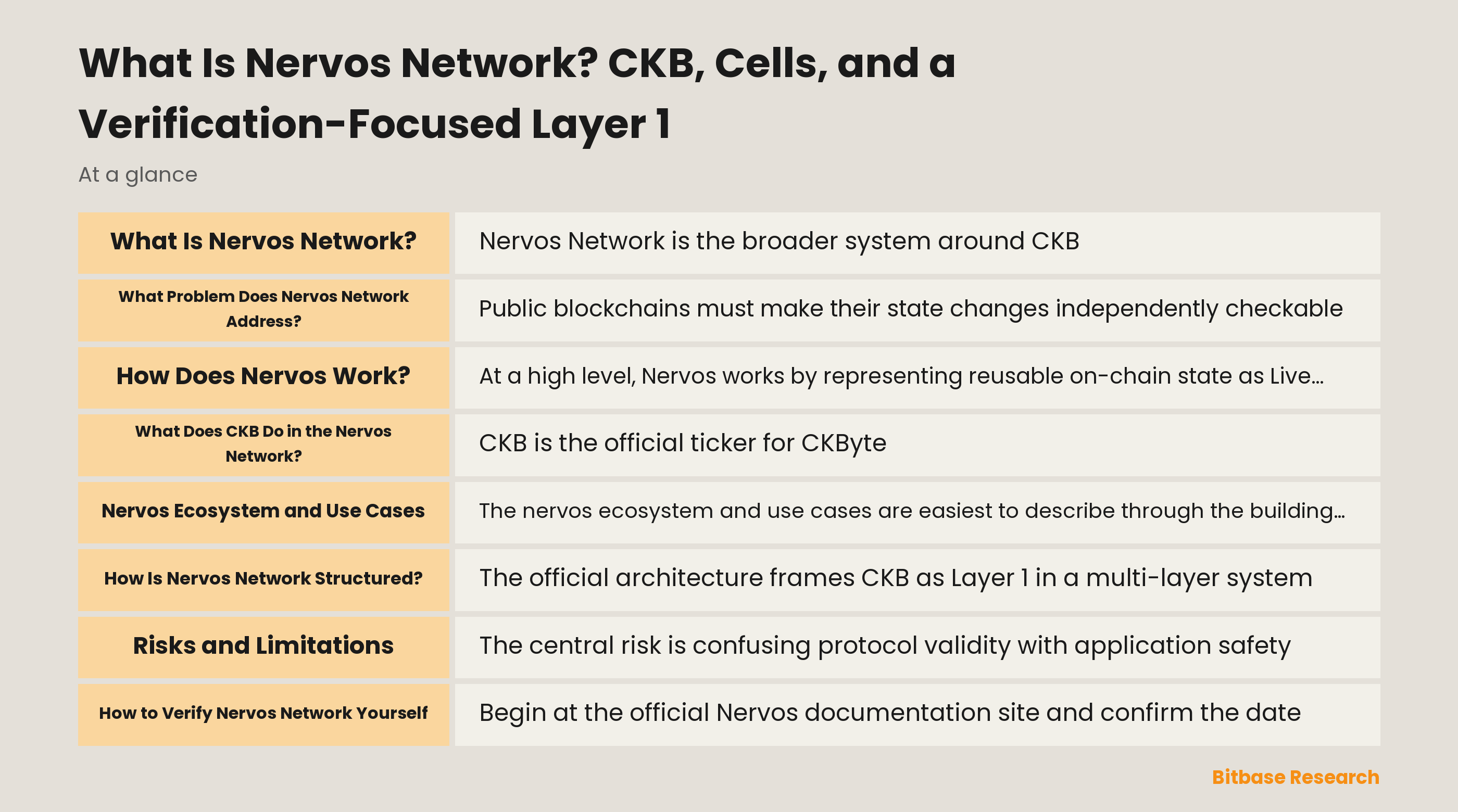
The nervos ecosystem and use cases are easiest to describe through the building blocks exposed by the official documentation rather than through a changing list of brands. The docs present CKB development materials for handling Cells, writing scripts, using SDKs, and working with assets or digital objects. A use case is meaningful when it identifies the network, Cell structure, scripts, data, and verification path rather than relying on a logo or a broad ecosystem label.
For example, a developer can model a custom asset or an application state with Cells and scripts, while an end user can encounter an application whose records ultimately use those rules. The base layer’s role is to validate the transaction against the associated scripts. It does not endorse the application’s purpose, guarantee availability of its interface, or make an off-chain statement correct simply because an address is visible on a chain.
Official Nervos materials also point to projects and tools associated with CKB, including developer resources and an explorer. These references are useful starting points, but they are not measurements of adoption, security, decentralization, or service continuity. Each project can change, deploy on a particular network, or use a different contract and version. Current claims about an integration need current, project-specific evidence.
When evaluating a claimed use case, ask four concrete questions: What Cells hold the relevant state? Which lock and type scripts are involved? What exact transaction or script hash can be inspected? Which official documentation ties those records to the claimed functionality? This approach is more durable than inferring a conclusion from the network name alone.
How Is Nervos Network Structured?
The official architecture frames CKB as Layer 1 in a multi-layer system. Its role is to provide an environment for durable state, consensus, and verification. Other protocols or applications may focus on different execution, communication, or user-experience needs. The layers are related, but a claim about one layer should not be automatically transferred to another without technical evidence.
Within the base layer, the Cell model, scripts, CKB-VM, transactions, and consensus each have different jobs. Cells represent state. Scripts enforce the conditions of particular state transitions. The virtual machine executes the scripts. Transactions propose the transition. Nodes and miners participate in validation and history under the consensus protocol. Keeping those roles separate makes it easier to locate where a claim could fail.
The official CKB node repository describes the software as a public, permissionless layer-1 implementation and describes CKB-VM as compatible with RISC-V. Source code is valuable for review, but repository visibility is not an audit result. A reviewer still needs to match a release, network configuration, script binary, or deployment to the precise thing being relied on.
This structure also means there is no universal answer to whether an application is safe or useful. The answer can depend on code quality, external dependencies, how a Cell transition is constructed, whether a script is current, and whether a user is viewing the intended network. The base protocol provides verification rules; responsible assessment still requires inspecting the particular facts.
Risks and Limitations
The central risk is confusing protocol validity with application safety. A transaction can satisfy the lock and type scripts that are deployed, while the application design, interface, data interpretation, or external service around it still has a flaw. Scripts are programs, and programs can contain errors, depend on assumptions, or be deployed with an unexpected configuration.
Cell-based state also requires careful reading. A visible address balance alone may not explain which Cells exist, what data they contain, or what scripts constrain them. A claimed asset, application, or identifier can use a familiar name while pointing to a different network, script, or data structure. A block explorer record is valuable evidence, but only after the reader checks its network, address or hash, and relationship to official documentation.
Network and protocol details can change through releases or upgrade processes. Documentation itself carries dates, and the official sources describe hard forks as changes that require nodes to follow updated rules. Current behavior should therefore be checked against the relevant release, network, and dated technical documentation rather than inferred from an older tutorial or an unrelated code branch.
There are also ordinary operational risks: misleading websites, copied addresses, unsupported software, unavailable services, and incomplete documentation can all produce bad conclusions. This article makes no audit claim. The absence of a published issue in a page consulted here is not proof that the code, a contract, or a particular interface has been independently assessed or will behave as expected.
How to Verify Nervos Network Yourself
Begin at the official Nervos documentation site and confirm the date, page scope, and network referred to by a claim. Use the documentation to establish the vocabulary: CKB is the native CKByte, a Cell carries state and capacity, and scripts define the relevant validation rules. If a claim cannot be tied to an official page, repository, or an identifiable on-chain record, label it unverified rather than filling the gap with an assumption.
For public chain data, use the official CKB block explorer to inspect a CKB address, transaction hash, block height, or script hash. Compare the exact network, identifier, transaction inputs and outputs, and any displayed Cell or script details with the documentation. This is a read-only verification path: it does not require a wallet connection, a signature, or a transaction submission.
Because CKB is native to the Nervos base layer, do not assume a promotional page’s contract address represents native CKB. First establish whether the claim concerns the CKB network or a separate representation in another environment. Then compare the exact identifiers with the official Explorer and official documentation. The most important defense is to verify the whole chain of evidence, not merely a similar-looking name.
For software or protocol claims, use the official Nervos Network repository and match the relevant branch, release, documentation version, and network. Read changes and security notes in context. An official repository is a reliable source for what code is published, but it does not by itself prove that a third-party site runs that code or that a particular deployment has no defects.
The Bottom Line
Nervos Network is best understood through CKB’s verification-focused base layer. CKB combines proof-of-work consensus, a Cell model for state, scripts that govern transitions, and a RISC-V-compatible virtual machine that executes those scripts. The design is precise about how a state transition is validated, but it does not turn every application claim into an established fact.
CKB is the native CKByte asset. Its documented roles include providing storage capacity and covering transaction and computation-related fees. Those roles explain why CKB is part of the state model, but they do not answer whether a particular application, interface, or representation should be trusted. The durable habit is to check the network, Cells, scripts, identifiers, current official documents, and the official block explorer before relying on a specific claim.
Related market pages
- CKB: View price · Perpetual market
Disclaimer: This article is educational content from Bitbase Academy, provided for information only. It explains what a project does and what role its token plays in that system; it does not constitute investment, trading, tax, or financial advice, and it is neither a recommendation nor an endorsement of any project or token. Bitbase has not carried out due diligence on the project described here, and mentioning it does not mean Bitbase lists or supports the asset. Crypto assets carry significant risk, including price volatility, thin liquidity, smart-contract failure, regulatory uncertainty, and the possible loss of their entire value. Written as of August 2026; a project's status, tokenomics, team, and contracts can change at any time. Verify everything yourself through official channels, the contract address, and a block explorer, and beware of imitation sites and phishing links.
References
[1] Nervos CKB Documentation home (official) docs.nervos.org
[2] How CKB Works (official documentation, updated 2026-07-03) docs.nervos.org
[3] Nervos Blockchain / CKB Fundamentals (official documentation, updated 2026-07-03) docs.nervos.org
[4] Cell Model (official documentation, updated 2026-07-03) docs.nervos.org
[5] Consensus / NC-MAX (official documentation, updated 2026-06-02) docs.nervos.org
[6] CKB Tokenomics page (official Nervos website) www.nervos.org
[7] Nervos CKB node repository (official Nervos Network GitHub) github.com
[8] CKB Explorer frontend repository (official Nervos Network GitHub) github.com