Obol documents Distributed Validator Technology for Ethereum: several independent participants can form one logical validator through middleware, while OBOL is described as part of the Collective's governance and economic coordination layer.
Readers researching Obol Network use cases, asking what is Obol Network, or looking for an obol definition should separate an architectural description from a guarantee about a validator, a network, or a financial outcome. This profile explains the mechanism that Obol's own materials describe and keeps the operational and economic boundaries explicit.
Obol's materials use the terms Distributed Validator, DVT, Charon, and Obol Collective in related but distinct ways. A Distributed Validator is the architectural idea of one Ethereum validator being operated through a group rather than a single machine. Charon is Obol's documented middleware implementation, while the Collective and the OBOL token concern the wider community and economic layer.
What Is Obol?
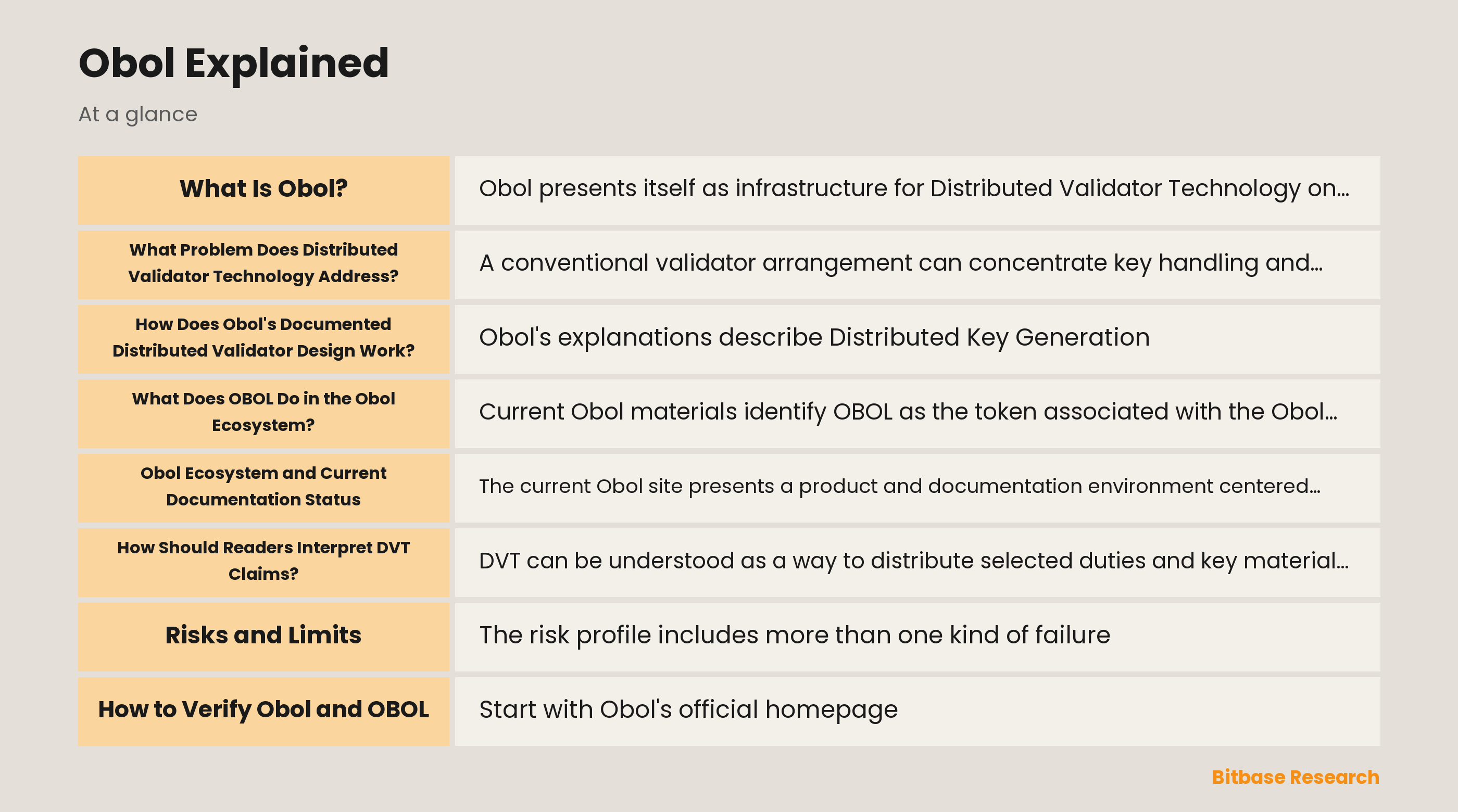
Obol presents itself as infrastructure for Distributed Validator Technology on Ethereum. In the project's description, a distributed validator is a group of independently operated components that appears to Ethereum as one logical validator. The purpose of the arrangement is to replace a single operational point with a threshold-based group design; it is not a separate base blockchain or a promise that any particular group will function correctly.
The word DVT describes a technology pattern rather than a shortcut around Ethereum's validator rules. The participating components must still coordinate around validator duties and network conditions. Obol's documentation discusses a middleware layer called Charon in that context. This article treats it as a documented software and protocol design, without advising a reader to operate a validator, create a cluster, or use any service.
What Problem Does Distributed Validator Technology Address?
A conventional validator arrangement can concentrate key handling and operational dependence in one environment. That creates correlated failure and security concerns: an outage, configuration error, compromised credential, or common client issue can affect the same validator function. DVT is intended to distribute parts of that responsibility among a group and to require a threshold of contributions before a duty is represented as complete.
This changes the design problem; it does not make the problem disappear. A group still depends on correct software, communication, key-share handling, threshold assumptions, and the behavior of participating parties. The relevant question is therefore not whether DVT makes a validator invulnerable, but which failure modes are being redistributed and which new coordination, availability, or implementation risks remain.
How Does Obol's Documented Distributed Validator Design Work?
Obol's explanations describe Distributed Key Generation, or DKG, as a way to generate validator key shares so that the complete validator private key need not be held in one normal operating location. The documentation also describes threshold signatures: separate partial signatures can be combined when the configured threshold is met. These are cryptographic and architectural concepts, not a procedure for setting up a validator.
Charon is described as a distributed-validator middleware client that sits between the surrounding validator stack and the group coordination process. Its threat-model material emphasizes that the exact security picture depends on the cluster's design and external conditions. The same material notes that a threshold shortfall can stop a cluster from performing duties, and that collusion, compromised components, software defects, or misconfiguration remain relevant considerations.
What Does OBOL Do in the Obol Ecosystem?
Current Obol materials identify OBOL as the token associated with the Obol Collective. The official homepage frames it as a coordination and alignment mechanism within an economic layer, while the token documentation describes governance and retroactive-funding participation. That is the project's stated role for the ticker OBOL; it should not be confused with the cryptographic key shares used by a distributed validator.
The distinction matters because a token can serve community-governance or programmatic coordination functions without being required for the cryptographic execution of every validator duty. Equally, a published description of token utility does not establish a right to a particular service, outcome, reward, or governance result. The details of token arrangements and community decisions can change over time.
Obol's historical token announcement and its current documentation do not turn a technical profile into an instruction to obtain, transfer, delegate, or otherwise interact with a token. This article therefore confines itself to the documented high-level role: OBOL belongs to the Collective's economic and governance context, whereas DVT describes how a validator group can be organized.
Obol Ecosystem and Current Documentation Status
The current Obol site presents a product and documentation environment centered on Distributed Validators, an operator community, security materials, and governance information. It also uses the broader term Obol Stack. These labels help explain how the project groups its technical, community, and economic materials, but they do not independently confirm the present availability, maturity, adoption, or suitability of every named component.
The official documentation itself is a reason to retain caution. Its security material calls the threat model a transparency resource rather than a comprehensive audit or complete security reference. The project also publishes changing pages about product functionality, software versions, governance, and tokens. Before publication, each time-sensitive statement needs to be checked again against the official source that currently governs it.
How Should Readers Interpret DVT Claims?
DVT can be understood as a way to distribute selected duties and key material across a threshold configuration. It may be useful to describe the intended reduction of single-environment dependence, but it is not accurate to convert that design goal into an absolute security, uptime, decentralization, or slashing-prevention claim. The actual result depends on the implementation, operators, thresholds, software clients, connectivity, and the evolving Ethereum environment.
It is also important not to mix historical, technical, and promotional claims. A past test, a quoted total, an integration name, or a roadmap statement is not proof of current status. A careful reader should treat source dates, scope statements, and explicit caveats as part of the information itself, especially where an infrastructure claim is presented in broad language.
Risks and Limits
The risk profile includes more than one kind of failure. Threshold settings can be insufficient for a particular event, several participants can share a correlated weakness, an implementation can contain a defect, and communications or identity material can be attacked or mishandled. The official threat model also makes clear that a group can lose liveness when the required threshold is not available and that a sufficiently adverse set of participants can affect safety.
There are information risks as well. Contract records, governance rules, token supply or transfer status, supported environments, software releases, audits, partner references, and operational metrics can all change. Neither a block explorer entry nor an official page alone proves that every current claim is complete, so readers should verify the relevant claim against its scope and date rather than relying on copied summaries.
How to Verify Obol and OBOL
Start with Obol's official homepage, its educational DVT material, and the security documentation. These sources should consistently distinguish the Distributed Validator architecture, the Charon middleware, and the OBOL token's stated governance or economic role. The official domains and channels listed in the security documentation are a useful safeguard against similarly named pages and phishing copies.
For a token-specific fact, look for a current official announcement that identifies the applicable network and contract address, then compare that identifier with the corresponding block explorer record. Confirm that the name, ticker, network, date, and stated function all match the same official context. If an identifier or policy statement conflicts, is missing, or is outdated, pause rather than infer a conclusion. This is a verification principle, not an operational guide.
Conclusion
Obol is best understood as a documented Distributed Validator Technology effort for Ethereum, with Charon described as middleware for a threshold-coordinated validator design. The architecture can distribute certain responsibilities and key material, but it does not eliminate operational, cryptographic, governance, or implementation risk. A DVT explanation should remain a mechanism explanation rather than a promise about security or online performance.
OBOL belongs to the Obol Collective's stated governance and economic context, not to a claim that any holder receives a particular result. Before publication, confirm the current software and security materials, the relevant network and contract address if a token fact is discussed, and the contemporary status of governance and product claims. Keeping those checks separate from the stable architectural outline makes the profile more accurate.
Related market pages
- OBOL: View price
Disclaimer: This article is educational content from Bitbase Academy, provided for information only. It explains what a project does and what role its token plays in that system; it does not constitute investment, trading, tax, or financial advice, and it is neither a recommendation nor an endorsement of any project or token. Bitbase has not carried out due diligence on the project described here, and mentioning it does not mean Bitbase lists or supports the asset. Crypto assets carry significant risk, including price volatility, thin liquidity, smart-contract failure, regulatory uncertainty, and the possible loss of their entire value. Written as of August 2026; a project's status, tokenomics, team, and contracts can change at any time. Verify everything yourself through official channels, the contract address, and a block explorer, and beware of imitation sites and phishing links.
References
[1] Obol official homepage obol.org
[2] What is a DV? (Obol official learning material) obol.org
[3] Charon Threat Model (Obol official documentation) docs.obol.org
[4] Token Holders FAQ (Obol official documentation) docs.obol.org
[5] Security Overview (Obol official documentation) docs.obol.org
[6] Announcing the OBOL Token and Decentralized Operator Ecosystem (Obol official blog) blog.obol.org