Omni Network is presented as infrastructure for coordinating activity across separated Ethereum rollup environments.
Ethereum can scale through rollups, yet that scaling approach also creates many distinct execution contexts with their own state, timing, and application instances. Omni Network addresses that coordination problem in its public materials. This explainer treats the omni network as an architectural and documentary subject, not as an assurance that a particular capability is available everywhere or works in a particular way at publication time.
What Is Omni Network?
Omni is described in official material as interoperability and chain-abstraction infrastructure. Its whitepaper frames the original objective as Ethereum-native interoperability: enabling communication among rollup environments while preserving the idea that Ethereum is a connected ecosystem. The point is not to erase every technical boundary or to replace Ethereum with one new ledger. It is to give applications a way to reason about related activity that occurs in more than one execution environment.
That objective needs careful vocabulary. A rollup can have its own execution rules, state history, finality timing, and application deployment. When an application spans several rollups, the difficulty is not only moving information from A to B. It is deciding what information is authoritative, when it is sufficiently final for the next step, and how a destination environment should interpret it. Omni's design is aimed at that coordination layer. It also means that coordination cannot erase independent rollup rules; those rules remain explicit inputs to every cross-domain process, so an application must model timing, message interpretation, and failure behavior with the same care it gives to its own local state.
Why Rollup Fragmentation Matters
Fragmentation is a distributed-systems problem rather than merely a presentation problem. State can be created in one rollup while a related application decision occurs in another. Those environments may confirm events at different times and may expose different data or execution assumptions. A message that correctly describes a source event can still arrive too early, be repeated, be delayed, or be unusable for a destination program unless the full protocol defines how those cases are handled.
For developers, this changes an apparently local application into a system that must account for origin, ordering, verification, failure, and recovery across domains. For users, it can mean that the experience of one application is divided by network boundaries even when the application appears to have one identity. The whitepaper identifies this split of users, capital, and development work as the motivation for a rollup-focused interoperability design.
Messages, Intents, and the Bridge Distinction
Calling every cross-system protocol a bridge hides an important distinction. A bridge commonly refers to a mechanism focused on an asset representation or an asset movement between ledgers. A generic cross-rollup messaging layer has a wider possible job: it can carry authenticated claims, instructions, or event information so that a destination program can make a defined decision. The two categories can overlap, but a message system is not automatically reducible to a bridge.
Omni's material also calls for distinguishing a message from an intent. A message is a communication object whose origin, contents, and verification path matter. An intent is a structured expression of a desired end state and constraints, without prescribing every intermediate route. The newer documentation discusses an intent-oriented layer, while the earlier whitepaper explains cross-rollup messages and consensus architecture. These are related ideas, but their dates, scope, and operational assumptions should not be blended into one unstated guarantee.
OMNI as the Documented Ticker
OMNI is the ticker used by the project's official token documentation, which labels it an ERC-20 token. The 2024 whitepaper also uses the notation $OMNI when discussing resources within its proposed protocol architecture for cross-rollup messages and an EVM layer. This establishes how the official materials name the ticker and where that symbol appears in the project's own technical narrative.
A ticker alone does not settle broader questions. It does not establish a current feature list, a contract detail, an allocation, a control arrangement, or any additional user right. The token page and the whitepaper have their own dates and purposes, so publication work should identify the source being summarized and recheck dynamic details directly against the project's official material on the publication day.
The Omni Ecosystem and Its Documentation
The phrase omni ecosystem and use cases is most useful when grounded in public artifacts instead of broad expansion claims. The documentation organizes material around an overview, intent concepts, and developer-facing components, while the public source repository exposes code and project structure. Together, those artifacts show how the project explains itself; they are not a complete, permanent inventory of every environment, application, or capability associated with the name.
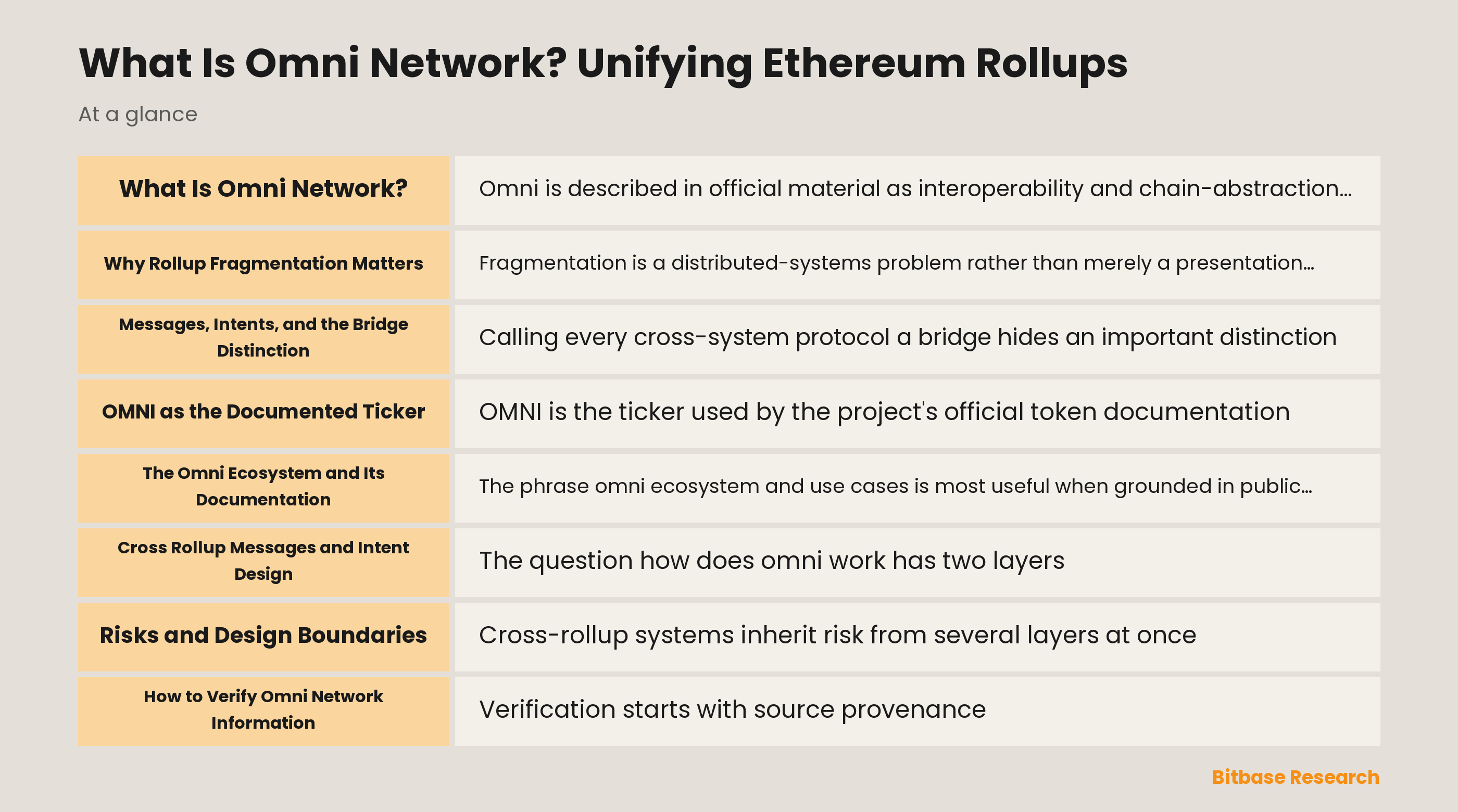
Different official artifacts answer different questions. The whitepaper records a 2024 architecture and design rationale, the documentation can describe later concepts, the terms distinguish services from the protocol, and the source repository can reveal implementation materials. A careful reader compares dates, definitions, and scope before treating a statement from one artifact as a statement about another.
Cross Rollup Messages and Intent Design
The question how does omni work has two layers: the cross-rollup architecture described in the whitepaper and the outcome-oriented coordination described in newer documentation. In the whitepaper's model, validators observe cross-rollup message requests, form message data for consensus, and a delivery component carries finalized information to a destination environment. That is an architectural description of a proposed message path, not a claim that every message has identical timing or protection in every setting.
Intent design starts from a permitted outcome rather than a fully fixed sequence of intermediate operations. The documentation describes solvers that evaluate and fulfill such structured intents, with later verification and settlement steps in the documented flow. This does not make distributed coordination disappear. A complete design still needs precise limits, expiry behavior, replay protection, source and destination finality rules, failure handling, and a clear definition of what counts as successful fulfillment.
Risks and Design Boundaries
Cross-rollup systems inherit risk from several layers at once: the source environment, the method used to verify a source claim, the party or mechanism that carries information, the destination execution, and any later settlement logic. A defect, a misunderstood finality rule, unavailable infrastructure, or a mismatch between application assumptions can lead to incorrect execution, delayed completion, or an unresolved state. Intent-based coordination also introduces its own questions about constraint interpretation, competition among fulfillers, and liveness.
The whitepaper's statements about speed, security, and broad compatibility are architecture and design material, not a universal performance promise. Public documentation and code can evolve, and a repository's existence does not independently establish review coverage, active integrations, geographic availability, or legal effect. Those facts, along with the exact status of components and technical parameters, need publication-day verification from official sources.
How to Verify Omni Network Information
Verification starts with source provenance. Read the official overview for the project's current self-description, the intent documentation for the terminology used in that layer, and the whitepaper for the dated architecture and its assumptions. Keep the source date beside any technical claim. If a statement cannot be tied to a specific official page or clearly marked code artifact, it should not be promoted from possibility to fact.
For ticker-related language, use the official token page to confirm the naming and then recheck all time-sensitive details on the publication day. Read the terms separately because they distinguish the website services from the protocol. The official repository can help identify public implementation materials, but branch names, commits, and files should not be mistaken for proof that a feature is active, comprehensive, or independently reviewed.
Conclusion
Omni Network is best understood as an attempt to address the coordination costs created when Ethereum activity is split among rollups. Its whitepaper emphasizes an Ethereum-native interoperability architecture for cross-rollup messages, while newer documents describe an intent-oriented coordination layer.
The useful analytical distinction is between messages, which communicate verifiable information or instructions across domains, and intents, which specify an allowed outcome and constraints. Neither term removes the need to evaluate finality, verification, delivery, application logic, and failure cases.
The most accurate publication stance is therefore precise and modest: describe the official materials, distinguish dated design from dynamic documentation, explain the ticker only to the extent documented, and recheck all operational facts before publication.
Disclaimer: This article is educational content from Bitbase Academy, provided for information only. It explains what a project does and what role its token plays in that system; it does not constitute investment, trading, tax, or financial advice, and it is neither a recommendation nor an endorsement of any project or token. Bitbase has not carried out due diligence on the project described here, and mentioning it does not mean Bitbase lists or supports the asset. Crypto assets carry significant risk, including price volatility, thin liquidity, smart-contract failure, regulatory uncertainty, and the possible loss of their entire value. Written as of August 2026; a project's status, tokenomics, team, and contracts can change at any time. Verify everything yourself through official channels, the contract address, and a block explorer, and beware of imitation sites and phishing links.
References
[1] Omni Devs Welcome docs.omni.network
[2] Omni Token Documentation docs.omni.network
[3] Omni Ethereum-Native Interoperability Whitepaper docs.omni.network
[4] Omni Network Terms of Service docs.omni.network
[5] Omni Official Source Repository github.com