OpenLedger is documented as AI-focused blockchain infrastructure for recording data and model provenance; OPEN is its stated native utility token and Proof of Attribution is the project's central attribution framework.
The search phrase open ledger extension can sit beside the project name, but it is a name-confusion and phishing topic rather than a description of a recommended product. This profile explains what current first-party materials document about AI data attribution, DataNets, and the OPEN utility role. It does not treat a documented mechanism as proof of present-day availability, model quality, security, legality, or a result for any participant.
What Is OpenLedger?
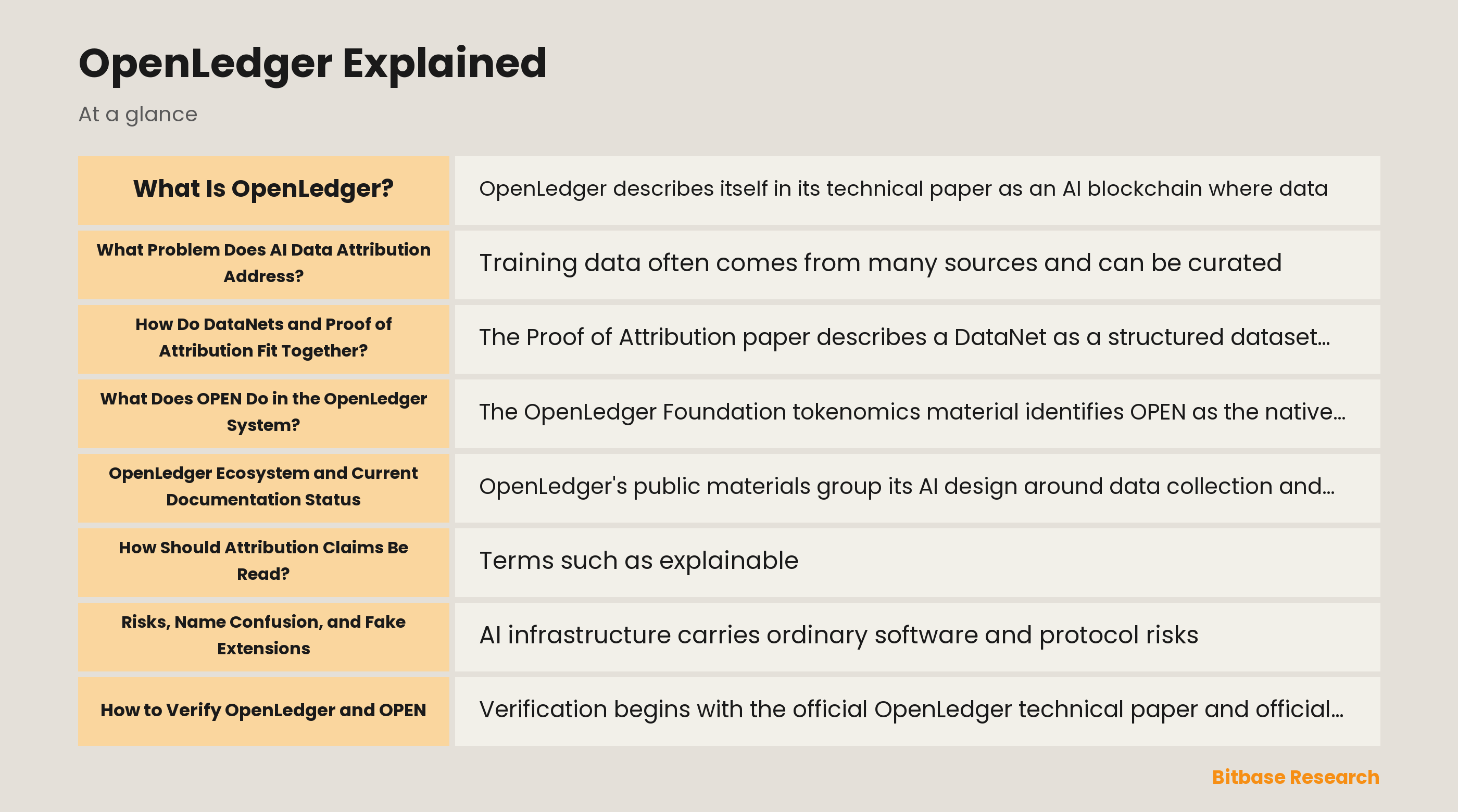
OpenLedger describes itself in its technical paper as an AI blockchain where data, models, and intelligent agents can be recorded in a common onchain environment. The basic objective is to make the provenance of data used in a model easier to represent and to create a documented link between a model output and data that may have influenced it. Its public product material also uses the names DataNet, Model Factory, and OpenLoRA for parts of that wider AI-oriented design.
That description is architectural. It says how the project frames the relationship among contributors, datasets, models, and inference activity. It does not mean that every AI output can be fully explained, that every dataset is accurate or lawfully usable, or that a provenance record alone establishes a complete account of a model's behavior. Those are separate technical, legal, and governance questions.
OpenLedger's attribution material calls its proposed framework Proof of Attribution. In plain terms, attribution asks whether a system can trace relevant parts of a model result back to data that shaped the model. The project describes this as a way to make data contribution more visible and to connect recorded provenance with a reward design. A project description should keep the word proposed or documented in view because the reliability of an attribution result depends on the model, data, method, and implementation context.
What Problem Does AI Data Attribution Address?
Training data often comes from many sources and can be curated, transformed, combined, or reused before it reaches a particular model version. When a model produces an output, it can be difficult to describe which source material mattered, what the source's rights were, or whether a contribution was useful in that particular context. The OpenLedger paper identifies this lack of traceability and contributor recognition as a central problem for an AI data ecosystem.
An attribution framework can provide a record of declared inputs and a method for assigning a contribution score. It cannot by itself settle whether the original data was truthful, sufficiently representative, licensed for every use, or safe for a given model application. Nor does it replace independent evaluation of a model's accuracy, bias, robustness, privacy properties, or suitability for high-impact decisions.
The distinction matters for AI data attribution. A record that something was registered or associated with a training process is not identical to a legal ownership claim, a guarantee of consent, or a conclusion that a result was caused by a single data item. The value of the system described by OpenLedger lies in the attempt to make provenance and contribution logic more inspectable, while the underlying factual and ethical questions still require their own evidence.
How Do DataNets and Proof of Attribution Fit Together?
The Proof of Attribution paper describes a DataNet as a structured dataset contributed by one or more participants and recorded with associated metadata and timestamps. Models can log training provenance in relation to those DataNets. At the design level, that links a model version to declared data sources and makes the provenance trail available to the attribution process.
For smaller specialized models, the paper discusses influence-function approximations. The intended question is how removing or changing a data point might affect loss for a prediction. For larger language models, the paper describes a suffix-array-based method that compares generated tokens with a compressed representation of training material. These are technical approaches documented by the project, not a universal assertion that every kind of model or data can be attributed with the same precision.
Both approaches involve assumptions. An approximation can be sensitive to model architecture, training procedure, data preparation, sampling, and the way an output is evaluated. Token overlap can reveal a relationship to material in an indexed corpus, but it does not by itself prove authorship, permission, usefulness, or the full causal history of an answer. Readers should understand the difference between a traceable system record and a complete explanation of intelligence.
The project also connects attribution to recorded contributor rewards. That is an economic design linked to the described protocol. It should not be read as a promise that every submitted item will be accepted, used, attributed, or rewarded, or that a recorded score will remain unchanged as rules and implementations evolve.
What Does OPEN Do in the OpenLedger System?
The OpenLedger Foundation tokenomics material identifies OPEN as the native utility token for the OpenLedger AI blockchain. Its documentation describes roles that include network gas, fees connected to AI activity, and a reward mechanism associated with Proof of Attribution. These are the stated functional roles of the ticker OPEN, rather than a claim about a financial return, ownership, or a particular outcome from holding it.
The official utility material connects OPEN with several layers of the described ecosystem, including model activity, data contribution, network operations, and governance-related processes. A role described in token documentation is not the same as confirmation that every feature has the same deployment status or is available in every jurisdiction. It is also not evidence that an individual can obtain a service, receive a reward, or influence a decision.
Token allocation, supply, circulation, contracts, chain support, governance rules, and service fees can change and therefore belong to publication-day checks. This profile intentionally avoids repeating time-sensitive quantities. The enduring editorial point is narrower: official materials present OPEN as an operational utility token tied to the project's AI-data and network design, not as equity in the project or a promise of profit.
OpenLedger Ecosystem and Current Documentation Status
OpenLedger's public materials group its AI design around data collection and curation, model work, inference-related attribution, and an onchain record of provenance. DataNets are the data-focused unit in the paper, while the product overview names Model Factory and OpenLoRA as other pieces of the proposed ecosystem. Together, these descriptions explain the project narrative without proving that every named component has a uniform production status.
The project publishes material through more than one official domain, including the OpenLedger site and OpenLedger Foundation documentation. Their wording, publication date, and scope should be compared at the time an article is published. Older pages, future-oriented statements, and token-launch documentation may describe a different phase from a current interface or service notice.
For that reason, current status should never be inferred from an old technical paper, a search result, a copied logo, or a similarly named service. Confirm the current official project identity, the relevant official channel, any announced chain, and whether a specific product or feature is actually listed as available before converting documentation into a present-tense statement.
How Should Attribution Claims Be Read?
Terms such as explainable, verifiable, and payable AI describe ambitions and design goals in the project's attribution material. They are useful prompts for asking what was recorded, what method was used, and what a score represents. They do not automatically mean that a model's reasoning is fully transparent, that an attribution calculation is error-free, or that a reward rule is fair in every circumstance.
The paper distinguishes technical methods for smaller and larger models, which is a reminder that attribution is method-dependent. A contribution score can be a measure within a chosen system rather than a universal measure of human creativity, data quality, ownership, or social value. Evaluation should consider the limits of the selected method and the records it can actually inspect.
Data provenance also does not eliminate privacy, licensing, or content-quality concerns. Metadata may say where a dataset was recorded, yet it may not answer every question about consent, downstream use, personal information, or quality control. The documented architecture can help organize evidence, but users, builders, and reviewers still need separate policies and technical controls for those issues.
Risks, Name Confusion, and Fake Extensions
AI infrastructure carries ordinary software and protocol risks. Models can produce incorrect or unsuitable output, datasets can be incomplete or misleading, attribution calculations can be disputed, and implementation changes can alter how recorded information is interpreted. Smart contracts, network dependencies, governance decisions, and service availability can also introduce failure points that a project overview cannot remove.
There is a separate identity risk around OpenLedger. Similar names may refer to unrelated products, and a token ticker or project label can be copied in a deceptive message, website, browser extension, application listing, or social-media account. The phrase open ledger extension should therefore be read as a prompt to check identity carefully, not as evidence that a file, extension, install, account request, or authorization is legitimate.
The Foundation's public security notices warn that phishing attempts occur and emphasize official links. A name match, a logo, a search advertisement, a direct message, or a request for credentials does not authenticate a service. This article does not recommend installing software, connecting a wallet, creating an account, or granting any authorization; it only explains why identity verification matters before treating a claim as official.
How to Verify OpenLedger and OPEN
Verification begins with the official OpenLedger technical paper and official Foundation material, which should consistently identify the project and ticker OPEN. Compare the project name, domain, publication context, and token description across those primary sources. A copied article, a promotional account, or a third-party directory is not a substitute for a project-controlled source.
If the project publishes a current onchain identifier in an official announcement, compare the stated contract address with the corresponding block explorer and confirm that the network and ticker agree with the same official record. A contract address from an unaffiliated post, an old page, or an unverified extension should not be assumed to be canonical. Conflicting information is a reason to pause and seek a newer official notice.
Finally, verify the date and scope of every time-sensitive claim. That includes the live status of a component, token parameters, allocation, governance, supported networks, security reviews, and official access channels. These are verification principles for reading public information, not instructions for acquiring a token, using a product, or authorizing a transaction.
Conclusion
OpenLedger is best understood from its first-party materials as an AI-oriented blockchain design focused on data provenance and attribution. Its DataNet and Proof of Attribution descriptions explain how the project proposes to relate datasets, model provenance, and contributor recognition. OPEN is documented as the native utility token within that system.
The most useful boundary is between a documented mechanism and an externally verified outcome. Proof of Attribution does not by itself guarantee model quality, data rights, privacy, security, availability, or fair treatment in every case. Before publication, reconfirm the official identity, current status, chain and contract information if formally announced, and the present wording of OPEN's utility role.
Related market pages
- OPEN: View price · Spot market · Perpetual market
Disclaimer: This article is educational content from Bitbase Academy, provided for information only. It explains what a project does and what role its token plays in that system; it does not constitute investment, trading, tax, or financial advice, and it is neither a recommendation nor an endorsement of any project or token. Bitbase has not carried out due diligence on the project described here, and mentioning it does not mean Bitbase lists or supports the asset. Crypto assets carry significant risk, including price volatility, thin liquidity, smart-contract failure, regulatory uncertainty, and the possible loss of their entire value. Written as of August 2026; a project's status, tokenomics, team, and contracts can change at any time. Verify everything yourself through official channels, the contract address, and a block explorer, and beware of imitation sites and phishing links.
References
[1] Proof of Attribution: Powering Explainable and Payable AI on OpenLedger cdn.openledger.xyz
[2] OpenLedger product overview www.openledger.xyz
[3] OPEN Tokenomics, OpenLedger Foundation docs.openledgerfoundation.com
[4] Utility of OPEN, OpenLedger Foundation docs.openledgerfoundation.com
[5] Launching OPEN on Ethereum, OpenLedger Foundation docs.openledgerfoundation.com
[6] Official eligibility disclaimer and phishing warning, OpenLedger Foundation docs.openledgerfoundation.com