Orderly Network is documented as headless omnichain order-book infrastructure, rather than a single consumer-facing venue or a separate account type.
Orderly Network is a protocol and infrastructure stack intended to let independently branded applications rely on a shared central limit order book and a settlement design. The useful identity distinction is simple: Orderly Network names the underlying network and protocol, while a front end is an independent product that may use that infrastructure. An account record or an order-book record is data within a system, not the protocol itself. This article is explanatory and keeps documented design separate from conditions that can change.
What Is Orderly Network
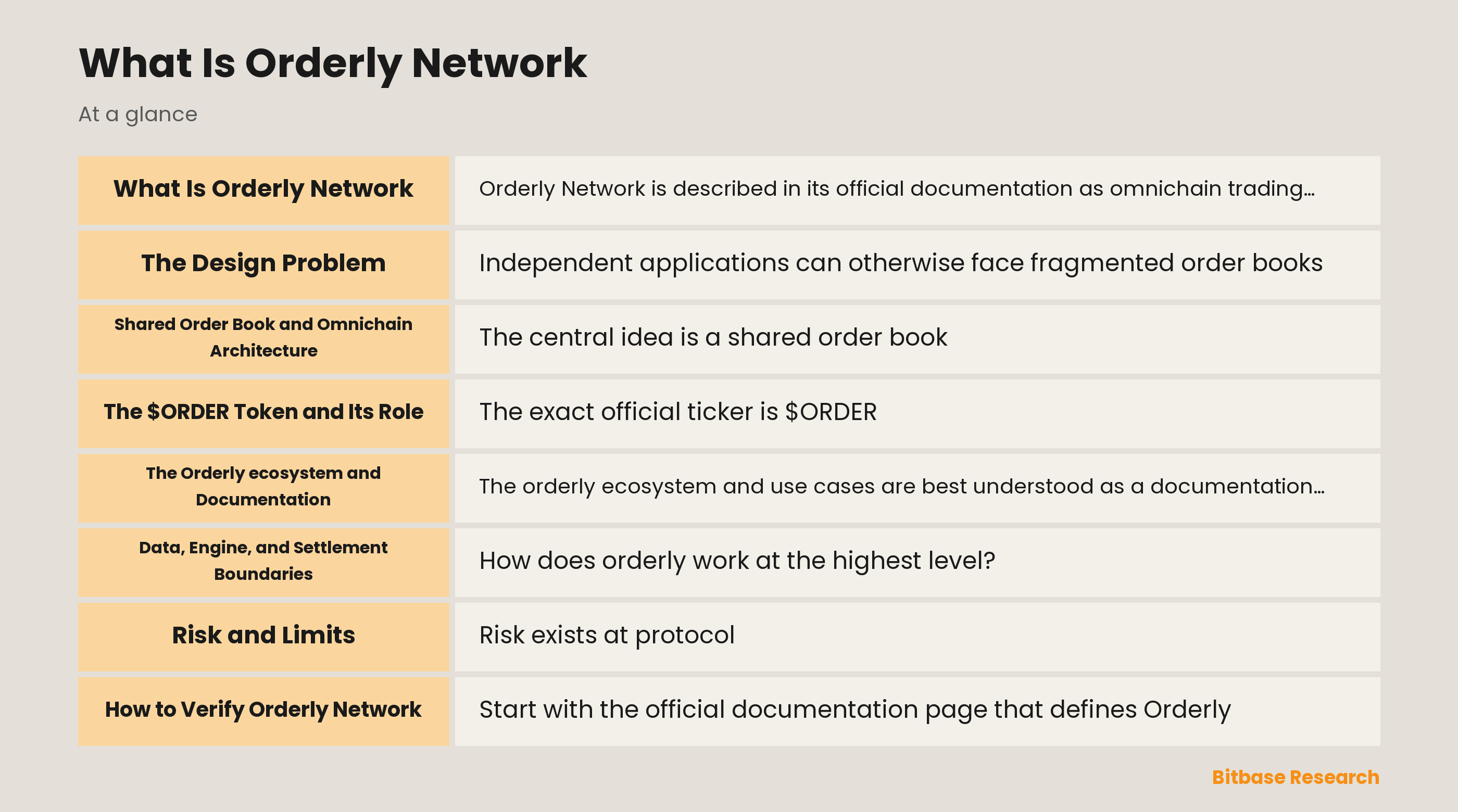
Orderly Network is described in its official documentation as omnichain trading infrastructure. “Headless” means its core role is not to prescribe a single public interface. Instead, the system supplies backend components that other applications can incorporate into their own products. That distinction matters because a name shown in an interface can refer to a builder’s product, whereas Orderly Network refers to the common infrastructure beneath it.
At a conceptual level, the project joins an order-book engine with a settlement layer and connections to supported chains. The documented purpose is to allow orders associated with multiple participating applications to be represented in one shared book rather than in isolated books. This is an architectural description, not a statement about present market depth, availability, or the result any participant will receive.
The Design Problem
Independent applications can otherwise face fragmented order books, duplicated operational stacks, and separate records across networks. A shared-infrastructure design attempts to make matching and record keeping common services instead of requiring each application to operate a completely separate implementation. It does not erase the distinction among applications, their operators, their policies, or the data they display.
The design also separates a high-frequency matching concern from an onchain record concern. Documentation presents that split as a way to organize responsiveness and verifiability in different layers. It should not be read as a promise about latency, price formation, access, legal treatment, or reliability under every condition. Those are current-state or context-dependent questions.
Shared Order Book and Omnichain Architecture
The central idea is a shared order book: participating activity is handled through one common matching environment rather than one book per connected interface. “Omnichain” in this context describes the architecture’s attempt to connect activity originating from more than one supported network to that common environment. It does not mean every chain, asset, application, or jurisdiction is included.
Official architecture materials describe three conceptual layers. An asset layer is associated with supported chains, an engine layer handles order-book and related services, and a settlement layer acts as a transaction ledger behind the scenes. This is a model for explaining responsibilities, not a user-facing sequence or a claim that every component has identical status across every network.
The $ORDER Token and Its Role
The exact official ticker is $ORDER. Official token materials identify $ORDER as the native token of Orderly Network and describe governance and ecosystem-incentive roles for it. $ORDER is not the name of the protocol, a front end, an app chain, an account, or an individual order-book entry; those are distinct concepts even when they appear in the same broader environment.
Token supply, allocation, emission, contract addresses, token formats, supported networks, governance implementation, and any incentive parameters are time-sensitive facts. They are deliberately not stated here as settled publication facts. A publication-day review of the official token overview, distribution material, and address page is needed before presenting any of those details.
The Orderly ecosystem and Documentation
The orderly ecosystem and use cases are best understood as a documentation category, not as an endorsement of every third-party product. Official materials describe builders and other participants around shared infrastructure. A third-party interface can be connected to the network without becoming the protocol itself, and a listing or integration does not establish that the third party is reviewed, safe, permanent, or appropriate for a particular person.
Documentation also changes as products and integrations change. Statements about which applications, networks, instruments, interfaces, or programs exist are therefore publication-day checks, not durable facts for this profile. The same caution applies to descriptions of audits, custody arrangements, reserves, legal terms, geographical restrictions, and current service status.
Data, Engine, and Settlement Boundaries
How does orderly work at the highest level? Official explanations distinguish engine and shared order-book services from onchain settlement records in the settlement layer. Official materials also use names such as operator and Orderly L2 for components in the broader design; their exact current scope and status require a publication-day check in first-party documentation. This division of responsibilities is an engineering description, not proof that any layer is free of failure or discretion.
Data has several boundaries in this model. Order-book, execution, account, and settlement-related information can have different sources, timing, and visibility. A displayed value may depend on indexing or a third party’s presentation, while an onchain record may require interpretation within the relevant contract and network context. A careful description should not collapse those categories into a single claim of finality or completeness.
Risk and Limits
Risk exists at protocol, smart-contract, engine or order-book service, cross-chain messaging, oracle or data, governance, execution, third-party, and regulatory levels. Software defects, operational interruptions, message delays, data errors, market stress, changing parameters, or governance decisions can affect how a system behaves. The presence of an onchain record does not by itself resolve every operational or economic risk.
Third-party risk is particularly important because an independent front end, application operator, data provider, custodian, or integration can add its own policies and dependencies. A project profile should not imply that Orderly Network controls every such party or that a relationship is permanent. Current integrations, product availability, geographic eligibility, audit scope, and legal treatment require direct verification at the time of publication.
How to Verify Orderly Network
Start with the official documentation page that defines Orderly, then compare it with the official architecture and order-book design pages. Check whether the documents still describe the same protocol scope, terminology, and layer responsibilities. This is a source-evaluation exercise, not a product-use instruction, and it avoids treating a third-party interface as an authoritative description of the network.
For the token identity, consult the official $ORDER overview and the official token-address material, then use the relevant block explorer only to corroborate a currently published contract address on the stated network. Do not infer a contract address from a ticker, a social post, or a similarly named asset. Contract, network, and token-format information all need a publication-day recheck.
Conclusion
Orderly Network is most accurately described as shared omnichain order-book and settlement infrastructure. Its protocol identity is separate from applications built on it, an app-chain or settlement component, accounts, and individual order-book records. The official ticker associated with the network’s native token is $ORDER, but the token should not be used to redefine what the protocol itself is.
The architecture combines offchain matching concepts with onchain settlement records and cross-network coordination. That model explains the project’s intended division of responsibilities, but it does not guarantee service status, liquidity, execution, security, availability, legality, or any outcome. Those claims require evidence appropriate to the date and jurisdiction.
For publication, retain the identity distinction and recheck all dynamic facts in first-party documentation. In particular, recheck token and contract data, network support, parameters, governance status, audit scope, third-party integrations, custody or reserve assertions, product status, and legal or geographic limits. This produces a clearer profile than treating changing documentation as permanent fact.
Related market pages
- ORDER: View price · Perpetual market
Disclaimer: This article is educational content from Bitbase Academy, provided for information only. It explains what a project does and what role its token plays in that system; it does not constitute investment, trading, tax, or financial advice, and it is neither a recommendation nor an endorsement of any project or token. Bitbase has not carried out due diligence on the project described here, and mentioning it does not mean Bitbase lists or supports the asset. Crypto assets carry significant risk, including price volatility, thin liquidity, smart-contract failure, regulatory uncertainty, and the possible loss of their entire value. Written as of August 2026; a project's status, tokenomics, team, and contracts can change at any time. Verify everything yourself through official channels, the contract address, and a block explorer, and beware of imitation sites and phishing links.
References
[1] Orderly documentation: What is Orderly? orderly.network
[2] Orderly documentation: Building on Orderly orderly.network
[3] Orderly documentation: Orderbook Design orderly.network
[4] Orderly documentation: Overview of $ORDER orderly.network
[5] Orderly documentation: $ORDER Related Smart Contract Addresses orderly.network