OriginTrail is a decentralized knowledge-graph system whose documentation describes a way to publish, locate, relate, and verify digital knowledge records across a peer-to-peer network. For readers asking what is origintrail crypto or simply origintrail crypto, the useful starting point is the DKG mechanism rather than a market label: it combines structured graph data, cryptographic fingerprints, blockchain records, and participating nodes.
What Is OriginTrail?
OriginTrail documents its Decentralized Knowledge Graph, or DKG, as a permissionless peer-to-peer data structure that interlinks Knowledge Assets in a semantic RDF format. A knowledge graph does not merely hold isolated files or database rows. It records entities and explicit relationships, so a record can state how a product, document, organization, location, identifier, or event is connected to another record. The graph format makes those relationships available for structured lookup and interpretation.
A Knowledge Asset is the DKG’s unit for handling a published knowledge record. The official concepts documentation describes it as a combination of graph data, cryptographic proof material, and an identifier called a Uniform Asset Locator, or UAL. The content, the way it is represented, the identifier, and the associated chain record each serve different functions. Seeing a Knowledge Asset as one indivisible “fact” would hide those distinctions.
What Problem Does OriginTrail Address?
Many data workflows make it hard to answer basic provenance questions: which source supplied this record, which version is being used, what relationships give it context, and whether a later copy still matches a prior digital record. A semantic graph can make connections queryable, while a fingerprint can make a selected representation available for integrity comparison. The goal is not to remove judgment from data work; it is to make some aspects of origin, linkage, and change history easier to inspect.
That boundary is especially important for supply-chain provenance or any record that refers to a physical event. A cryptographic fingerprint can help show that a retrieved digital assertion matches the representation anchored by a system, and a provenance trail can show who supplied or updated a record. Neither operation independently observes a shipment, tests a product, verifies a sensor, or proves that every field supplied by a publisher was true. Verifiable record history is useful evidence, but it is not a guarantee of real-world facts.
How Does the OriginTrail DKG Work?
The DKG documentation separates several roles. Graph data supplies structured descriptions and relationships; a peer-to-peer network stores and serves public knowledge records; blockchain components provide identity, ownership-related records, temporal anchoring, and economic coordination. RDF gives the graph a standardized way to express relationships, while query tooling can traverse or select those relationships. These pieces are designed to work together, but they should not be mistaken for the same layer.
In a simplified lifecycle, a publisher prepares a knowledge assertion, represents it as graph data, and associates it with the system’s identifiers and proof material. Network participants can make public material available, and a verifier can retrieve a representation, recalculate the relevant fingerprint, and compare it with the selected chain record. A positive match supports integrity for that comparison. It does not establish that the original input was complete, that the publisher was authorized outside the system, or that a conclusion drawn from the graph is the only reasonable one.
The UAL is meant to help identify and locate a specific Knowledge Asset in the DKG. Documentation also describes blockchain-facing ownership and temporal-state components, including NFT-based implementation for certain asset records. That architecture can preserve a traceable digital reference across updates, but it does not replace ordinary due diligence about who created a record, which chain and contract are involved, what version is being read, or what access restrictions apply to private material.
What Does TRAC Do in the OriginTrail System?
TRAC is the exact ticker used in OriginTrail’s official token documentation. On the documentation checked on 11 August 2026, it is described as the DKG utility token and is associated with publishing fees for Knowledge Assets, staking by Core Nodes and delegators, and reward distribution tied to network availability and performance. The same documentation describes these as economic roles in the network, rather than as a statement about the truth of any Knowledge Asset.
For readers researching origintrail tokenomics and use cases, it is safer to separate the documented functions from unstated assumptions. A token role can coordinate payment, participation, and incentive processes, yet it does not turn a graph record into independently verified reality. It also does not by itself establish a holder entitlement, a governance outcome, a security property, or a future network condition. Any changing parameter or chain-specific implementation should be checked against current primary documentation.
OriginTrail Ecosystem and Adoption Context
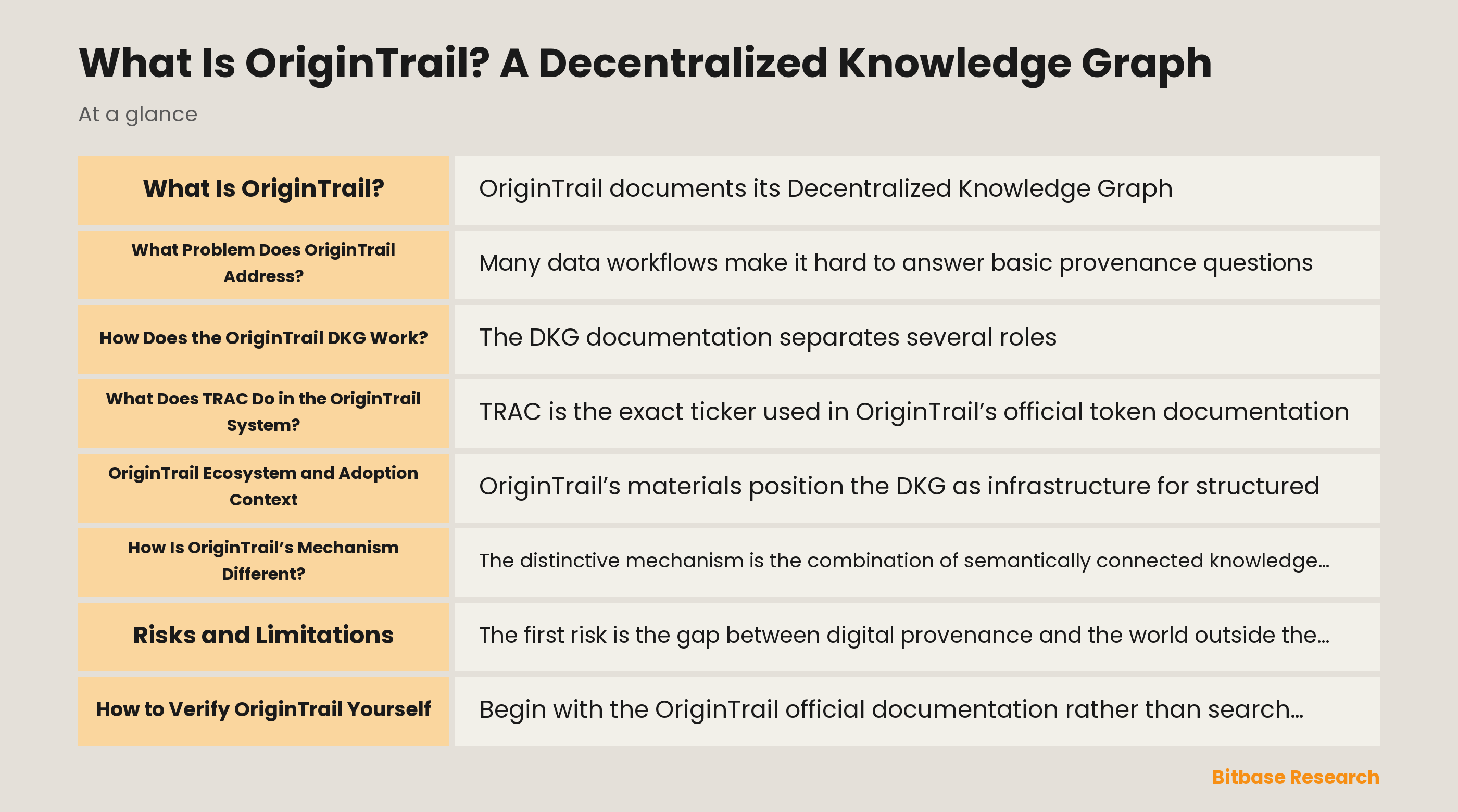
OriginTrail’s materials position the DKG as infrastructure for structured, verifiable knowledge in applications that need context and provenance. The documentation discusses knowledge assets, nodes, graph queries, AI-related use cases, and connected blockchain environments. This is an ecosystem description of components and intended uses, not an independently measured statement about adoption scale, service quality, or the suitability of any particular deployment.
The documentary snapshot matters. The pages reviewed on 11 August 2026 describe a multi-component system whose software, supported chains, operating requirements, and interfaces can evolve. A public repository and documentation page can help a reader inspect design claims, but they do not by themselves show how a particular node is configured, how an integration handles source data, or whether an external organization is currently using the system. Keeping that distinction prevents an example or project statement from becoming an unsupported adoption claim.
How Is OriginTrail’s Mechanism Different?
The distinctive mechanism is the combination of semantically connected knowledge with verifiable digital provenance signals. Graph data supplies the relationship layer; a UAL provides a way to refer to a Knowledge Asset; cryptographic fingerprints provide a comparison method; blockchain records anchor selected states; and network nodes contribute storage, discovery, and service functions. These are complementary roles, so a reader should ask which part of a claim comes from the graph, which part comes from a signature or fingerprint, and which part comes from an external source.
This design does not make semantic links self-validating. A graph can precisely represent a relationship that was incorrectly asserted, incompletely modeled, or interpreted too broadly. A correct fingerprint comparison says that two digital representations correspond in the chosen way; it does not decide whether a supplier description, document classification, or real-world event was accurate. The mechanism therefore makes provenance questions more inspectable while leaving source evaluation and contextual reasoning with people and applications.
Risks and Limitations
The first risk is the gap between digital provenance and the world outside the network. If initial data is misleading, incomplete, unauthorized, or poorly modeled, a durable fingerprint can preserve the record of that input without repairing it. Readers should distinguish integrity of a recorded representation from truth, completeness, legal effect, or quality of the underlying subject. This is not a flaw unique to one system; it is a limit of what cryptographic record comparison can test.
A second risk concerns availability, privacy, and implementation boundaries. Public and private knowledge material can have different access and replication properties, while node operation, query behavior, network configuration, and chain selection can affect what is reachable and how it is interpreted. Documentation may describe a protocol goal, but an individual application can add its own data models, permissions, dependencies, and failure points. The relevant evidence is therefore the exact version, network, contract, and deployment being examined.
There are also ordinary software and coordination risks. Smart contracts, node software, gateways, governance processes, token-related parameters, and third-party integrations can change or contain defects. This article does not infer a project-wide audit status from public documents or repositories. A reader assessing a concrete system should seek current official technical material, independently check the applicable contract and chain record, and treat security claims as needing their own evidence.
How to Verify OriginTrail Yourself
Begin with the OriginTrail official documentation rather than search advertisements or look-alike domains. Read the DKG overview and key-concepts pages, then compare the described Knowledge Asset, UAL, and fingerprint process with the implementation materials that are relevant to the version under review. For the token identity example, the official Base documentation publishes a TRAC contract address; compare its chain label and full contract address with a read-only block explorer before treating a token record as relevant.
Next, inspect the context of a specific Knowledge Asset rather than relying on a name alone. Check the publisher or source attribution where available, the time or state being referenced, the graph relationships used to reach a conclusion, and whether the record is public or subject to another access model. When a fingerprint check is available, understand exactly which representation was compared. A match can support integrity of that representation, not the broader truth of everything someone says about it.
Finally, keep verification read-only and scoped. Compare official documentation dates, release or repository information, chain identifiers, contract records, and source provenance without approving transactions, granting permissions, or following pages that ask for credentials. If a claim cannot be tied to a primary source or a clearly identified record, label it as unverified instead of filling the gap with a familiar story.
Conclusion
OriginTrail is best understood as a system for organizing knowledge records into a semantic graph with identifiers, peer-to-peer availability, and cryptographic provenance signals. Its DKG architecture can make relationships, selected record states, and source trails more inspectable. TRAC has documented roles in the system’s publishing and participation mechanics, but those roles should be kept separate from the evidentiary status of any individual knowledge record.
The practical takeaway is to ask layered questions. What data was asserted, by whom, in which representation, at what point in time, on which network, and what exactly can the fingerprint or chain record verify? That method preserves the value of discoverability and provenance while avoiding an unsupported leap from a well-formed digital record to a guaranteed real-world fact.
Related market pages
- TRAC: View price · Spot market
Disclaimer: This article is educational content from Bitbase Academy, provided for information only. It explains what a project does and what role its token plays in that system; it does not constitute investment, trading, tax, or financial advice, and it is neither a recommendation nor an endorsement of any project or token. Bitbase has not carried out due diligence on the project described here, and mentioning it does not mean Bitbase lists or supports the asset. Crypto assets carry significant risk, including price volatility, thin liquidity, smart-contract failure, regulatory uncertainty, and the possible loss of their entire value. Written as of August 2026; a project's status, tokenomics, team, and contracts can change at any time. Verify everything yourself through official channels, the contract address, and a block explorer, and beware of imitation sites and phishing links.
References
[1] OriginTrail Decentralized Knowledge Graph (DKG) docs.origintrail.io
[2] OriginTrail DKG Key concepts docs.origintrail.io
[3] OriginTrail $TRAC token docs.origintrail.io
[4] OriginTrail Base Network (L2) TRAC contract documentation docs.origintrail.io
[5] OriginTrail/dkg public implementation repository github.com