Particle Network presents chain abstraction as a way to make a multi-network environment feel more coherent without hiding the technical responsibilities that still exist.
Particle Network is infrastructure for chain abstraction, a design that aims to reduce the fragmentation people encounter when accounts, balances, execution environments, and network fees are spread across separate chains. This explainer examines particle network through the distinctions in its official documentation: Universal Accounts, Universal Liquidity, Universal Gas, and the documented role of PARTI. The question how does particle work is best answered by keeping those components separate rather than treating a unified interface as a single technical system.
What Is Particle Network?
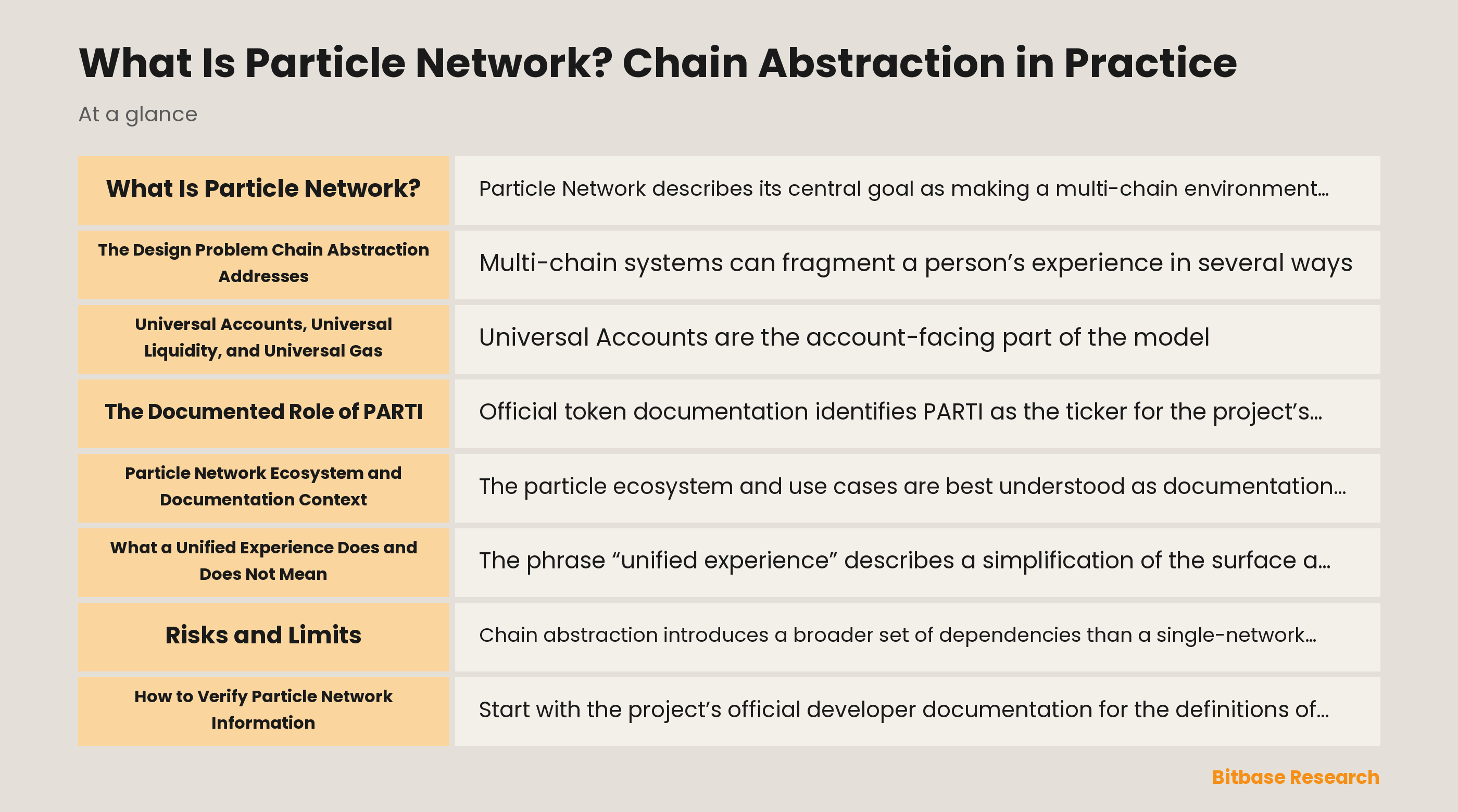
Particle Network describes its central goal as making a multi-chain environment easier to use through chain abstraction. In that model, a person or application can encounter a more unified account and balance context even when execution and settlement involve more than one network. The project’s terminology is important: it is not simply a name for moving data between chains, but a coordinated approach to account representation, liquidity handling, and fee handling.
The useful starting point is therefore architectural. Separate blockchains retain their own execution rules, finality processes, assets, and technical assumptions. Chain abstraction places a layer above that fragmentation so a request can be expressed against a broader account context. It seeks to reduce the need to reason about each network separately at the moment an authorized operation is prepared, while leaving the underlying networks and their constraints in place.
The Design Problem Chain Abstraction Addresses
Multi-chain systems can fragment a person’s experience in several ways. An account may appear differently across environments, assets may be distributed across locations, and the resource needed to pay a network fee may be distinct from the resource relevant to an intended action. An application also has to account for differences in execution, messaging, confirmation, and settlement. These are not merely presentation problems, because each difference can affect how an authorized operation is constructed and completed.
Particle Network’s documentation frames chain abstraction as an effort to turn those separate concerns into a coordinated flow. The desired result is a more continuous experience across supported contexts, not the removal of the chains underneath. That distinction matters: simplification can reduce visible steps and mental overhead, but it does not make independent networks share one consensus process or erase the conditions that govern execution on each of them.
Universal Accounts, Universal Liquidity, and Universal Gas
Universal Accounts are the account-facing part of the model. The developer documentation describes them as smart-account deployments coordinated across chains, intended to present one account and one balance context. In practical terms, that layer is about representation and authorization: it gives a request a consistent account identity and a way to be evaluated against an aggregated view. A Universal Account is not, by itself, the pool of resources that makes a cross-chain result possible.
Universal Liquidity is the coordination layer for those resources. The documentation describes a signed intent that can be fulfilled through liquidity sources and solvers on the relevant supported networks, with settlement following the authorized terms. Universal Gas is related but distinct. It addresses network-fee fragmentation by using a fee-coverage mechanism and subsequent settlement rather than requiring the account context to be pre-positioned with a particular native fee resource on every relevant chain. Each label answers a different question: account representation, resource routing, or fee handling.
The Documented Role of PARTI
Official token documentation identifies PARTI as the ticker for the project’s token and describes it in connection with the Particle Chain. The published role links PARTI to Universal Gas and to settlement activity associated with Universal Liquidity. The token material also uses network governance and security terminology when describing the broader system. Those descriptions explain the role the documentation assigns to PARTI within the architecture.
The role description should be kept separate from time-sensitive parameters. Issuance details, distribution arrangements, release conditions, canonical network information, governance processes, and implementation availability require a publication-day recheck. This article deliberately does not present fixed quantities, addresses, schedules, or an assumption that every documented function is active in every context. The stable explanatory point is that PARTI is described as part of the gas and liquidity settlement design, rather than as a substitute for Universal Accounts or Universal Liquidity.
Particle Network Ecosystem and Documentation Context
The particle ecosystem and use cases are best understood as documentation categories, not a promise of universal reach. The developer material explains account abstraction and chain-abstraction concepts, while the token material explains the role assigned to PARTI. Together they outline a stack in which an account layer, a liquidity-coordination layer, a gas layer, and a network-level token role have different responsibilities. Reading those sources side by side prevents a broad word such as “universal” from doing too much work.
An ecosystem description also needs a boundary. It does not establish that every chain, asset type, application, account mode, or execution path is supported. Documentation pages can describe a design and its intended components while the precise coverage varies by release, configuration, and technical route. Supported networks, supported assets, product availability, and integration scope are publication-day recheck items, especially where an article is meant to describe a live technical environment.
What a Unified Experience Does and Does Not Mean
The phrase “unified experience” describes a simplification of the surface a person sees when preparing an authorized action. It does not mean that a valid signature disappears. The authorization still needs to express what may happen and under what terms, and the relevant account context still needs assets sufficient for the authorized outcome and associated costs. The underlying action also still depends on the networks, contracts, routing components, and fee mechanisms involved.
Nor does a unified balance mean that every resource has become physically identical or that every network has adopted the same rules. Universal Liquidity is designed to coordinate across supported contexts, while Universal Gas is designed to reduce fee fragmentation. Those mechanisms can make separate elements work together, but they do not eliminate settlement logic, network finality, or the possibility that a requested path falls outside documented coverage. “Universal” is an architectural aspiration and product term whose actual scope must be checked against current official material.
Risks and Limits
Chain abstraction introduces a broader set of dependencies than a single-network action. Account logic, authorization semantics, cross-chain messaging, solver behavior, liquidity availability, fee coverage, target-chain execution, and settlement all contribute to the result. A problem in any one component can affect timing, completion, or the eventual state observed across networks. The architecture may reduce visible complexity while moving more coordination into infrastructure that must be reliable and correctly configured.
There is also a communication risk. A concise statement such as “one account and one balance” is useful as a product concept, yet it can obscure the difference between a unified view and the separate systems that make it possible. Current support, route availability, token parameters, governance arrangements, security reviews, partner relationships, regional conditions, and legal effects are all publication-day recheck items. The most careful reading treats official documentation as a description of components and boundaries, then verifies the live facts separately.
How to Verify Particle Network Information
Start with the project’s official developer documentation for the definitions of Universal Accounts and chain abstraction. Check whether the language distinguishes account representation from liquidity routing and gas handling. Then consult the official token material for the ticker and the roles attributed to PARTI. Using the documents for their specific subjects is more reliable than inferring token mechanics from an account overview or inferring account behavior from a token page.
For any publication, compare the date and version of the documentation with the facts being stated. Recheck supported networks, assets, account modes, fee arrangements, implementation status, security materials, governance details, legal terms, and canonical token information on the publication day. The verification goal is not to repeat a slogan, but to establish which layer a statement concerns and whether the source still supports it in the current context.
Conclusion
Particle Network’s chain-abstraction model is clearest when its named components remain distinct. Universal Accounts provide the account-facing context, Universal Liquidity coordinates resources across supported routes, and Universal Gas addresses fee handling. PARTI is documented as part of the network’s gas and liquidity-settlement design, with further network-level roles described in the token material.
That separation helps explain both the appeal and the limits of the model. A unified account experience can make a multi-chain environment feel less fragmented, yet authorization, available assets, routing, execution, finality, and settlement still matter. The system coordinates those elements; it does not make their underlying differences vanish.
The practical reading is therefore precise rather than absolute. Treat the official descriptions as an architectural map, use the component names according to their documented functions, and subject changing operational details to a publication-day recheck. That approach preserves the core idea of chain abstraction without overstating its coverage or removing the assumptions on which it depends.
Related market pages
- PARTI: View price · Spot market · Perpetual market
Disclaimer: This article is educational content from Bitbase Academy, provided for information only. It explains what a project does and what role its token plays in that system; it does not constitute investment, trading, tax, or financial advice, and it is neither a recommendation nor an endorsement of any project or token. Bitbase has not carried out due diligence on the project described here, and mentioning it does not mean Bitbase lists or supports the asset. Crypto assets carry significant risk, including price volatility, thin liquidity, smart-contract failure, regulatory uncertainty, and the possible loss of their entire value. Written as of August 2026; a project's status, tokenomics, team, and contracts can change at any time. Verify everything yourself through official channels, the contract address, and a block explorer, and beware of imitation sites and phishing links.
References
[1] Particle Network Developer Docs: Universal Accounts developers.particle.network
[2] Particle Network Developer Docs: Chain Abstraction Technology developers.particle.network
[3] Particle Network Docs: PARTI Token doc.particle.network
[4] Particle Network Docs: PARTI Utility doc.particle.network
[5] Particle Network Whitepaper: PARTI Utility and Purpose whitepaper.particle.network