peaq is documented as a Layer 1 foundation for a machine-oriented economic system, with peaq chain serving as the home chain of the peaq Trust Layer. The useful way to understand it is to separate three different things: a machine identity record, information associated with a machine, and the documented protocol role of the PEAQ native asset. That separation keeps an architectural description from becoming a claim about a particular device, data source, interface, or outcome.
What Is peaq?
peaq’s official documentation describes the project as economic infrastructure for machines. Its current materials place peaq chain beneath peaqOS as the home chain of the peaq Trust Layer. In that framing, the chain is a Layer 1 environment where designated peaqOS contracts live, while the wider stack is intended to support records and coordination relevant to machines and machine-oriented services.
The term DePIN is commonly used for decentralized physical infrastructure networks. In a machine-focused context, that label can cover very different systems: vehicles, sensors, robots, computing equipment, or software acting for those systems. peaq is not the physical infrastructure itself. It is a protocol layer that the official material describes as supporting machine-related identity, reputation, payments, ownership, and service coordination.
That scope matters. A description of peaq’s architecture does not establish that a particular machine is authentic, functioning, authorized, safe, or connected to the network. Nor does it establish the terms of a third-party service that uses the peaq name. The project profile therefore focuses on documented roles and on the questions that still require a current, deployment-specific review.
What Problem Does peaq Aim to Address?
Machine-oriented systems often need a way to distinguish one participant from another, record a relationship or permission, and exchange information across organizational boundaries. Conventional databases can do those jobs within a single operator’s environment, but they do not automatically provide a shared, independently inspectable record across many participants. peaq’s documentation frames its stack as infrastructure for that coordination problem.
The difficulty is not solved by giving every device a label. A persistent identity record, a statement about who may act for it, a reputation-related record, and a data item are different kinds of claims. Each needs a source, scope, update process, and interpretation. Treating them as one thing can make a technical diagram appear more conclusive than the underlying evidence supports.
For this reason, a Layer 1 record should not be read as proof of physical reality. A machine may have an on-chain identifier while an external sensor, operator, application, or service remains responsible for the information associated with it. The value of an inspectable record depends on the protocol rules and the surrounding process; it does not create an unconditional assurance about the physical world.
How Does peaq Work?
The official overview distinguishes peaqOS from the peaq Trust Layer. peaqOS is presented as a higher-level system through which developers and machines can use identity, credit, payment, and tokenization functions. peaq chain is described as the home chain underneath that layer, where the relevant peaqOS contracts reside. This is an architectural division, not a promise that every feature is available in every context.
The same documentation describes state from the home chain as mirroring to satellite chains so that other ecosystems can read it locally. Conceptually, that is a way to distinguish a canonical home record from an additional read context. It does not tell a reader which applications use the feature, whether a particular copy is current, or what permissions apply to a specific contract or interface.
Machine identity and machine data remain separate in this model. An identity record can help identify a participant in a stated protocol context. Data can be associated with that participant through a different service, event, or link. The existence of one does not validate the other, and neither is a reason to treat an unreviewed data feed, device claim, or external application as reliable.
What Does PEAQ Do in the peaq System?
PEAQ is the ticker identified in peaq’s official tokenomics documentation for the network’s native asset. The official material describes native-asset roles connected with fundamental network interactions, security-related protocol design, and governance. Those are documented protocol roles; they are not an instruction to obtain, hold, move, or use the asset through any particular interface.
The phrase “peaq tokenomics and use cases” needs the same distinction. Tokenomics concerns the documented issuance, allocation, and rule framework around the native asset. Use cases concern what a protocol or an application is intended to support. Neither category proves a future state of supply, a permanent governance arrangement, an external service’s conditions, or a result for a person who interacts with a product.
PEAQ also is not a substitute for a machine identity, a data record, or a verified implementation. The official token list distinguishes native and other token representations in a network-specific registry. A ticker alone is not a contract address and should not be used to identify a contract, a wrapped representation, or an external page without matching the current official record and the correct network.
peaq Ecosystem and Use Cases
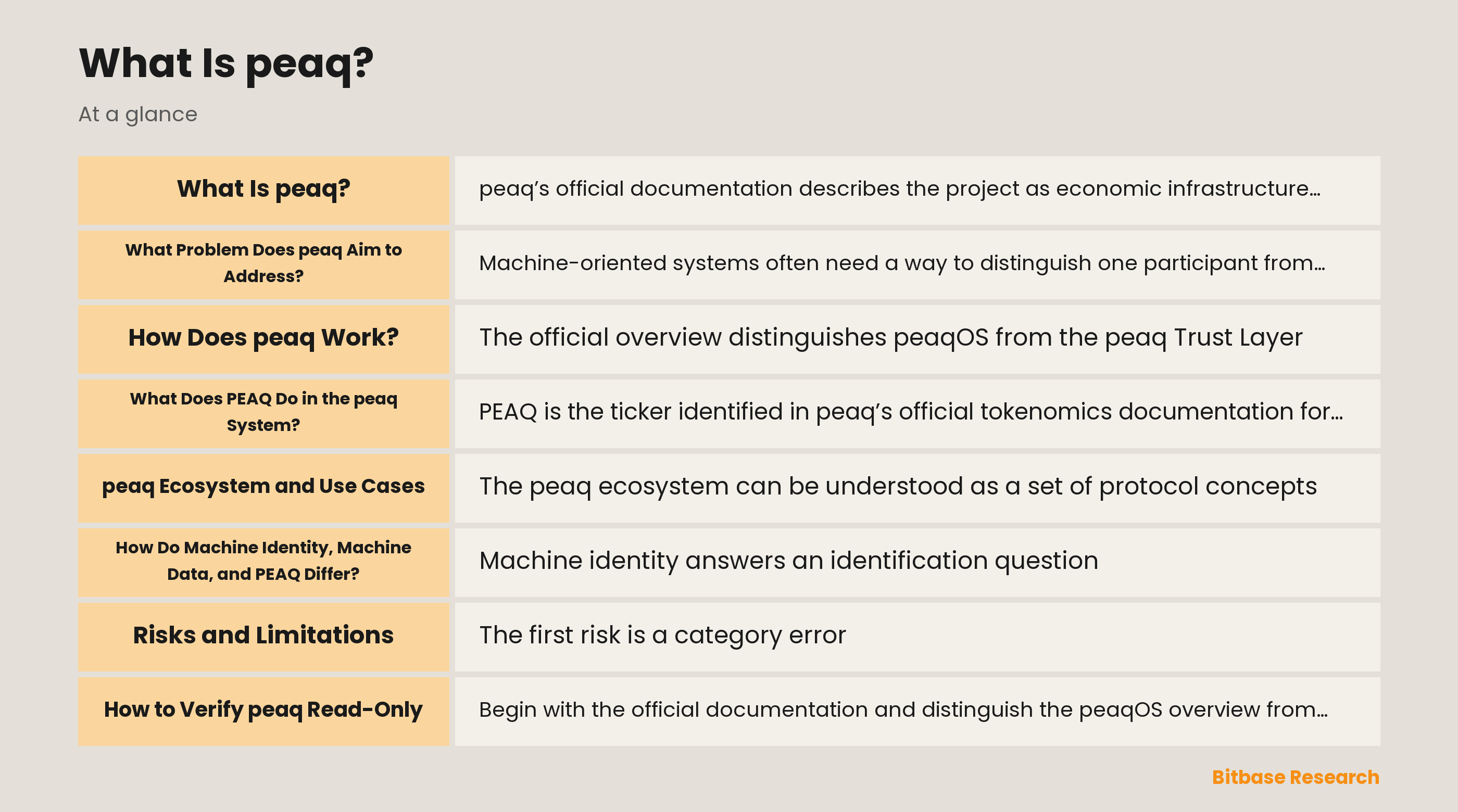
The peaq ecosystem can be understood as a set of protocol concepts, applications, services, and machine-oriented participants that may use the project’s documented infrastructure. The official material names functions such as identity, reputation, payments, machine earnings, ownership, and services. Those categories explain the intended scope of a machine-economy stack; they do not measure adoption, prove the condition of a particular participant, or certify any service.
For readers asking “what is peaq crypto,” the narrow answer is that PEAQ is the official ticker for peaq’s native asset, while peaq itself is a broader infrastructure project. That distinction is important because an asset label, a Layer 1 protocol, a machine identity, and a service built around a machine can all be related without being interchangeable.
How Do Machine Identity, Machine Data, and PEAQ Differ?
Machine identity answers an identification question: which protocol participant is this under the defined rules? It can be useful for associating records with a stated identifier. It does not, on its own, prove that a physical machine exists, that the entity presenting it controls it, or that every action attributed to it occurred as represented.
Machine data answers a different question: what information is being associated with the participant, where did it come from, and under what conditions should it be interpreted? A data link may be useful for coordination or inspection, but it still requires attention to provenance, timing, completeness, and the rules that determine who may submit or change it. A chain record cannot independently certify an off-chain measurement.
PEAQ is different again. It is the native asset whose role is described in the project’s tokenomics material. It does not make a data statement true or turn an identity record into a hardware attestation. Keeping these functions distinct is a practical safeguard against confusing an architecture’s intended components with evidence about a machine, a dataset, or an external service.
Risks and Limitations
The first risk is a category error. A project can document a mechanism for identities, records, or coordination while a reader assumes it guarantees a physical fact. The source of a data item, the authority behind an identity assignment, and the conditions of an application all need separate scrutiny. A protocol description is not a conclusion about any individual device or organization.
Technical and governance conditions are also variable. Software versions, contract permissions, upgrade paths, third-party dependencies, network configuration, and the availability of supporting services can change. A general documentation page cannot demonstrate the current code, review history, access control, or operational condition of a specific deployment. These limitations are especially relevant where a claim depends on a particular address, interface, or machine-related record.
Token-related facts need the same care. The official documentation contains supply and inflation material, but numerical schedules, allocations, governance parameters, and the status of a token registry are date-sensitive. They should be checked from the current official source at publication time. This article makes no prediction, recommendation, or claim about any economic result.
How to Verify peaq Read-Only
Begin with the official documentation and distinguish the peaqOS overview from the peaq chain introduction. Check the domain, page title, date context, and whether a statement describes an existing component, a planned function, or a broad concept. Then match each claim to the page that actually supports it rather than relying on a repost, a similarly named project, or an undated summary.
For the native asset, confirm that the current official tokenomics page still identifies the ticker as PEAQ. Then compare the project’s current token list with the relevant network. Where an official record identifies a contract address or a network-specific representation, compare it read-only with the matching block explorer. Verify the network name, asset label, and visible implementation information where available; do not infer any of them from a search result.
If an identity, data, or service claim matters, ask what exactly is being verified. A protocol record can be checked for its existence and stated fields, but the origin of an off-chain fact may require separate evidence. A mismatch in source, date, network, contract address, or permissions is a reason to stop and seek current clarification, not a gap to fill with an assumption.
The Bottom Line
peaq is best understood as a documented Layer 1 and trust-infrastructure stack for machine-oriented coordination. Its architecture distinguishes a home-chain record layer from higher-level peaqOS functions, and it is intended to support concepts such as identity, reputation, payments, ownership, and services. That description explains a proposed role without proving a particular machine, application, or data source.
PEAQ is the official ticker for the project’s native asset and has documented protocol roles that are separate from device identity and data. The reliable next step for any specific claim is a current, read-only review of the matching official page and network record, with supply, inflation, contract, deployment, and permissions facts checked again on the publication date.
Related market pages
- PEAQ: View price
Disclaimer: This article is educational content from Bitbase Academy, provided for information only. It explains what a project does and what role its token plays in that system; it does not constitute investment, trading, tax, or financial advice, and it is neither a recommendation nor an endorsement of any project or token. Bitbase has not carried out due diligence on the project described here, and mentioning it does not mean Bitbase lists or supports the asset. Crypto assets carry significant risk, including price volatility, thin liquidity, smart-contract failure, regulatory uncertainty, and the possible loss of their entire value. Written as of August 2026; a project's status, tokenomics, team, and contracts can change at any time. Verify everything yourself through official channels, the contract address, and a block explorer, and beware of imitation sites and phishing links.
References
[1] peaq documentation home (official documentation) docs.peaq.xyz
[2] What is peaq chain (official documentation) docs.peaq.xyz
[3] Tokenomics (official documentation) docs.peaq.xyz
[4] Token List (official documentation) docs.peaq.xyz