Plume Network is documented as a public, EVM-compatible blockchain focused on real-world assets, with a design that connects onchain records to issuer, identity, and data-oriented processes.
The search phrases plume network ecosystem and use cases, plume network staking, and how does plume network work identify common questions, but they are not evidence that a particular feature is current, permitted, or suitable in a particular situation.
This profile explains the limits of Plume's published RWA design. It distinguishes a documented onchain mechanism from the separate legal, operational, and factual arrangements that determine what an asset representation actually means.
What Is Plume Network?
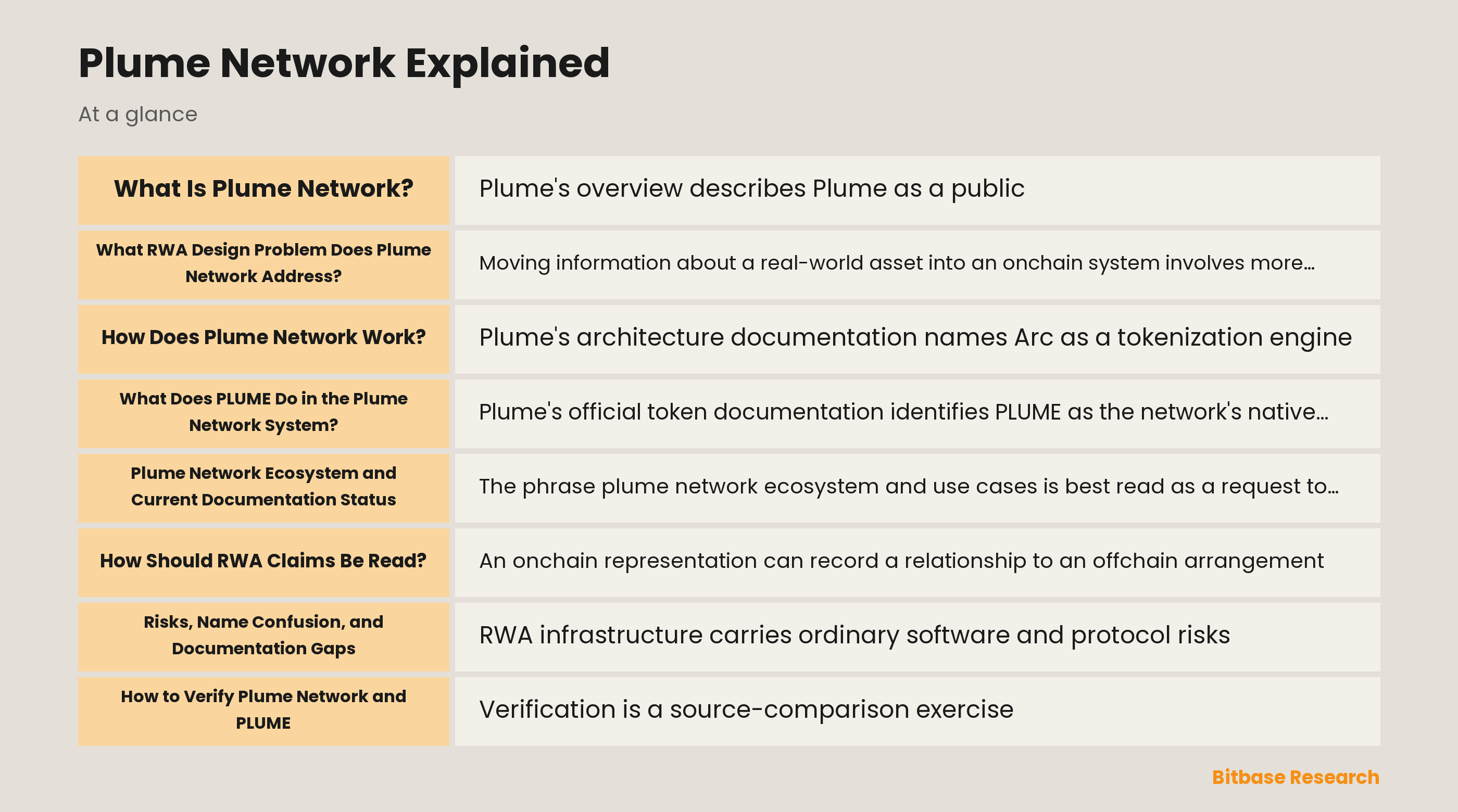
Plume's overview describes Plume as a public, EVM-compatible blockchain built for real-world assets, often shortened to RWAs. Its materials use the broader term RWAfi for an ecosystem thesis in which blockchain records, tokenized representations, and applications are designed to work together.
That description identifies a technical and ecosystem focus. It does not turn every token on the network into the underlying real-world item, and it does not determine the rights attached to any particular representation. Those matters depend on the asset issuer, the relevant legal documents, recordkeeping, custody arrangements where applicable, and the jurisdiction involved.
An RWA can refer to a digital representation associated with something outside a blockchain, such as an economic or contractual interest, a physical item, or a data-derived reference. The label alone does not establish title, enforceability, eligibility, or the scope of any right. A useful reading therefore starts with the project architecture and then keeps the offchain arrangement separate.
What RWA Design Problem Does Plume Network Address?
Moving information about a real-world asset into an onchain system involves more than writing a token to a ledger. An issuer may need a way to describe the asset, link relevant records, manage who may hold or receive a representation, and align the onchain record with applicable obligations outside the chain.
Plume's published materials frame its architecture around tokenization, identity, compliance-oriented components, and real-world data. In that context, the design problem is how a blockchain can provide common rails for asset representations while leaving asset-specific terms and legal relationships to the parties and frameworks that govern them.
The official asset-tokenization material discusses converting legal and economic claims connected to an underlying asset into composable smart-contract representations. That is a description of a possible issuance design, not a finding that every token has the same legal effect or that an onchain entry alone settles an offchain dispute.
How Does Plume Network Work?
Plume's architecture documentation names Arc as a tokenization engine, Passport as an identity and account-oriented component, and Nexus as a real-world data layer. These names describe a proposed or documented stack for connecting asset information and related controls with blockchain applications.
At a high level, an asset representation can be associated with smart-contract rules and recorded data, while an issuer may define the terms that govern it. The record can make specified information machine-readable, but it cannot independently verify every fact about an offchain asset, the authority of an issuer, or the continuing accuracy of associated data.
The identity-verification documentation also describes mechanisms through which asset issuers may apply checks for particular restricted assets. Its wording includes future-facing and configuration-specific statements. Those statements document a design path; they do not establish that a particular identity provider, check, restriction, or asset-issuance route is active for every case.
What Does PLUME Do in the Plume Network System?
Plume's official token documentation identifies PLUME as the network's native utility token. The source describes functional roles connected to network fees and governance-related processes. This is a description of a ticker and its documented utility framing, not an ownership claim in Plume or an assertion of a result for a holder.
Token parameters, supported environments, governance arrangements, and the live scope of any function can change. For that reason, this profile does not repeat time-sensitive quantities or turn a token page into a statement about present availability, security, legal treatment, or any financial outcome.
The phrase plume network staking is included here only because it is a common search query. It is not an instruction, a participation prompt, or evidence that any particular function, condition, or outcome applies.
Plume Network Ecosystem and Current Documentation Status
The phrase plume network ecosystem and use cases is best read as a request to map documented roles, not as a list of assured services. Plume's materials describe an RWA-oriented ecosystem involving asset representation, issuer tooling, identity-related controls, and data integration. Different applications or asset issuers can have materially different terms and restrictions.
The documentation names Arc, Passport, and Nexus, while some pages use future-oriented language such as coming soon or describe features in a planned context. That makes publication date, page scope, and exact wording important. A component named in an architecture page should not automatically be characterized as uniformly live or available.
An official Plume Genesis post dated June 2025 recorded a public-mainnet launch announcement. That historical announcement does not by itself establish the current status of every application, integration, rule set, or access condition. Current documentation must be checked in its own publication context.
How Should RWA Claims Be Read?
An onchain representation can record a relationship to an offchain arrangement, but it is not automatically the arrangement itself. For a real-world asset, the relevant legal and economic meaning may depend on issuer documentation, corporate or contractual records, custody or administration arrangements, and applicable law.
Plume's asset-tokenization documentation discusses regulatory distinctions and restrictions, including examples associated with U.S. offerings. Those examples are educational material about a framework. They do not decide an asset's classification, establish legal compliance, or replace the analysis required for a specific issuer, asset, jurisdiction, or participant.
Transfer controls and identity-related checks can be part of a documented issuance design. Their presence does not prove that every transfer is permitted, that every check is accurate, or that an asset representation carries a universally enforceable right. A chain-level record and an offchain legal relationship must be assessed as related but separate evidence.
Risks, Name Confusion, and Documentation Gaps
RWA infrastructure carries ordinary software and protocol risks. Smart-contract logic can contain faults, data can be delayed or inaccurate, and a change in a component or governance arrangement can change how a record is interpreted. Cross-system dependencies can create additional failure points.
There are also asset-specific risks. A representation may be incomplete, may depend on information not visible onchain, or may be subject to issuer terms, recordkeeping errors, legal limits, disputes, and jurisdictional differences. No onchain label by itself establishes security, legal compliance, liquidity, an audit conclusion, availability, or a positive result.
Name confusion is another risk. A similar name, copied branding, stale page, or unaffiliated message is not proof of a genuine project source. Treat conflicting or incomplete documentation as a reason to withhold a conclusion until the current first-party material can be compared.
How to Verify Plume Network and PLUME
Verification is a source-comparison exercise. Current first-party overview, architecture, asset-issuance, identity, and token materials should identify the same project, use consistent terminology, and make clear whether a statement describes a live feature, a historical announcement, or a future design.
When an official Plume publication identifies a contract address, the corresponding block explorer record can be compared with that same official publication, its stated network, and the ticker PLUME. An address from an unaffiliated page, copied message, or obsolete document should not be treated as canonical merely because it looks plausible.
The date and scope of every variable claim matter, including product status, identity controls, transfer restrictions, token parameters, security information, legal notices, and official channels. This is a way to evaluate public documentation, not a guide to acquire an asset or use a service.
Conclusion
Plume Network is best understood from its official materials as RWA-focused blockchain infrastructure with documented components for asset representation, identity-related controls, and data integration. PLUME is the stated native utility ticker within that network design.
The essential boundary is between a documented mechanism and an externally established outcome. An onchain representation is not by itself proof of real-world ownership, permission, legal compliance, asset quality, or continued availability. Publication should follow a fresh check of the relevant official record and its specific scope.
Related market pages
- PLUME: View price · Spot market · Perpetual market
Disclaimer: This article is educational content from Bitbase Academy, provided for information only. It explains what a project does and what role its token plays in that system; it does not constitute investment, trading, tax, or financial advice, and it is neither a recommendation nor an endorsement of any project or token. Bitbase has not carried out due diligence on the project described here, and mentioning it does not mean Bitbase lists or supports the asset. Crypto assets carry significant risk, including price volatility, thin liquidity, smart-contract failure, regulatory uncertainty, and the possible loss of their entire value. Written as of August 2026; a project's status, tokenomics, team, and contracts can change at any time. Verify everything yourself through official channels, the contract address, and a block explorer, and beware of imitation sites and phishing links.
References
[1] Plume overview docs.plume.org
[2] Plume architecture docs.plume.org
[3] Asset Tokenization, Plume Arc docs.plume.org
[4] Identity Verification, Plume Arc docs.plume.org
[5] PLUME token documentation docs.plume.org
[6] Plume Genesis official launch announcement plume.org
[7] RWA Academy: securities and onchain representation plume.org