POKT Network is described in its official documentation as a decentralized open data-delivery protocol. The useful answer to “what is pokt network” is therefore about how a data request is coordinated, recorded, and checked: relays carry requests, sessions define temporary assignments, suppliers serve data, and claims with proofs connect off-chain work to protocol settlement. This is a systems explanation, not a guide to interacting with a service or an assertion about a live deployment.
What Is POKT Network?
POKT Network is a protocol-oriented framework for delivering data. Its official material presents it as an open, decentralized data-delivery network, with blockchain RPC requests as a common example of the information that can be delivered. The central idea is not that every source of data behaves identically, but that a protocol can coordinate distinct roles around a request rather than relying on one operator to define the whole path.
In the documented model, an application needs information, a gateway can route the request, and a supplier provides a response from a service it supports. These labels describe separate responsibilities. They should not be collapsed into a claim that every application, gateway, or supplier has the same software, permissions, reliability, or current availability.
A relay is the protocol term for a data request and its response. That definition is useful because it keeps the discussion concrete: the network is concerned with delivering data and accounting for that delivery. It does not turn a general architectural description into a guarantee about any individual data result, interface, or external system.
What Problem Does POKT Network Address?
Many blockchain applications need a way to obtain chain data or submit a query to a chain-facing service. When that access depends on a narrowly controlled delivery path, an outage, policy change, or technical fault in that path can affect the applications relying on it. POKT Network’s documentation frames decentralized data delivery as a way to coordinate that dependency through protocol roles and recorded rules.
The design separates who needs data from who supplies it and from the layer that routes a request. This separation matters analytically. A gateway’s routing role is different from a supplier’s data-serving role, and both are different from the protocol’s record and validation functions. Describing those functions separately makes the architecture easier to inspect than treating “decentralized” as a single property.
The project’s documentation also discusses data services beyond a single blockchain context. That wider framing is a scope statement, not a prediction that a particular service is currently available or suitable for a particular task. Current service definitions, implementations, and conditions must be checked from current official material when they matter.
How Does POKT Network Deliver Data?
At a high level, a relay begins when an application needs data for a defined service. A gateway can direct that relay toward suppliers assigned to the relevant session, and a supplier returns the response. The protocol’s role is to make the assignment and later accounting process legible through rules rather than through one central scheduler.
A session is a bounded period that links an application, a service, and a set of suppliers. Official technical documentation describes this assignment as deterministic from relevant protocol inputs. That characteristic explains why session membership can be evaluated against protocol state, but it does not by itself establish the quality or meaning of the data returned by a given supplier.
The documented flow also distinguishes immediate data delivery from later settlement. During a session, a supplier can keep cryptographic records associated with the relays it serves. Those records are relevant later when work is represented to the protocol. This article describes the mechanism only; it does not provide instructions for configuring, operating, or submitting anything.
What Does POKT Do in the System?
POKT is the ticker used by the project’s official token documentation for the protocol’s native token. In the documented system, POKT is connected to protocol accounting and settlement among defined roles. This is a functional description of a protocol component, not a statement about an external listing, a particular asset record, or a personal financial decision.
The important distinction is between the token’s documented system role and a live numerical parameter. Official material describes settlement after valid claims and proofs, but the exact rates, distributions, and other parameters can change. This profile intentionally does not state a supply figure, a settlement ratio, a fee amount, or any other time-sensitive quantity.
The ticker also does not identify a contract address on its own. Similar labels can appear in unrelated contexts, and a project name does not authenticate a third-party page. When a network-specific record matters, the relevant official source and the matching chain record need to agree before the label should be treated as meaningful.
POKT Network Ecosystem and Documented Uses
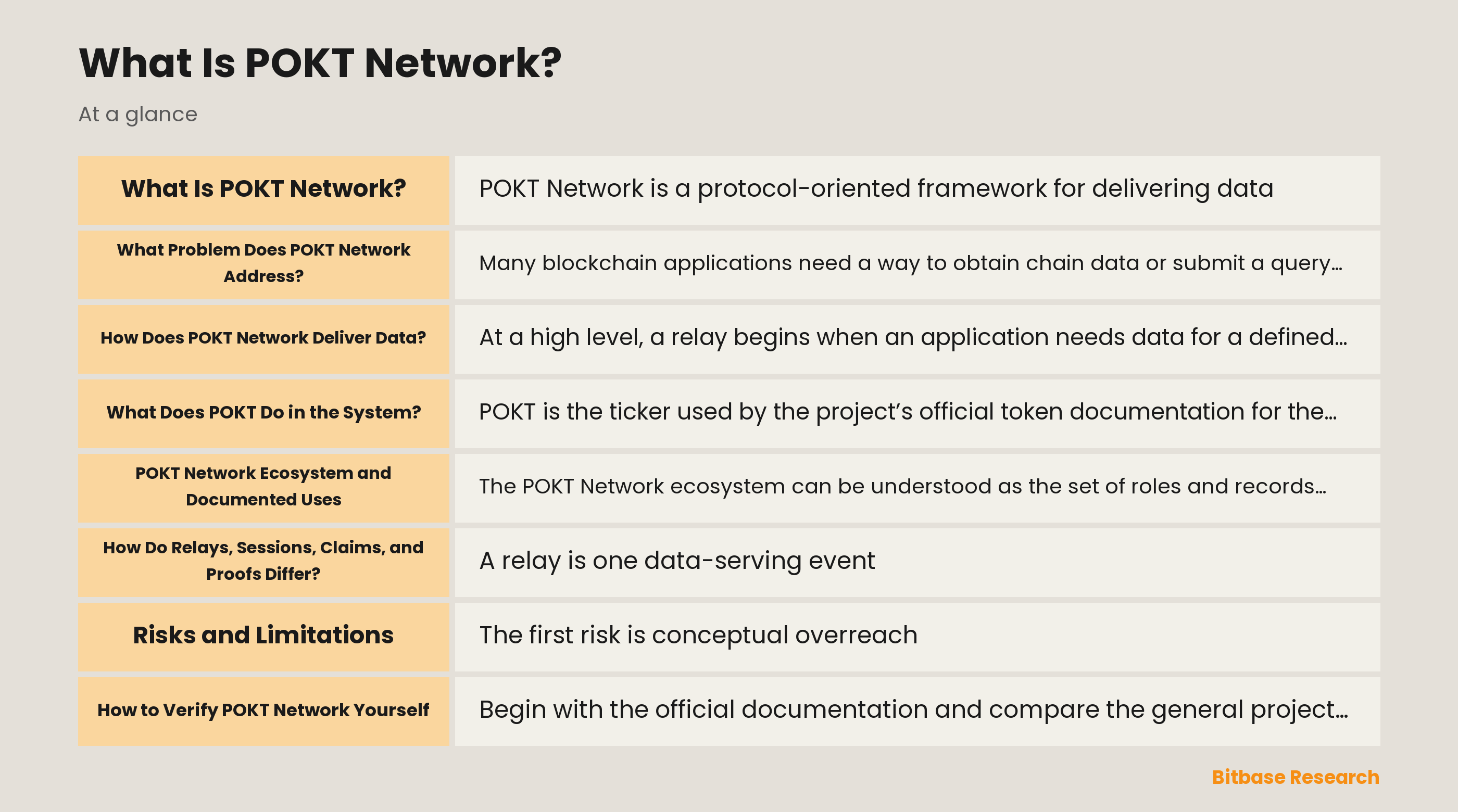
The POKT Network ecosystem can be understood as the set of roles and records named in the protocol material: applications that seek a service, gateways that can coordinate routing, suppliers that serve data, service definitions, and protocol contributors. This is an architectural scope, not an adoption count or an endorsement of a particular integration.
The most familiar documented use is delivery of blockchain RPC data, but the official description treats the architecture as data-oriented more broadly. That point explains the project’s design vocabulary without turning it into a setup guide. Whether a specific service is supported, how it is configured, and what its current limits are are separate questions that require current verification.
An ecosystem label should not erase boundaries between independent participants. A gateway, supplier, application, and service definition can have different code, governance, and operational conditions. The right reading is that the protocol describes how they may relate in a data-delivery flow, not that every participant inherits a shared security posture or a common guarantee.
How Do Relays, Sessions, Claims, and Proofs Differ?
A relay is one data-serving event: a request and the corresponding response. A session is a time-bounded protocol context that associates an application and a service with selected suppliers. A claim is a supplier’s structured statement about work represented for that session, while a proof is cryptographic evidence related to the claim that the protocol can evaluate.
These terms occur at different stages. Relays concern delivery; sessions provide the assignment context; claims summarize work after that context; and proofs support the protocol’s validation before settlement. Keeping the sequence clear prevents a common overstatement: a claim is not the same thing as a completed validation, and a proof mechanism is not a blanket assurance about every off-chain component.
The official technical material describes a commit-and-reveal style relationship between a recorded claim and a later proof. That explains why the protocol can check evidence without recording every data event directly on-chain. It remains necessary to examine the current version, parameters, and scope of the mechanism before making any deployment-specific conclusion.
Risks and Limitations
The first risk is conceptual overreach. “Decentralized data delivery” describes a protocol design, not a promise that every response is correct, timely, private, or continuously available. Data sources, gateways, suppliers, client code, service definitions, and protocol versions can each introduce conditions that a high-level overview cannot settle.
There are also implementation and governance risks. Session rules, proof-selection details, economic parameters, access policies, software releases, and the set of supported services can change. A statement that accurately describes one version of documentation may become incomplete when the protocol or a related deployment changes, so date and scope are material parts of any review.
Identity and record-matching risks matter as well. A name or ticker alone cannot establish that an external interface, contract record, or chain is official. When a specific record is relevant, compare the current official context, the network name, and read-only technical information. If those elements conflict, the safe conclusion is that the claim has not yet been verified.
How to Verify POKT Network Yourself
Begin with the official documentation and compare the general project description with the pages covering sessions, claims, proofs, tokenomics, and terminology. Check the domain, the page context, and whether wording describes a current mechanism, a configurable parameter, or a historical change. This distinguishes a primary source from an unverified repost or a stale summary.
Confirm that the current official material still uses POKT for the protocol role being discussed. Do not infer a contract address from a label, a search result, or a social post. If an official source identifies a network-specific record, compare it read-only with the matching block explorer, including the network context and any disclosed implementation relationship.
For a technical statement, match each sentence to the narrowest supporting source. The project overview supports the role-level description, while the sessions and proofs material supports the lifecycle explanation. A mismatch in version, network, page date, or terminology is a reason to pause and obtain current clarification rather than fill the gap with an assumption.
The Bottom Line
POKT Network is most clearly understood as a documented protocol for decentralized data delivery. Its vocabulary separates the data event called a relay from the session that provides assignment context, the claim that represents work, and the proof used in validation. That separation explains the design without treating it as a guarantee about a live service.
POKT is the project’s documented native-token ticker and has a system role in protocol accounting. Current parameters, service scope, software status, and network-specific records remain changeable facts. A careful reader should verify the exact current official source and matching read-only record for any claim that goes beyond this architectural overview.
Related market pages
- POKT: View price
Disclaimer: This article is educational content from Bitbase Academy, provided for information only. It explains what a project does and what role its token plays in that system; it does not constitute investment, trading, tax, or financial advice, and it is neither a recommendation nor an endorsement of any project or token. Bitbase has not carried out due diligence on the project described here, and mentioning it does not mean Bitbase lists or supports the asset. Crypto assets carry significant risk, including price volatility, thin liquidity, smart-contract failure, regulatory uncertainty, and the possible loss of their entire value. Written as of August 2026; a project's status, tokenomics, team, and contracts can change at any time. Verify everything yourself through official channels, the contract address, and a block explorer, and beware of imitation sites and phishing links.
References
[1] Pocket Network Documentation (official) docs.pocket.network
[2] About Pocket Network (official documentation) docs.pocket.network
[3] Sessions, Claims & Proofs (official documentation) docs.pocket.network
[4] POKT Tokenomics (official documentation) docs.pocket.network
[5] Token overview (official documentation) docs.pocket.network
[6] Glossary (official documentation) docs.pocket.network