POND is Marlin's documented utility asset. Marlin is the verifiable-computing protocol, Oyster is its TEE-based compute network, and MPond has a distinct node role.
The phrase pond crypto needs a precise subject before it can be useful. In this profile, POND means only the asset documented by Marlin. It is not a generic word, every asset with a similar name, or the unaffiliated name PondCoin. Marlin names the protocol context, Oyster names the TEE-based compute network in current documentation, and POND plus MPond name distinct assets. Separating these labels prevents a familiar ticker or word from becoming a false identity claim.
What Is POND
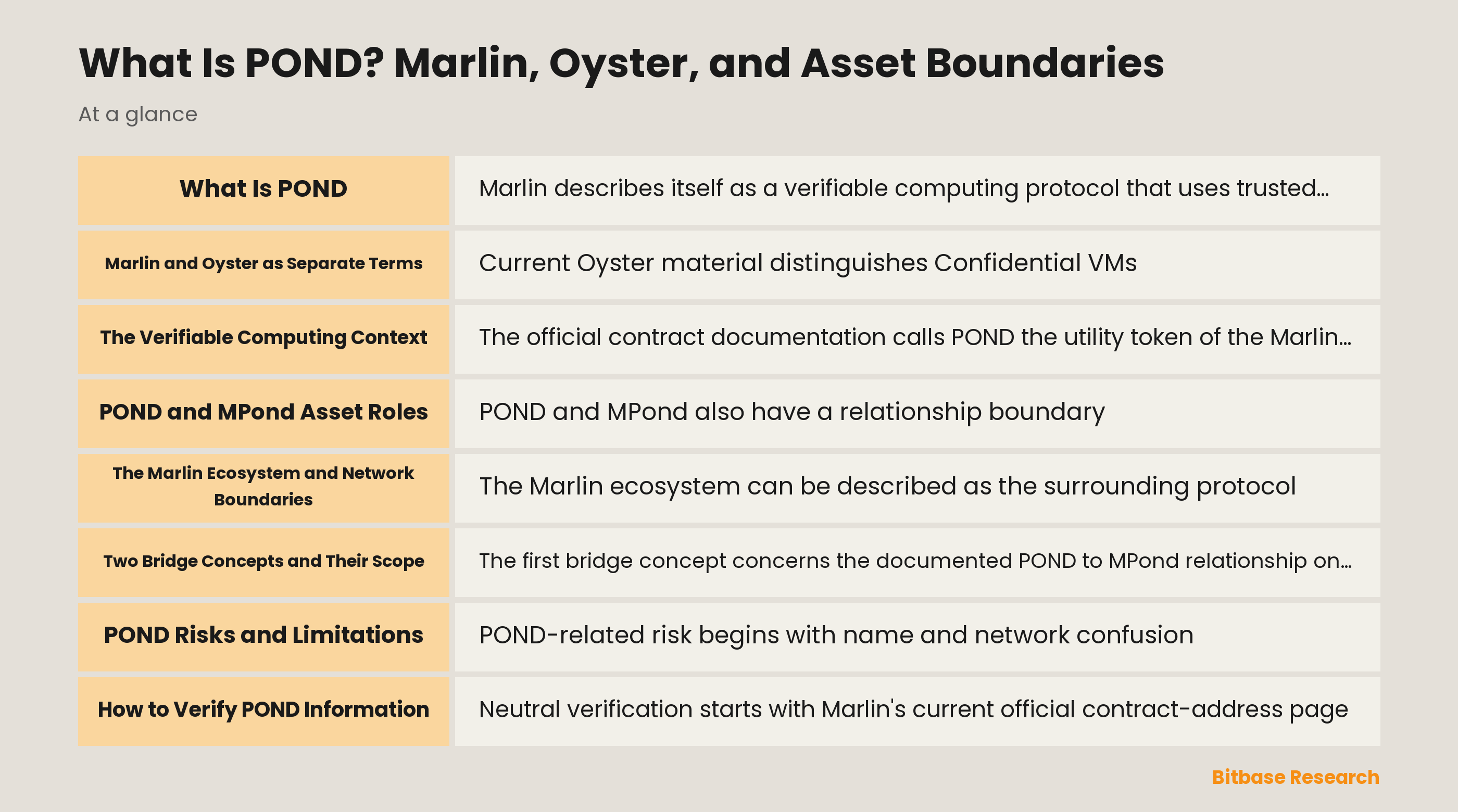
Marlin describes itself as a verifiable computing protocol that uses trusted execution environments, commonly called TEEs, for complex workloads over decentralized infrastructure. Its documentation says that the compute network is also referred to as Oyster. This supports a narrow formulation: Marlin is the protocol context and Oyster is the current compute-network name. It does not establish that every historical Marlin component, application, or similarly named product is an Oyster service.
A protocol description is not a promise about each workload. Marlin materials describe computations that can occur away from a base chain and be checked with proofs or attestations. That is a design model for verifiable execution. It does not show that every program is correct, confidential, continuously available, or appropriate for every purpose. A particular application still depends on its code, configuration, contracts, and current documentation.
Marlin and Oyster as Separate Terms
Current Oyster material distinguishes Confidential VMs, or CVMs, from Oyster Serverless. CVMs are described as dedicated confidential-computing instances, while Serverless is described as shared function execution. This distinction matters because Marlin and Oyster are not interchangeable names for one asset or one identical product surface. The mode, the chain-facing contract, and the exact source page determine what a statement can safely cover.
The official comparison also sets boundaries on technology claims. It lists a Serverless execution limit that may be modified and marks WASM support as work in progress. CVM and Serverless have different execution and networking characteristics. These details support a conditional, date-sensitive explanation of the design. They do not support permanent claims about capacity, universal compatibility, security, or availability.
The Verifiable Computing Context
The official contract documentation calls POND the utility token of the Marlin protocol. It describes POND in connection with the protocol's documented design for receiving blocks or transactions from Marlin nodes. The safest profile wording is that POND is a protocol utility asset. It is not ownership of Marlin, ownership of Oyster hardware, a claim on every application using the protocol, or an automatic right to a service or future feature.
MPond is a separate asset in the same documentation. Marlin describes MPond as the asset used to operate Marlin nodes and join the network. That role differs from POND's utility description even though the names are similar and related in the documented system. A neutral profile should not treat MPond as a spelling variant of POND, or treat either asset as a general membership certificate. Conditions and current contracts remain facts to check again on the publication date.
POND and MPond Asset Roles
POND and MPond also have a relationship boundary. Official materials describe a Marlin mechanism for POND and MPond conversion on Ethereum. They separately describe an official Arbitrum bridge for moving listed assets between Ethereum and Arbitrum. These are different mechanisms with different stated purposes. Explaining the difference prevents an asset-role relationship from being confused with a network-location relationship. This article intentionally gives no interaction sequence for either mechanism.
Network labels are part of asset identity. Marlin's official address page currently lists POND contracts on Ethereum, Arbitrum, and BNB Chain, and MPond contracts on Ethereum and Arbitrum. The same page says that network tokens and several contracts migrated from Ethereum to Arbitrum. These are source-supported boundaries, not evidence that every POND-looking record on every network is official, current, interchangeable, or supported by the same product function.
The Marlin Ecosystem and Network Boundaries
The Marlin ecosystem can be described as the surrounding protocol, compute, documentation, and application context, but it is not one asset class. A relay contract, an Oyster compute service, a node role, a POND contract, and an independent application can occupy different layers. Calling all of them the POND ecosystem without qualification blurs product, infrastructure, and asset boundaries that the official material keeps separate.
The current address page separately lists Oyster Serverless contracts on Arbitrum One, including relay-related contracts and a USDC token entry. That establishes a contract-scope boundary for the Serverless product. It does not establish that POND is the settlement asset for all Oyster activity, that MPond is a Serverless credential, or that a POND holder receives a particular compute resource. Each of those would be a separate current claim requiring a separate source.
Two Bridge Concepts and Their Scope
The first bridge concept concerns the documented POND to MPond relationship on Ethereum. The second concerns the official Arbitrum bridge for moving identified assets between Ethereum and Arbitrum. The names can sound similar, but their objects differ. One concerns the relationship between two assets, and the other concerns the network position of an already identified asset. This is an explanatory distinction, not a tutorial, timing expectation, or recommendation to take an on-chain action.
A bridge page also has limits as a source. It can support a high-level description of the named mechanism and the network context it identifies. It cannot by itself prove that every interface is currently available, that a person is eligible for an action, that an action has completed, or that an unaffiliated asset with a similar ticker is connected to Marlin. Historical material can provide context, but it should not replace the current official contract-address page.
POND Risks and Limitations
POND-related risk begins with name and network confusion. A ticker without the official issuer context, network, and contract address does not identify a project. Similar names, copied images, stale screenshots, and unsupported contract records can all lead to misidentification. A technical record can help identify a listed contract, but it does not prove continuing feature availability or an affiliation with another project. Identity statements must therefore remain as narrow as the source allows.
Technology claims require the same care. The official comparison connects Serverless security to the Chrome V8 sandbox and CVM security to the underlying TEE implementation. It also lists development and execution constraints. That rules out absolute wording about confidentiality, universal compatibility, or uninterrupted operation. A responsible profile can explain the stated design while marking changes in software, network conditions, contracts, and source wording for release-date review.
How to Verify POND Information
Neutral verification starts with Marlin's current official contract-address page. For an editorial check, compare the named asset, stated network, and official contract address with the corresponding block explorer record. This is a documentary consistency check, not a direction to interact with a contract. It is valuable when a source uses a ticker alone, because the ticker itself does not contain the issuer or network boundary.
A second check is to match each claim to the right official source. Use the current introduction for Marlin and Oyster framing, the address page for listed token and product-contract boundaries, and the bridge page only for the distinction it explicitly states. The official GitHub repository can identify public implementation material, but it does not replace current product documentation. Recheck wording, network labels, contract addresses, and feature status close to release.
Conclusion
What is POND, then? It is most accurately introduced as Marlin's documented utility asset within a broader verifiable-computing context. That is more precise than treating POND as the protocol itself, as a synonym for Oyster, or as an identity label for every project named Pond. MPond, compute modes, bridge concepts, and listed networks provide related context, but each has an independent source-supported role.
The useful summary is a boundary map. Marlin names the protocol context. Oyster names the TEE-based compute network in the current documents. POND and MPond name distinct assets with different stated roles. A conversion mechanism and a network bridge name different relationships. Contract records provide technical references, while documentation explains what those references are said to represent. No layer should be used to promise an outcome outside its documented scope.
Before publication, review the official sources again for changes to product wording, Oyster mode status, network identifiers, contract addresses, bridge scope, and the relationship between POND and MPond. Retain the distinction from PondCoin and other similarly named assets unless a primary source establishes an affiliation. This release-date check keeps the article educational and accurate without turning changing technical documentation into a permanent assertion.
Related market pages
- POND: View price
Disclaimer: This article is educational content from Bitbase Academy, provided for information only. It explains what a project does and what role its token plays in that system; it does not constitute investment, trading, tax, or financial advice, and it is neither a recommendation nor an endorsement of any project or token. Bitbase has not carried out due diligence on the project described here, and mentioning it does not mean Bitbase lists or supports the asset. Crypto assets carry significant risk, including price volatility, thin liquidity, smart-contract failure, regulatory uncertainty, and the possible loss of their entire value. Written as of August 2026; a project's status, tokenomics, team, and contracts can change at any time. Verify everything yourself through official channels, the contract address, and a block explorer, and beware of imitation sites and phishing links.
References
[1] Marlin introduction to verifiable computing docs.marlin.org
[2] Marlin official contract addresses docs.marlin.org
[3] Marlin bridge documentation docs.marlin.org
[4] Marlin official website www.marlin.org
[5] Marlin official Oyster implementation repository github.com