Propy brings together real-estate workflow concepts, document records, blockchain references, and the PRO utility token, but none of those elements independently replaces property law or an official land registry.
Searches for propy crypto, Propy PRO tokenomics and use cases, and what is Propy PRO can blur several different ideas into one label. Propy's own materials describe transaction-management and document-record concepts, while separate materials describe the PRO ticker and blockchain-related services. A careful explanation keeps the workflow layer, a document's content, a blockchain record, the PRO token, and real-property rights in distinct categories.
What Is Propy (PRO)?
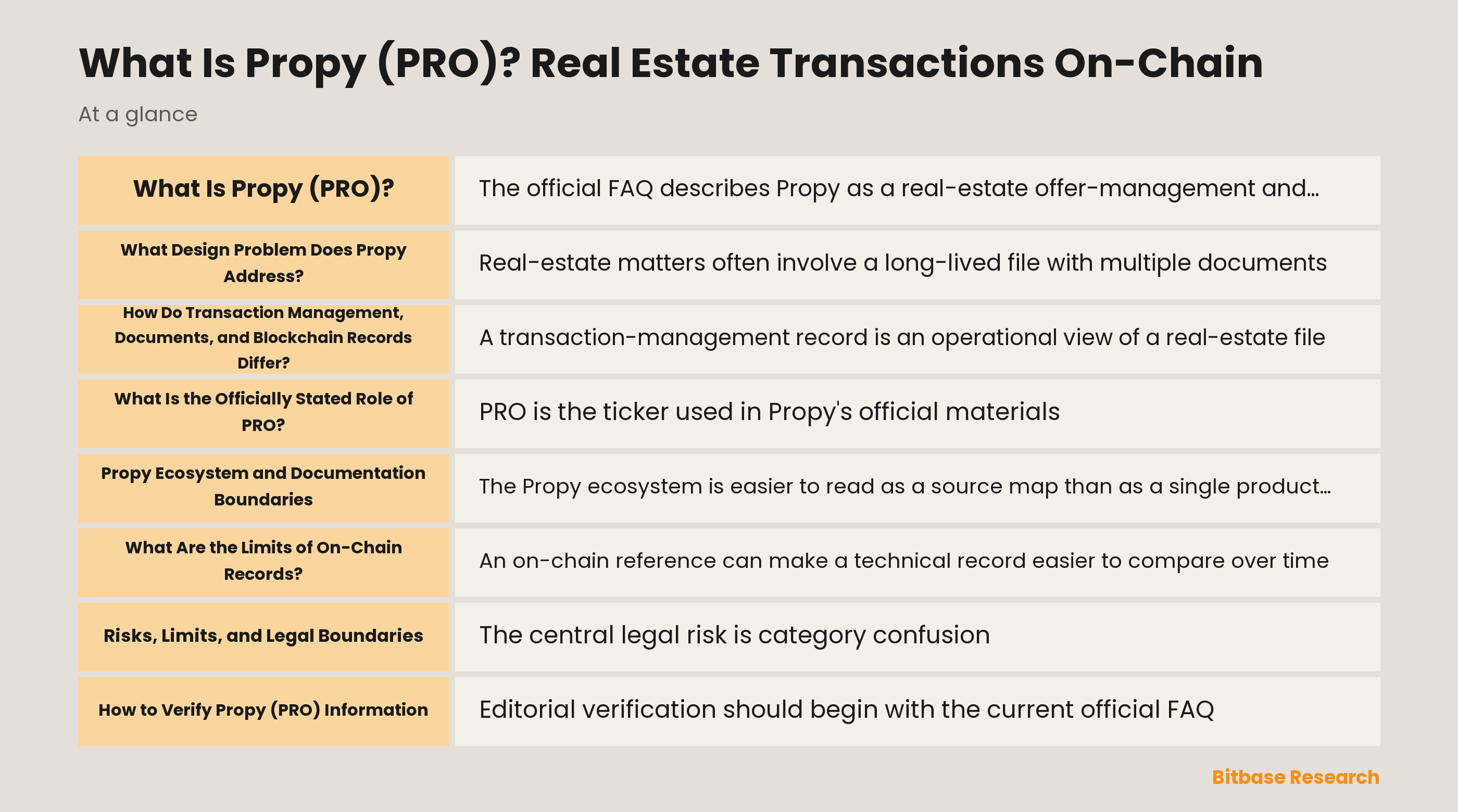
The official FAQ describes Propy as a real-estate offer-management and transaction platform. That is a useful starting point for understanding the project as workflow software: it may organize information, roles, documents, and process records around a real-estate matter. It is not, by that description alone, a public authority, a land registry, or a substitute for the legal systems that establish property rights.
The name Propy can also appear beside blockchain-record language and the ticker PRO. These references should not be collapsed into one claim. Workflow tools concern how a file is coordinated; a document is the underlying content; a blockchain record can provide a technical reference; and PRO is the ticker discussed in official token materials. Each layer has its own source, scope, and publication-day facts to verify.
What Design Problem Does Propy Address?
Real-estate matters often involve a long-lived file with multiple documents, role-specific information, changing process states, and records that must be retained or compared later. A transaction-management system aims to make that information easier to organize and trace than a collection of disconnected messages and files. This is a workflow objective. It does not establish whether a particular document is complete, authoritative, enforceable, or accepted by a relevant registry.
The design problem becomes more complex because property rules are local. A workflow that is intelligible in one jurisdiction can still face different title, identity, signature, recording, consumer-protection, and registry requirements elsewhere. Software can structure information, but it cannot make those requirements identical. Any claim about geographic scope, supported legal process, or current service availability therefore needs official and jurisdiction-specific review immediately before publication.
How Do Transaction Management, Documents, and Blockchain Records Differ?
A transaction-management record is an operational view of a real-estate file. It can describe who is associated with a matter, which materials are present, and where a process stands. A document is the substantive record itself, such as an agreement, disclosure, authorization, or deed-related material. These are not the same as a blockchain entry. A blockchain entry may contain a reference, hash, timestamp, or other structured data connected to a document or process.
Propy's FAQ says the platform creates a unique hash and a specific schema for a deal record on blockchain, and says that the record is used for document validation without personal information on that record. In technical terms, a hash can help compare data sets: a changed input produces a different result. That can support an integrity check, but it does not by itself establish who issued the document, whether its contents were correct, whether authority existed, or whether it has a legal effect.
What Is the Officially Stated Role of PRO?
PRO is the ticker used in Propy's official materials. The 2025 Propy white paper characterizes PRO as an ERC-20 utility token associated with specified Propy services, while Propy's consideration terms describe a purpose connected to services in the stated ecosystem. These are statements about a token's intended utility in the project's own materials, not a general statement about every product, document, or property-related record carrying the Propy name.
The same source set draws an important boundary: it describes PRO as not conferring ownership, governance, or profit rights in Propy. A token designation also does not turn token holdings into an interest in a particular parcel of real estate. Supply, allocation, token representation, applicable terms, technical identifiers, and the current scope of any stated utility are dynamic matters that must be checked from official material on the publication date.
Propy Ecosystem and Documentation Boundaries
The Propy ecosystem is easier to read as a source map than as a single product claim. The FAQ addresses workflow and blockchain-record explanations. The 2025 white paper discusses PRO and describes address-related records, deed-related record concepts, and other proposed or stated service categories. The consideration terms address a particular legal context for PRO, while the site terms address conditions and limits for the site. Each source has a distinct purpose.
That distinction is especially important when a static document uses broad language about an ecosystem. A white paper can describe intended design or a stated utility without proving current availability, jurisdictional coverage, technical deployment, or legal recognition. Before publication, the document version, effective date, source scope, token representation, and any description of a service or integration should be rechecked rather than inferred from a shared brand.
What Are the Limits of On-Chain Records?
An on-chain reference can make a technical record easier to compare over time, but it is not automatically the authoritative record for a piece of land. The Propy white paper expressly distinguishes an address-related NFT from legal rights, ownership, or a claim to the underlying real-world property. That distinction matters even when a digital record is precise, durable, or connected to a property description, because a technical identifier and a real-property right answer different questions.
The site's terms also draw a boundary between blockchain-based representations and title to underlying real estate. Property rights may depend on jurisdictional law, a valid underlying instrument, the identity and authority of relevant parties, signature requirements, title examination, registry acceptance, and other facts outside a blockchain record. An on-chain record can be evidence within a process only to the extent recognized by the appropriate legal and registry framework, which requires publication-day legal review.
Risks, Limits, and Legal Boundaries
The central legal risk is category confusion. On-chain records or token holdings do not by themselves create, transfer, or validate real-property rights. They do not independently establish title, registry recognition, signature validity, authority, priority, or enforceability. A record that is technically consistent may still be connected to an incomplete, inaccurate, unauthorized, or legally ineffective underlying document. These questions vary by jurisdiction and must be assessed against current law and competent local sources.
There are also technical and operational risks. Hashing depends on the data selected for comparison, while a public or shared record can have privacy, retention, access, and interpretation implications. Smart-contract behavior, network conditions, document formats, data-handling practices, source pages, and service terms can change. No fixed claim about audits, integrations, deployment, permissions, availability, legal status, or geographic coverage should be made without a fresh first-party and jurisdiction-specific check.
How to Verify Propy (PRO) Information
Editorial verification should begin with the current official FAQ, the current version of the Propy white paper, the consideration terms, and the site terms. Compare what each source actually addresses: workflow, document validation, token framing, NFT-related representation, or legal conditions. Record the page date and scope, because a static white paper, a current FAQ, and a set of terms do not carry the same kind of evidence.
For claims involving a particular property, the relevant land-registry rules, title requirements, identity standards, signature rules, and local legal treatment need separate review. For claims involving PRO, confirm the exact official ticker context and any current technical identifier from an official source, not from a copied summary. This verification process is about the quality and limits of evidence; it is not evidence that a specific service, record, or token has a particular legal or technical effect.
Conclusion
Propy is best understood by separating its layers. Its official materials describe workflow and document-record concepts for real-estate matters, blockchain-related record concepts, and a PRO utility-token framing. Those descriptions can explain how the project organizes its own terminology, but they do not merge software, a document, a blockchain entry, a token, and property ownership into the same thing.
The useful technical distinction is between recording information and proving a legal result. A hash or on-chain reference can help support a data-integrity question. It cannot, by itself, determine who has a real-property right, whether a deed is legally effective, whether a registry recognizes an entry, or whether a particular service is available in a jurisdiction. The same caution applies to a token: its stated utility is not a property right.
For publication, retain the source boundaries and recheck all dynamic facts. That includes the current status and scope of workflow tools, document-record practices, PRO's official representation and stated utility, token supply and allocation disclosures, technical identifiers, terms, integration claims, security statements, and every jurisdictional claim about title, signatures, registration, or real-property effects. A precise explainer is stronger when it makes those distinctions explicit.
Disclaimer: This article is educational content from Bitbase Academy, provided for information only. It explains what a project does and what role its token plays in that system; it does not constitute investment, trading, tax, or financial advice, and it is neither a recommendation nor an endorsement of any project or token. Bitbase has not carried out due diligence on the project described here, and mentioning it does not mean Bitbase lists or supports the asset. Crypto assets carry significant risk, including price volatility, thin liquidity, smart-contract failure, regulatory uncertainty, and the possible loss of their entire value. Written as of August 2026; a project's status, tokenomics, team, and contracts can change at any time. Verify everything yourself through official channels, the contract address, and a block explorer, and beware of imitation sites and phishing links.
References
[1] Propy FAQ propy.com
[2] Propy Whitepaper 2025 propy.com
[3] Propy Consideration Terms and Conditions propy.com
[4] Propy Terms and Conditions propy.com