Pudgy Penguins is a brand ecosystem anchored by an NFT collection, while the collection, the consumer brand, individual-holder rights, SBT contexts, derivative assets, and PENGU are separate categories.
Pudgy Penguins is easiest to understand as a layered project rather than as one interchangeable digital object. The recognizable penguin art, individual collection items, public-facing brand, related digital contexts, and PENGU label can be connected in project storytelling, yet each is identified by different records and terms. Keeping those layers separate is the foundation for an accurate explanation. A careful scope map also helps readers distinguish a creative narrative from the records or terms that support a particular claim. It makes later review clearer: a shared name or visual motif may show association, but it does not establish a common identity, a common right, or a common function.
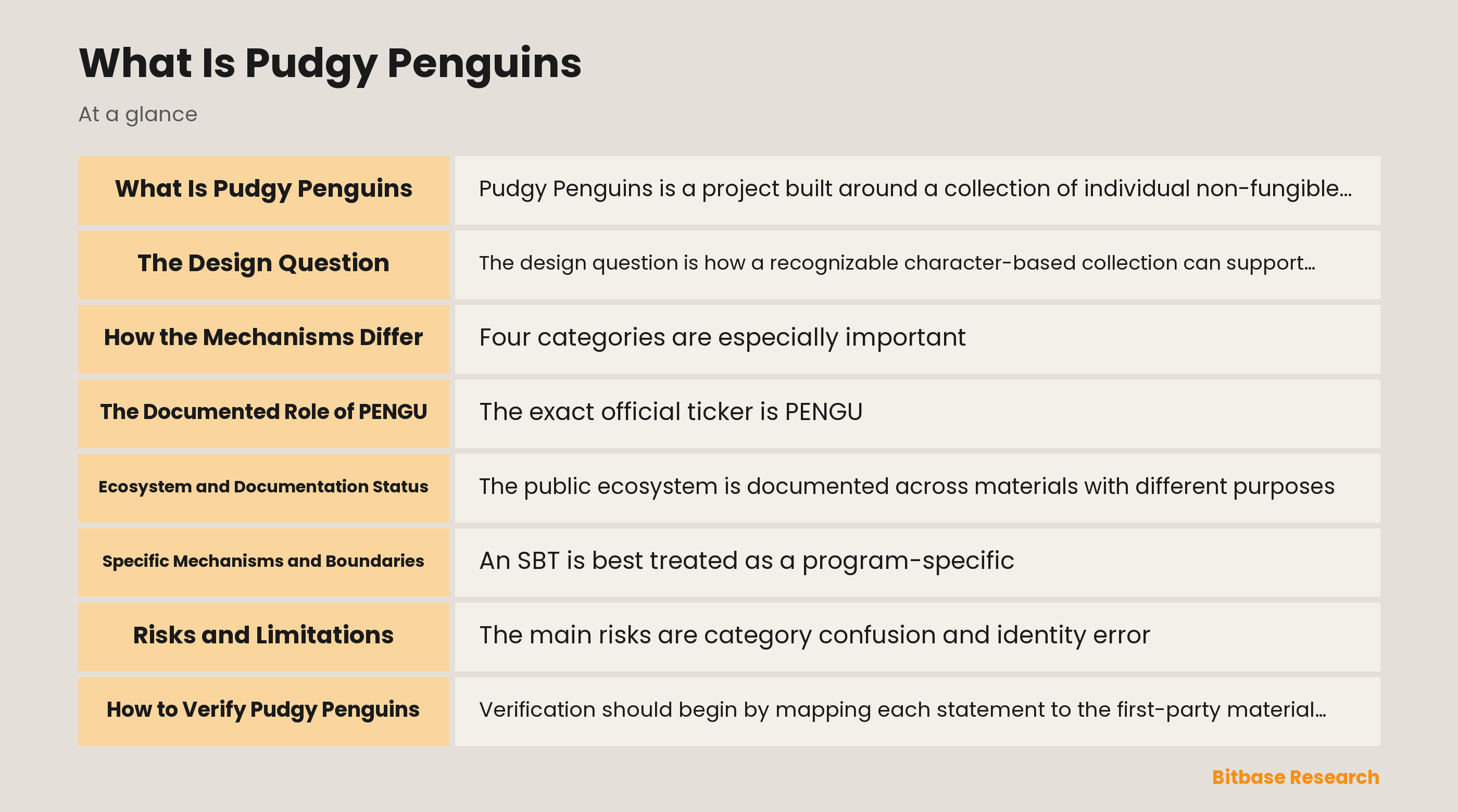
What Is Pudgy Penguins
Pudgy Penguins is a project built around a collection of individual non-fungible tokens and a recognizable penguin brand. An individual collection item is a distinct blockchain-recorded token with its own identifier and associated artwork context. The official brand presentation describes a community and consumer-facing identity built around the characters, but that identity is broader than any one collection item.
The question what is pudgy penguins nft should therefore be answered at the level of a specific collection item, not by treating the whole brand as a single NFT. A collection name can refer to artwork, cultural identity, public communications, or a set of token records. None of those meanings automatically defines the others, and none alone establishes a general right to every related program or asset.
The Design Question
The design question is how a recognizable character-based collection can support a coherent cultural and consumer brand without erasing the boundary between a token record and a broader intellectual-property system. A brand can create characters, stories, physical goods, community language, and digital experiences. Those elements can reinforce one another, but they are not technically or legally identical simply because they share a penguin image.
This layered design also explains why a high-level ecosystem diagram needs cautious reading. The collection can provide a durable set of individual records, while the brand can organize public communication and consumer initiatives. Licences, SBT programs, supplemental digital items, and a token label may sit alongside those layers. Each connection needs an applicable official document that states its scope, conditions, and current status.
How the Mechanisms Differ
Four categories are especially important. A Pudgy Penguins NFT is an individual non-fungible collection item. The Pudgy Penguins brand is the broader creative and consumer-facing identity. PENGU is a separately named token label in official terms. An SBT, or soulbound-token context, is a non-transferable record associated with a particular program. These categories can appear in the same ecosystem without becoming substitutes for one another.
Holder rights require the same precision. Official intellectual-property materials describe rights attached to particular artwork under particular written conditions. That does not turn every holder into a representative of the brand, and it does not make an individual NFT equivalent to a licence for all brand uses. Any proposed right, scope, restriction, or derivative use should be read from the current agreement that actually governs it.
The Documented Role of PENGU
The exact official ticker is PENGU. Pudgy Penguins' official terms refer to a PENGU token and characterize it as intended for fun and entertainment. That establishes the project-associated ticker, but it does not make PENGU an individual collection item, a unit of ownership in the brand, a general intellectual-property licence, or proof of status in every SBT or digital-asset context.
The phrase pudgy penguins coin can obscure those distinctions if it is used as a shortcut for the entire project. A ticker is an identifier for a token label, whereas an NFT collection is made of individual non-fungible records and the consumer brand is a separate organizational and creative layer. Current network identity, contract address, supply, distribution, permissions, and availability are publication-day facts that require fresh first-party confirmation.
Ecosystem and Documentation Status
The public ecosystem is documented across materials with different purposes: a brand page, collection and community terms, intellectual-property materials, licensing information, and an official SBT surface. These materials are useful because they map different layers of the project. They should not be merged into one statement that every collection item, consumer product, character, SBT, derivative asset, and PENGU has the same status or function.
The documentation is also time-sensitive. A consumer initiative can describe a brand relationship, a licensing page can describe a defined arrangement, and an SBT page can describe a program-specific record. None of those pages alone proves a permanent or universal connection. The character name Pengu is likewise a brand character reference and should not be confused with the uppercase PENGU ticker.
Specific Mechanisms and Boundaries
An SBT is best treated as a program-specific, non-transferable record, rather than as another name for the original collection. It is not automatically a Pudgy Penguins NFT, PENGU, a licence, or a general membership credential. A digital adoption certificate, a character-themed item, or another derivative asset may also have its own metadata and terms. Its relationship to the original collection must be established independently.
The same boundary applies to consumer goods and brand activity. A physical item may express the brand, while an individual NFT is a distinct digital record and PENGU is a separately named token. Brand recognition can connect the audience around these items without creating automatic interchangeability between them. Statements about partnerships, integrations, product state, regional availability, and associated rights should be held for publication-day verification.
Risks and Limitations
The main risks are category confusion and identity error. Similar names, images, tickers, and unofficial records can lead a reader to mistake one object for another. A copied image does not prove collection identity, a token label does not prove a current contract, and a reference to a brand does not prove a current licence or program status. Older pages can also omit later changes, restrictions, or replaced arrangements.
There are additional limits around intellectual-property scope, legal treatment, technical reliability, and availability. Contract identity, metadata integrity, administrative permissions, audits, supply, distribution, program eligibility, jurisdictional limits, and service status can change or be restricted. The existence of a cultural ecosystem does not remove these dependencies, and no general description can establish a result, a right, or a present feature on its own.
How to Verify Pudgy Penguins
Verification should begin by mapping each statement to the first-party material designed for that statement. The official brand page can support a brand-level description, current terms can support terminology used for the collection and PENGU, intellectual-property material can support a narrow discussion of artwork rights, and a program page can support only the specific SBT or derivative context it describes. The date and scope of each document should remain visible in the review.
A contract address or block explorer record should be treated as an identity check, not as a substitute for first-party confirmation. On publication day, the stated network, token ticker, collection identity, official contract listing, applicable agreement, current program status, and relevant regional restrictions should be cross-checked against current official materials. This is a research standard for distinguishing records and documents, not an instruction to use any service.
Conclusion
Pudgy Penguins is a layered ecosystem centered on a recognizable NFT collection and expanded through a public brand and related project contexts. The most reliable description keeps the individual collection item, the brand, artwork rights, SBT contexts, derivative assets, and PENGU in their own categories. Connections between them need evidence specific to the connection being described.
The phrase pudgy penguins nft utility and ecosystem is most useful when it prompts a scope map instead of an assumption that all possible benefits travel together. A collection item can have one documented relationship, a licensing arrangement another, an SBT context another, and PENGU another. Their names may be related, but their records, conditions, and meanings are not automatically interchangeable.
Before publication, the review should repeat the official ticker, token and collection identity, current contract and network information, intellectual-property terms, program-specific documentation, audit and permission disclosures, product status, third-party integrations, and legal or regional limits. Those dynamic facts belong to the publication-day evidence set, not to a permanent inference from the Pudgy Penguins name.
Related market pages
- PENGU: View price · Spot market · Perpetual market
Disclaimer: This article is educational content from Bitbase Academy, provided for information only. It explains what a project does and what role its token plays in that system; it does not constitute investment, trading, tax, or financial advice, and it is neither a recommendation nor an endorsement of any project or token. Bitbase has not carried out due diligence on the project described here, and mentioning it does not mean Bitbase lists or supports the asset. Crypto assets carry significant risk, including price volatility, thin liquidity, smart-contract failure, regulatory uncertainty, and the possible loss of their entire value. Written as of August 2026; a project's status, tokenomics, team, and contracts can change at any time. Verify everything yourself through official channels, the contract address, and a block explorer, and beware of imitation sites and phishing links.
References
[1] Pudgy Penguins, About www.pudgypenguins.com
[2] Pudgy Penguins, Terms of Use claim.pudgypenguins.com
[3] Pudgy Penguins, IP Rights claim.pudgypenguins.com
[4] Pudgy Media, Licensing Deals media.pudgypenguins.com
[5] Pudgy Penguins, Official SBT Surface sbts.pudgypenguins.com