Qubic is a network that documents a quorum-based computer, or QBC, for distributed computation and smart contracts. Its design uses Computors, ticks, and a quorum process rather than a familiar block-by-block virtual-machine model. This guide explains the documented architecture, the role of QUBIC, and the evidence a reader can inspect without taking an on-chain action.
What Is Qubic?
Qubic is a project whose official documentation presents a quorum-based computer as the basis for a decentralized computing network. In that description, participating Computors execute defined protocol work, and a quorum process is used to settle the network’s state. The project is therefore more than a label for a unit: it includes a technical architecture, software, documentation, and a set of rules for applications that use that architecture.
A search for what is qubic crypto should separate those layers. Qubic can mean the network and its computing model, while QUBIC is the official financial ticker for the network’s native unit. Treating the project name, the native unit, and every application built around them as the same thing makes technical claims harder to verify.
The official material also uses terms that differ from common blockchain vocabulary. For example, it describes ticks as the unit of state and consensus timing, and it describes contracts in a restricted C++ environment. Those choices are useful to understand before drawing conclusions from a short description, a ticker label, or a third-party summary.
What Problem Does Qubic Aim to Solve?
Distributed applications need a way to reach a consistent result even when no single operator should be the source of truth. Qubic’s documentation frames its answer around a quorum of Computors that execute protocol rules and agree on a state snapshot. The goal is not simply to store records; it is to provide an execution environment where defined computation and shared state can be checked under the network’s own rules.
That design shifts the questions a technical reader should ask. It is not enough to hear that a network is decentralized or that a calculation is executed near hardware. The important questions are which nodes participate, what the quorum validates, how a tick is formed, what code is accepted, and what assumptions an application makes about the resulting state.
How Does Qubic Work?
According to the official introduction, Computors are the participants associated with execution and network security, while the quorum process determines when a state is final under the protocol. The documentation describes a recurring selection and ranking context for these roles, but the details of a live network can change. A reader should use current official material rather than assuming that a historical description remains a permanent parameter.
The developer documentation describes Qubic as using ticks rather than conventional blocks. A tick is presented as a state snapshot with the effects of validated activity for that moment, and quorum votes are used for finality in that design. This means that a system built for Qubic must understand its tick model and its stated timing rules rather than import assumptions from a chain that organizes history into linked blocks.
For smart contracts, Qubic documents a restricted form of C++ that is compiled into the Qubic Core executable and executes close to the underlying hardware. The official material also describes a contract lifecycle involving review and protocol processes before a contract becomes part of a deployed system. That is a distinct security boundary: source availability and deterministic compilation can aid inspection, but they do not by themselves establish that any particular contract logic is correct.
What Does QUBIC Do in the Qubic System?
For readers researching qubic tokenomics and use cases, the starting point is the official Tokenomics page. It identifies QUBIC, not QU, as the official financial ticker and describes the native unit as computational energy used in documented network functions. The page discusses issuance, distribution, and burning as protocol mechanisms, so these should be read as design documentation rather than as a statement about value or a reason to take an action.
The phrase qubic coin is also best understood in that network context. The documentation describes QUBIC as the native coin while distinguishing it from assets that applications can create in the ecosystem. Whether a particular function consumes QUBIC, how a parameter is set, and how supply rules operate are technical questions that should be checked against the current official documentation and current network records.
Qubic Ecosystem and Current Documentation
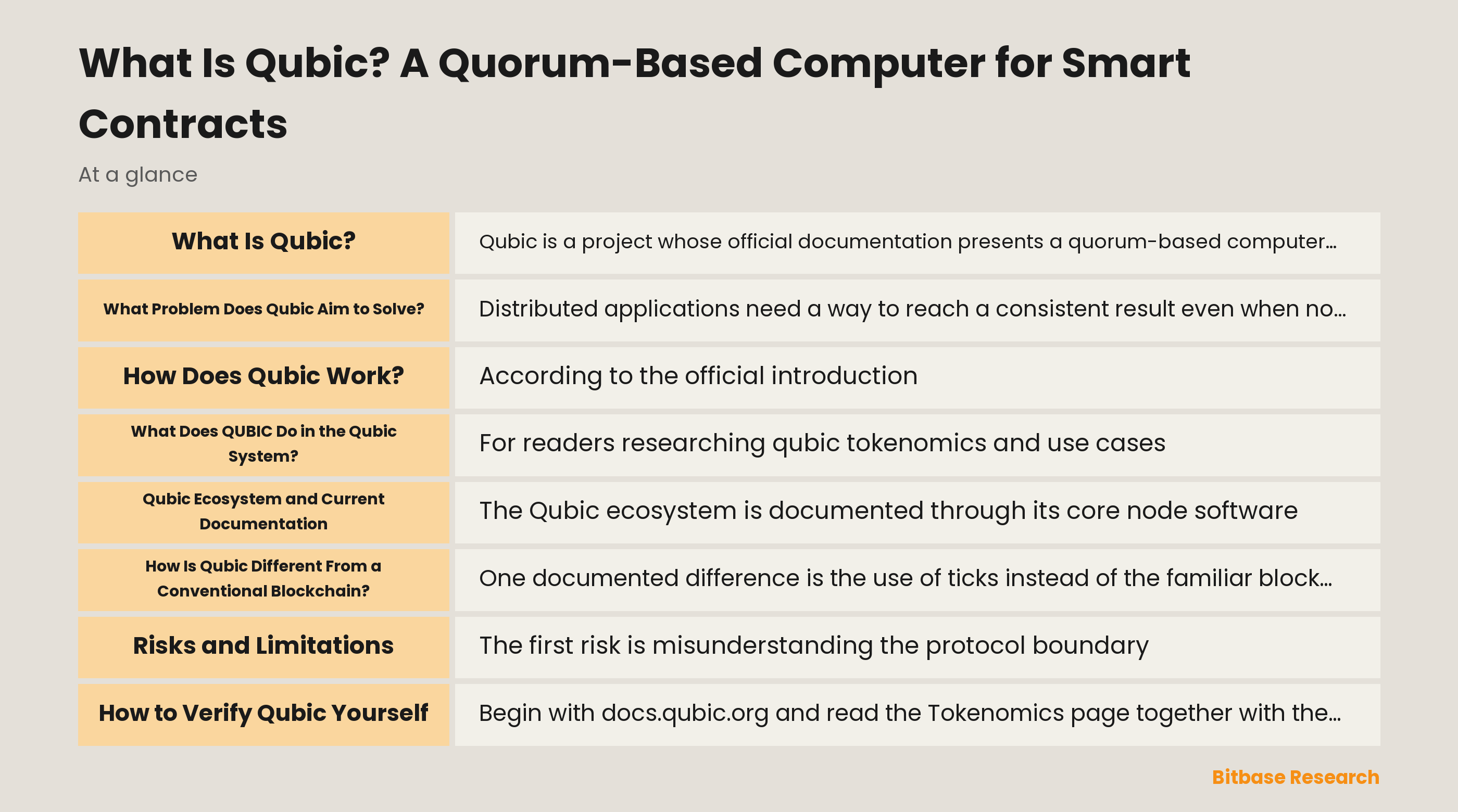
The Qubic ecosystem is documented through its core node software, developer guides, contract architecture, API material, and related open-source repositories. These sources describe interfaces and concepts that developers may inspect, including the Qubic Programming Interface and the distinction between read-only functions and state-changing procedures. A documentation list is not an adoption measurement, and it does not establish the security or availability of every implementation built around it.
The documentation itself says that some material is in public preview and may change. That makes source dates and exact scope especially important. A reader should distinguish a general overview from a current protocol rule, a contract-specific statement, or an independently verified network observation.
How Is Qubic Different From a Conventional Blockchain?
One documented difference is the use of ticks instead of the familiar block sequence. The official developer material says that ticks are validated state snapshots and explains that the design does not use traditional chained blocks in the same way. This does not make one model universally preferable; it means finality, history retention, scheduling, and client behavior need to be evaluated on Qubic’s own terms.
Another difference is the execution model. Qubic contracts are described as restricted C++ programs compiled into core software, with a defined route for public contract identification and review. In contrast, many readers expect bytecode interpreted in a virtual machine. The difference changes what code, build process, contract index, and runtime assumptions a reviewer needs to examine.
Risks and Limitations
The first risk is misunderstanding the protocol boundary. A quorum result, a documented tick, or publicly visible source code does not prove that an application chose the right rule, handles failures safely, or uses an appropriate contract. Integrators still need to review the exact code, data inputs, upgrade path, permissions, and behavior when dependencies are unavailable.
There are also documentation and operational limitations. The official docs can change, parameters can evolve, and a technical architecture can be implemented differently by separate applications. This article makes no audit conclusion. Before relying on a particular deployment, compare its current code and identifiers with official sources, locate any named audit directly from the auditor, and confirm that its stated scope matches the code being considered.
How to Verify Qubic Yourself
Begin with docs.qubic.org and read the Tokenomics page together with the Introduction and the developer pages on ticks and smart contracts. Confirm the exact ticker spelling, then distinguish claims about the native unit from claims about a particular contract or application. The official GitHub organization and its Qubic Core contract directory provide a second, read-only place to compare documented architecture with published source.
For an explorer check, use explorer.qubic.org and navigate to Network, Assets, and Smart Contracts without connecting a wallet or submitting anything. The official architecture page gives QX as a reproducible example: contract index 1 and address BAAAAAAAAAAAAAAAAAAAAAAAAAAAAAAAAAAAAAAAAAAAAAAAAAAAAAARMID. Compare that identifier and its code record with the current official documentation; because QUBIC is a native unit, do not assume it has an EVM-style token contract address.
Conclusion
Qubic is best approached as a documented computing architecture with its own vocabulary: Computors, quorum settlement, ticks, and restricted C++ contracts. The model can only be understood by following the current technical documentation rather than applying assumptions from a different execution environment.
QUBIC is the official ticker for the native unit described in that architecture. A careful reader should keep the project, the native unit, and a specific deployed contract separate, then verify each relevant claim through the official docs, published source, and the official block explorer before relying on it.
Related market pages
- QUBIC: View price
Disclaimer: This article is educational content from Bitbase Academy, provided for information only. It explains what a project does and what role its token plays in that system; it does not constitute investment, trading, tax, or financial advice, and it is neither a recommendation nor an endorsement of any project or token. Bitbase has not carried out due diligence on the project described here, and mentioning it does not mean Bitbase lists or supports the asset. Crypto assets carry significant risk, including price volatility, thin liquidity, smart-contract failure, regulatory uncertainty, and the possible loss of their entire value. Written as of August 2026; a project's status, tokenomics, team, and contracts can change at any time. Verify everything yourself through official channels, the contract address, and a block explorer, and beware of imitation sites and phishing links.
References
[1] Qubic Docs — Tokenomics docs.qubic.org
[2] Qubic Docs — Introduction docs.qubic.org
[3] Qubic Docs — Ticks and Concurrency docs.qubic.org
[4] Qubic Docs — Smart Contract Architecture docs.qubic.org
[5] Qubic Explorer — Smart Contracts explorer.qubic.org
[6] Qubic Core — Contracts source directory github.com