RARI is the governance token named by the RARI Foundation for the Rarible ecosystem, but it is distinct from Rarible Protocol, RARI Chain, and RARI DAO.
People searching for rari tokenomics and use cases, rari crypto, or what is rari crypto can encounter four related names that answer different questions. This article treats Rarible Protocol as documented infrastructure, RARI Chain as a network name, RARI DAO as a governance context, and RARI as a token ticker. Keeping those categories separate is more useful than treating a shared brand as proof that every component has the same function, status, or rules.
What Is RARI?
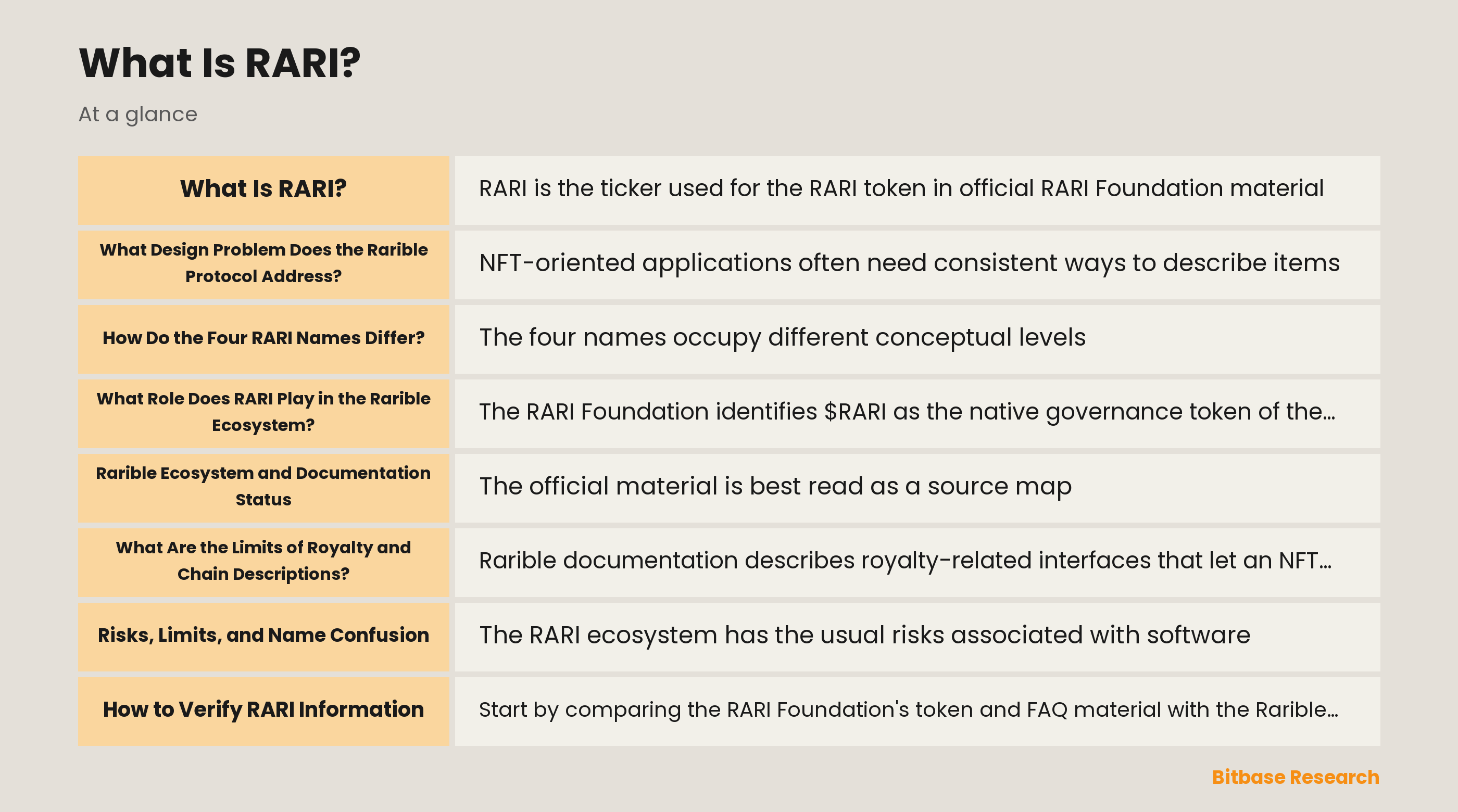
RARI is the ticker used for the RARI token in official RARI Foundation material. That material describes RARI as the native governance token of the Rarible ecosystem. The statement identifies a documented governance role; it does not turn RARI into the protocol codebase, a network, a DAO, an interface, or a universal label for every product associated with the broader ecosystem.
Rarible Protocol, RARI Chain, RARI DAO, and the RARI token should therefore be read as separate layers. Rarible Protocol refers to documented NFT infrastructure and developer-facing components. RARI Chain is a chain name. RARI DAO is the governance setting discussed by the Foundation. RARI is the fungible governance ticker. A single sentence about one layer should not silently be used as evidence about another.
What Design Problem Does the Rarible Protocol Address?
NFT-oriented applications often need consistent ways to describe items, collections, metadata, activities, and contract-level information across more than one chain environment. A protocol-oriented infrastructure layer can provide shared data conventions and software components so that each application does not need to recreate every indexing and contract interaction pattern independently. This is a design objective, not a promise about completeness, availability, or any particular outcome.
The Rarible documentation describes APIs, SDKs, indexing, and smart-contract components in a multichain setting. Those descriptions help explain why the word Protocol is useful: it points to technical infrastructure and published interfaces rather than to the RARI token itself. Documentation can explain an intended architecture, while the status, version, supported scope, and security of every component remain facts that need current verification.
How Do the Four RARI Names Differ?
The four names occupy different conceptual levels. Rarible Protocol is the technical and documentation layer. RARI Chain is a named chain environment that appears in first-party chain documentation. RARI DAO is the community governance layer used in Foundation material. RARI is the ticker attached to a governance token. None of these labels automatically supplies the contract identity, operating status, legal meaning, or technical properties of the others.
This separation matters because source types have different evidentiary weight. A protocol document can describe an API or royalty interface. A chain page can identify a chain entry. A governance page can describe a proposal process. A token page can describe a governance role. Reading them together can build a map, but it cannot justify filling missing details from one source with assertions drawn from another source.
What Role Does RARI Play in the Rarible Ecosystem?
The RARI Foundation identifies $RARI as the native governance token of the Rarible ecosystem and links tokenholder governance to decisions concerning the RARI DAO, Foundation treasury, Rarible Protocol, and RARI Chain. This is the appropriate starting point for describing RARI: it is a governance-oriented ticker in the Foundation's own ecosystem map, rather than a synonym for every technical component carrying a similar name.
Governance language has limits. It should not be read as a guaranteed entitlement, a fixed operational rule, proof of control over every implementation, or proof that a particular proposal will take effect. Governance surfaces, voting conditions, delegation arrangements, treasury processes, and cross-chain representations can change. Their exact current scope must be checked from official sources on the publication date instead of inferred from a static overview.
Rarible Ecosystem and Documentation Status
The official material is best read as a source map. RARI Foundation pages describe the token and DAO framing, while Rarible documentation describes protocol components such as APIs, SDKs, indexing, contracts, supported-chain records, and royalty-related interfaces. These sources are complementary, but they are not interchangeable. A documented protocol feature does not establish a present chain condition, and a token governance page does not establish a particular API capability.
Before publication, the editorial record should be checked again for official domains, page dates, chain records, token representations, contract identifiers, governance documentation, and the current status of any interface or integration. Supply, allocation, audit information, permissions, royalty behavior, chain availability, geographic constraints, and third-party relationships are all time-sensitive. This article deliberately does not present them as fixed facts.
What Are the Limits of Royalty and Chain Descriptions?
Rarible documentation describes royalty-related interfaces that let an NFT contract expose royalty information. That technical description is narrower than a universal result for every collection, contract, interface, chain, or downstream application. Whether a particular implementation recognizes a standard, how a contract behaves, and what rights a creator or holder may have are separate questions that require current primary-source and legal review.
RARI Chain should also remain separate from the protocol and token. First-party documentation can identify a RARI Chain entry or describe historical design goals, but a name in a document is not enough to prove present deployment status, supported applications, permissions, security properties, or jurisdictional treatment. The chain's current technical state and any royalty-related behavior belong on a publication-day verification list.
Risks, Limits, and Name Confusion
The RARI ecosystem has the usual risks associated with software, smart contracts, indexing, governance, bridge or chain dependencies, changing documentation, and third-party services. A published architecture does not independently prove that every implementation is secure, current, available, compatible, or suited to a particular purpose. Governance mechanisms can also be affected by changing rules, participation patterns, and implementation choices.
There is an additional identity risk because four closely related names can be compressed into one label. Similar tickers, copied logos, unofficial pages, and incomplete summaries can blur the difference between a token, a protocol, a chain, and a DAO. The safest editorial approach is to trace each statement to its appropriate official source and to leave an uncertain detail unstated rather than treating brand similarity as confirmation.
How to Verify RARI Information
Start by comparing the RARI Foundation's token and FAQ material with the Rarible Protocol documentation and its supported-chain information. The sources should consistently distinguish the RARI token from RARI Chain, RARI DAO, and Rarible Protocol. Check the page date and scope as well: an historical announcement, a current documentation page, and a governance discussion are different kinds of evidence. For an official token representation, compare the published contract address with the matching chain context and a reputable block explorer. A contract address or a block explorer record alone does not establish that a page, ticker, or representation is official. The surrounding official source, its date, the relevant network, and the stated purpose must agree before an identifier is treated as an editorial fact.
Finally, re-check active governance rules, deployed contracts, token representations, chain records, royalty behavior, audits, permissions, product status, legal terms, and regional availability immediately before publication. If a first-party source does not establish a detail clearly, the correct editorial response is to describe only the documented boundary. Verification is a source-quality practice, not a guide for using any product.
Conclusion
RARI is most accurately described as the governance ticker named in RARI Foundation material for the Rarible ecosystem. Rarible Protocol is the documented infrastructure layer, RARI Chain is a network name, and RARI DAO is the governance context. Their association does not make them interchangeable or prove that a fact about one layer applies to the others.
The useful distinction is between a first-party description and a verified current condition. A token's documented governance role does not prove a fixed governance outcome, a chain condition, an interface capability, a legal conclusion, or a particular technical result. Those matters remain separate questions with their own sources and dates.
For publication, retain the separation of names and re-check every dynamic fact from official material. That includes token and contract identity, governance scope, protocol and chain status, royalty-related behavior, integrations, permissions, audit information, and geographic or legal constraints. A careful explanation remains valuable precisely because it does not fill those gaps with assumptions.
Related market pages
- RARI: View price
Disclaimer: This article is educational content from Bitbase Academy, provided for information only. It explains what a project does and what role its token plays in that system; it does not constitute investment, trading, tax, or financial advice, and it is neither a recommendation nor an endorsement of any project or token. Bitbase has not carried out due diligence on the project described here, and mentioning it does not mean Bitbase lists or supports the asset. Crypto assets carry significant risk, including price volatility, thin liquidity, smart-contract failure, regulatory uncertainty, and the possible loss of their entire value. Written as of August 2026; a project's status, tokenomics, team, and contracts can change at any time. Verify everything yourself through official channels, the contract address, and a block explorer, and beware of imitation sites and phishing links.
References
[1] RARI Foundation: RARI ecosystem overview rari.foundation
[2] RARI Foundation FAQ: What is RARI? rari.foundation
[3] Rarible Protocol documentation: What is the Rarible API? docs.rarible.org
[4] Rarible Protocol documentation: Supported Blockchains docs.rarible.org
[5] Rarible Protocol documentation: Royalties docs.rarible.org