
Ravencoin is documented as a Bitcoin code fork whose design adds protocol level support for issuing and moving named assets, while RVN remains the network's native coin.
The search terms what is Ravencoin RVN, rvn tokenomics and use cases, and rvn coin point to related but different subjects. Ravencoin is the blockchain protocol and software project; RVN is its native coin; and an asset issued on the chain is a separate, user defined protocol record. Treating all three as one thing hides an important boundary. This profile explains the design described in first party materials without turning a technical description into a statement about value, availability, legal effect, or a reason to use a particular asset.
What Is Ravencoin
Ravencoin is presented in its official materials as a protocol based on a fork of the Bitcoin code. Its stated design direction is to add asset aware features to a Bitcoin style, UTXO based system. In plain language, the protocol is intended to recognize certain asset information as part of its own rules rather than leaving that information solely to an outside convention. That makes Ravencoin a network and implementation context, not merely another label for every item that may later be represented on its ledger.
The native coin is RVN. It is distinct from assets that people or organizations may issue on the Ravencoin chain. An on chain asset can carry a name and defined protocol metadata, whereas RVN is the native unit referenced by the network's own documentation. A named asset is therefore not automatically a second form of RVN, and an asset's name does not by itself establish who issued it, what it represents, whether an off chain promise exists, or whether anyone recognizes it outside the protocol.
The Design Problem Ravencoin Addresses
The design problem begins with a limitation of systems that record a general payment unit but do not natively understand an additional asset layer. If asset information is only an external annotation, ordinary software may not distinguish the base unit from the separate record when interpreting an output. Ravencoin's documentation describes an asset aware approach intended to encode and track specified asset properties at the protocol level. This is an architectural goal, not a guarantee that every application will interpret every asset correctly or that every claim attached to an asset is true.
Asset aware rules also seek to make the asset record visible to software that follows the protocol's asset format. The official material describes names, quantities, selected metadata, and related records as part of the asset model. This differs from saying that a chain can independently verify the real world subject named by an asset. The chain can record the protocol data supplied to it; the identity, authority, custody, contractual terms, and any legal consequences connected with an external subject remain separate questions that need their own evidence.
How Ravencoin's Mechanism Differs
Ravencoin inherits a Bitcoin code lineage and UTXO model, but its documented differentiation is the inclusion of asset issuance, asset movement, unique assets, and related metadata capabilities in the protocol design. This allows the network to distinguish the native RVN unit from records that represent separately named assets. It is not a claim that all asset related interfaces, integrations, or software versions have the same behavior at every time. Current implementation versions, network condition, and algorithm settings are publication date verification items.
The difference is especially useful at the level of terminology. A blockchain entry can be a technical record of an RVN transaction, an asset transaction, or metadata associated with an asset record. The existence of that record does not automatically create a legal title, prove beneficial ownership, register a security, authenticate a physical item, or settle a dispute. Ravencoin's asset model describes protocol level representation and transfer rules. Any external rights depend on the issuer's disclosures, applicable terms, and relevant legal context, all of which must be reviewed separately.
The Role of Ticker RVN in Ravencoin
RVN is the officially identified native coin of the Ravencoin network. Official project material associates the native coin with the network's proof of work design and with protocol functions surrounding the asset system. This identifies a technical role within the network; it does not mean that holding RVN automatically grants access, governance authority, revenue, compensation, or a claim on any asset issued by somebody else. The abbreviation RVN should likewise be checked against current first party materials when a publication is prepared.
The phrase rvn tokenomics and use cases should be handled cautiously. It can describe the native coin's protocol context and the way official documentation distinguishes it from issued assets, but it should not be reduced to a static supply figure, emission statement, or allocation claim. Supply, distribution, mining conditions, fees, and any current policy details can change in relevance or presentation and require publication date confirmation. A technical explanation of RVN is more durable when it separates documented roles from time sensitive numerical data.
Ravencoin ecosystem and Documentation Boundaries
The Ravencoin ecosystem can be understood as a collection of layers: the base protocol, the official website, asset documentation, the white paper, source code, roadmap material, and independently maintained tools or projects that may describe Ravencoin support. These layers do not carry identical evidentiary weight. A protocol document can explain a design, while a repository can show an implementation path, and a third party interface may have its own status, security, and terms. No general ecosystem description proves that a particular service remains available.
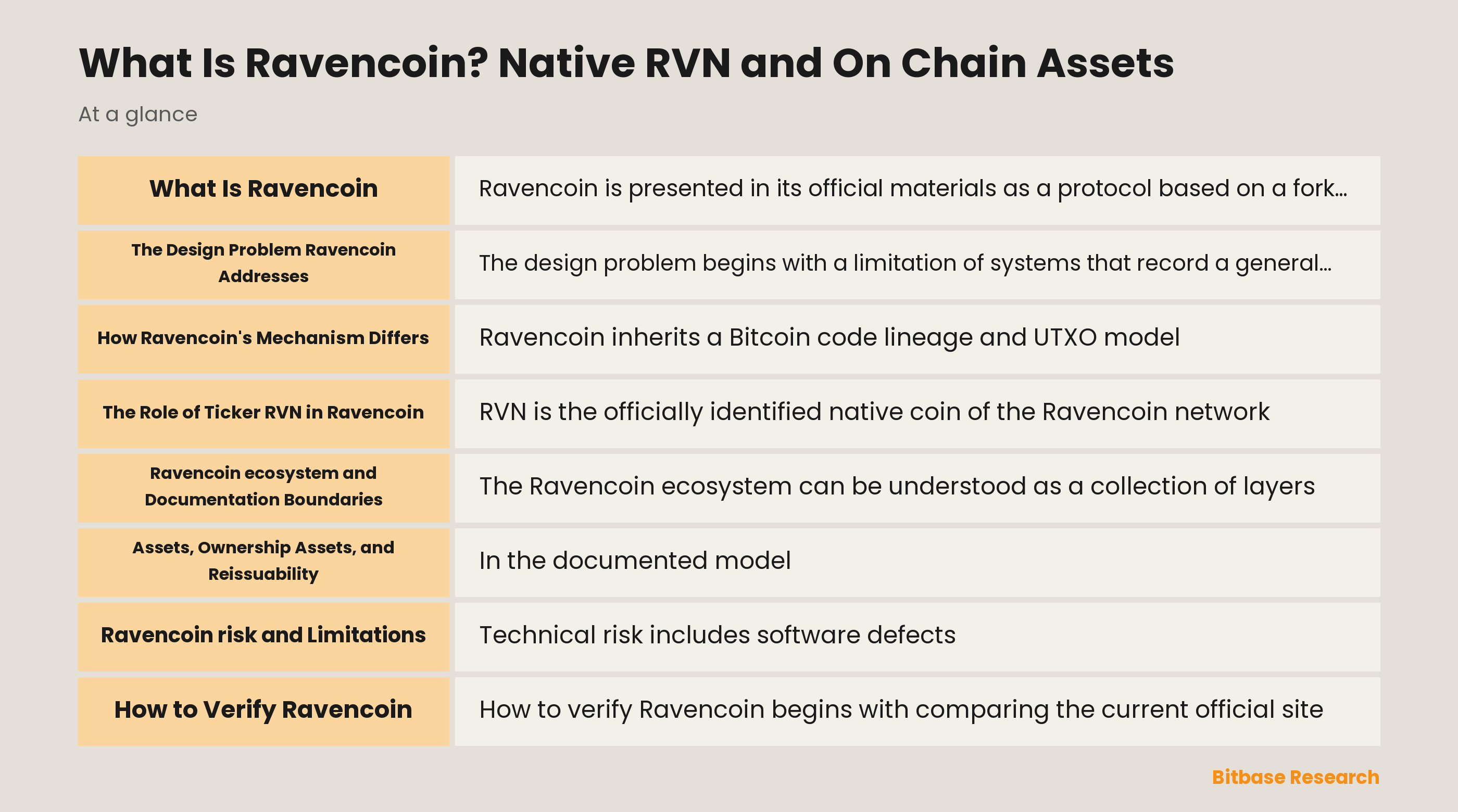
Documentation boundaries matter because the official asset page itself is technical and subject to revision, while a roadmap records planning context rather than an unconditional delivery promise. The public source repository can expose code and release history, but it is not by itself a completed security assessment or a statement that every branch is production ready. Before publication, code version, release status, network state, audits, integrations, partner claims, regional conditions, and legal language should be rechecked in current first party materials.
Assets, Ownership Assets, and Reissuability
In the documented model, an asset is a separately named protocol record with selected properties. It can be used as a digital representation chosen by its issuer, but that representation is technical rather than self authenticating. The fact that a name or metadata appears on chain does not establish that the issuer is authorized, that a linked item exists, or that a recipient receives a legally enforceable right. The relevant issuer, governing terms, identity evidence, and jurisdictional effect remain outside the chain and must not be inferred from the record alone.
An ownership asset is described as a related protocol object associated with certain asset administration functions, including the possibility of reissuance or related child asset structures under the documented rules. A unique asset is a distinct type intended to identify a one of one unit within the protocol model. Reissuability is a recorded property that can affect whether the protocol permits later changes such as additional units or metadata changes. These are mechanics, not a statement that an ownership asset creates legal ownership or that uniqueness establishes authenticity beyond the chain.
Ravencoin risk and Limitations
Technical risk includes software defects, incompatible implementations, malformed metadata, user interface mistakes, changes in the codebase, consensus disruptions, and misunderstandings of what a protocol record proves. A public ledger can make entries inspectable without proving the truth of an off chain description. A name can be similar to another name, a linked document can change outside the chain, and an asset's issuer can make claims the protocol cannot validate. These limitations apply even when the underlying record is correctly formed.
There is also risk in treating historical documentation as a current operational statement. The white paper, asset materials, repository, and roadmap were written or updated in particular contexts. Mining algorithm configuration, software releases, network conditions, asset issuance costs, security findings, and tool support are all time sensitive. Legal classification, regional availability, issuer authority, custody, and enforceability are external matters. None should be assumed from a technical overview, and no asset should be described as automatically carrying rights, income, control, or compensation.
How to Verify Ravencoin
How to verify Ravencoin begins with comparing the current official site, asset documentation, white paper, source repository, and roadmap, while keeping their purposes separate. Identity and the ticker RVN should agree across current first party sources. Historical design claims should be distinguished from present implementation claims, and a roadmap item should be treated as planning context unless current release evidence confirms it. This is a neutral research standard rather than a set of network interaction instructions.
For record level claims, an asserted official contract address or a block explorer entry should be compared with current official documentation and public on chain records on the publication date. Native RVN should not be assumed to have the same contract address model as an external representation. A block explorer can show a technical record, but it does not by itself verify issuer identity, legal rights, asset backing, audit coverage, or the truth of off chain metadata. Those claims require appropriately scoped primary evidence.
Conclusion
Ravencoin is most accurately described as a Bitcoin code fork with an asset aware protocol design and a native coin identified as RVN. The distinction between RVN and issued assets keeps the explanation grounded: RVN is the network's native unit, while assets are separate named records with issuer selected meaning. The design can support technical representation and record keeping without converting every on chain entry into an independently verified statement about the world beyond the network.
The asset vocabulary deserves the same care. Assets, ownership assets, unique assets, and reissuability describe capabilities and constraints in a protocol model. They do not settle who has authority over an issuer, whether a representation is accurate, whether a claim is enforceable, or whether a project related tool is currently functional. Versions, network status, algorithm configuration, costs, sources, and related claims should be confirmed at publication time rather than copied forward as timeless facts.
A durable introduction therefore stays with the documented boundaries: Ravencoin is the protocol, RVN is the native coin, and issued assets are distinct on chain records. Official sources can explain the intended architecture and code context, while external legal, operational, and factual claims need their own current verification. That separation is useful for readers because it explains the mechanism without implying value, rights, access, guaranteed availability, or an outcome for any person.
Related market pages
- RVN: View price · Perpetual market
Disclaimer: This article is educational content from Bitbase Academy, provided for information only. It explains what a project does and what role its token plays in that system; it does not constitute investment, trading, tax, or financial advice, and it is neither a recommendation nor an endorsement of any project or token. Bitbase has not carried out due diligence on the project described here, and mentioning it does not mean Bitbase lists or supports the asset. Crypto assets carry significant risk, including price volatility, thin liquidity, smart-contract failure, regulatory uncertainty, and the possible loss of their entire value. Written as of August 2026; a project's status, tokenomics, team, and contracts can change at any time. Verify everything yourself through official channels, the contract address, and a block explorer, and beware of imitation sites and phishing links.
References
[1] Ravencoin official website ravencoin.org
[2] Ravencoin Assets documentation ravencoin.org
[3] Ravencoin white paper ravencoin.org
[4] RavenProject Ravencoin source repository github.com
[5] RavenProject Ravencoin roadmap github.com