Raydium is documented as a set of Solana programs for automated market making and liquidity infrastructure, while RAY is identified in official materials as Raydium's native SPL token.
The common English searches raydium ecosystem and use cases, raydium solana, and how does raydium work ask related but different questions. One concerns the documented ecosystem, one concerns the network context, and one concerns the mechanism. This profile answers them at an architectural level. It does not turn a documented design into a claim about value, availability, security, legal status, or an outcome for any person.
What Is Raydium on Solana?
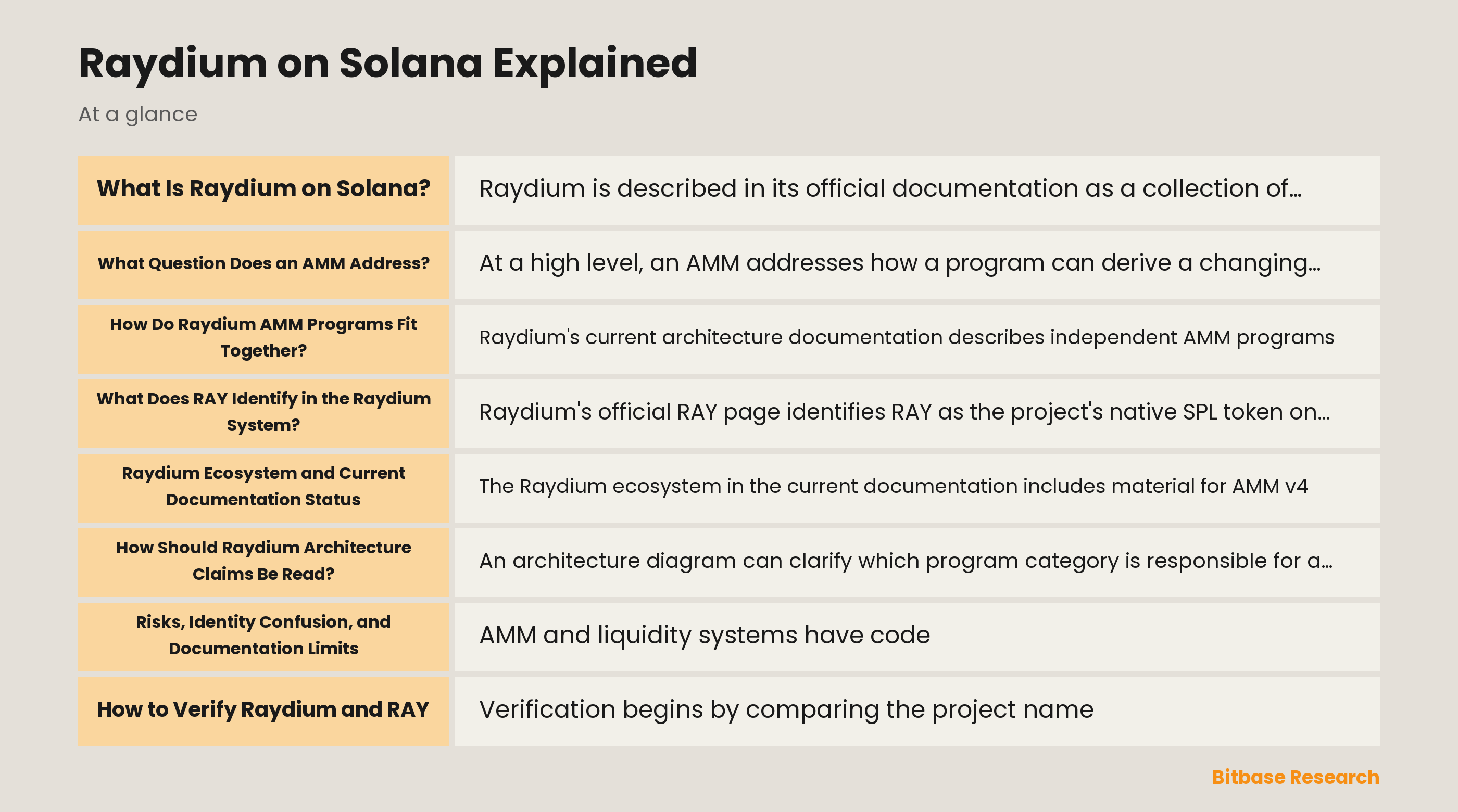
Raydium is described in its official documentation as a collection of permissionless, non-custodial smart-contract programs on Solana. The documentation presents these programs as a liquidity and automated market making stack rather than as one indivisible application. That distinction matters because each program has its own state, curve logic, version history, and risk surface.
An automated market maker, or AMM, is a system that represents an exchange relationship through programmed rules and balances held by program-controlled vaults. Rather than relying on a human intermediary to set every relationship, the program applies its stated curve to the reserves associated with a pool. The mechanism describes a way to organize onchain liquidity. It does not tell a reader whether a particular asset is sound, suitable, legally issued, or likely to retain any value.
The word liquidity here means that a program has a structured reserve design from which its curve can be calculated. It is not a promise that an asset can always be converted at an expected rate, that the reserve composition will remain stable, or that a particular route will be available. A liquidity description is therefore a starting point for understanding architecture, not a guarantee of execution, safety, or market depth.
What Question Does an AMM Address?
At a high level, an AMM addresses how a program can derive a changing relationship between two reserves without an external order book. A constant-product design commonly expresses its central relationship as x · y = k. If one reserve changes relative to the other, the curve implies a different relationship between the two sides. This is a mathematical model, not a prediction or a recommendation.
Raydium's documentation distinguishes more than one AMM design. CPMM is the standard constant-product form, while CLMM concentrates liquidity in selected ranges and Stable AMM uses an interpolated lookup-table curve for correlated assets. The existence of several designs reflects different program structures and constraints. It does not mean that one design is universally safer, more suitable, or more profitable than another.
Liquidity is also a state concept, not a quality label. Reserve balances, curve parameters, token behavior, program upgrades, and surrounding Solana conditions can affect what the mechanism represents at a given moment. A concise explanation should separate the durable idea of a curve-based program from time-sensitive observations about any individual pool or interface.
How Do Raydium AMM Programs Fit Together?
Raydium's current architecture documentation describes independent AMM programs, including AMM v4, CPMM, CLMM, and Stable AMM, together with supporting infrastructure such as routing and configuration conventions. The programs share the broader Solana environment but do not collapse into one universal pricing engine. A reader should therefore avoid treating the name Raydium as proof that every component has identical behavior or status.
CPMM is documented as a Solana-native constant-product AMM. CLMM is documented as a range-based design organized around ticks and position-level accounting. Stable AMM is documented as a separate program with a lookup-table curve. These descriptions explain why the Raydium architecture has multiple liquidity forms, without prescribing any action or claiming a result from them.
Official current documentation also draws an important historical boundary. AMM v4 once had an OpenBook order-book integration, but the documentation says that integration has been deactivated and that the associated accounts are inert. It must not be presented as a current source of shared liquidity. In this sense, how does raydium work is best answered through current program and curve descriptions, not through an obsolete integration narrative.
What Does RAY Identify in the Raydium System?
Raydium's official RAY page identifies RAY as the project's native SPL token on Solana. The accurate ticker is RAY. This identifies the token label used by the project documentation; it does not establish an ownership interest, a right to a return, a valuation, or a reason to acquire it.
A ticker is an identifier, not proof of authenticity. Similar-looking names, symbols, images, and descriptions can be copied. For editorial purposes, the token's official identity should be kept separate from unaffiliated material that merely reuses the word RAY or Raydium.
Supply data, mint information, allocation language, emissions, governance-related descriptions, and any utility wording are publication-day facts. They may be useful to a reader only when they are confirmed against the current official record and given their proper scope. This profile deliberately avoids repeating time-sensitive quantities or presenting any token mechanism as a promise.
Raydium Ecosystem and Current Documentation Status
The Raydium ecosystem in the current documentation includes material for AMM v4, CPMM, CLMM, Stable AMM, Farm, LaunchLab, and shared liquidity infrastructure. The documentation also separates native onchain programs from supporting offchain surfaces. This is a map of documented components, not confirmation that every named component has the same live status, geographic reach, interface availability, or maturity.
The current status language needs a release-day check. Official documents can change their descriptions of program versions, deactivations, upgrades, user-facing surfaces, or configuration options. The status of AMM v4, CPMM, CLMM, Stable AMM, Farm, and LaunchLab should therefore be read from the current official pages at publication, rather than inferred from an older article, a cached result, or a copied graphic.
The ecosystem list alone also does not establish a real-world-asset use case. It does not validate an underlying asset, an issuer, a legal claim, a reserve, or regulatory treatment. Any statement about a particular RWA arrangement requires its own primary evidence and should not be inferred from the existence of general Solana liquidity infrastructure.
How Should Raydium Architecture Claims Be Read?
An architecture diagram can clarify which program category is responsible for a type of state or curve. It cannot establish that a deployed instance is free of defects, that its configuration is appropriate, or that an external interface presents complete information. The meaning of a documented mechanism is narrower than a guarantee about its real-world consequences.
Non-custodial and permissionless are descriptions of a system model. They do not by themselves resolve questions about code risk, administrator authority, upgrade controls, token behavior, user error, regulatory treatment, or service continuity. Each of those questions has a different source of evidence and may change over time.
The documentation also distinguishes onchain programs from related offchain surfaces. That distinction helps prevent a broad product name from being treated as a single assurance. It does not imply that supporting infrastructure, documentation, indexing, or any interface will always be available, complete, or free from error.
Risks, Identity Confusion, and Documentation Limits
AMM and liquidity systems have code, configuration, composability, and asset-specific risks. Curve logic can behave differently from a reader's intuition, token features can introduce special behavior, and changes in surrounding systems can alter the conditions in which a program is interpreted. A concise profile cannot remove those risks.
There is also an identity risk. A familiar name, ticker, logo, screenshot, social account, or search result is not sufficient evidence that a source or asset is official. The official Raydium safety material emphasizes domain and identity checks because deceptive lookalikes and misleading labels can imitate legitimate projects.
An audit reference, a public code repository, or a security statement should be read for its exact scope and date. None independently guarantees security, compliance, liquidity, availability, or an absence of future changes. The appropriate editorial boundary is to describe what primary material says and to leave unverified claims outside the article.
How to Verify Raydium and RAY
Verification begins by comparing the project name, official documentation context, and the specific component being described across first-party Raydium material. A copied article, an unaffiliated directory, or a social post can be useful only as a lead, not as the authoritative source for a factual claim.
For RAY, publication review should match the ticker, Solana context, and the current official token record. A contract address or block explorer record can support identity review only when it corresponds to an identifier published by the official project material. It is not a substitute for checking the source, date, and scope of that material.
Finally, the review should distinguish stable mechanism statements from publication-day facts. Program versions, deactivation notices, mint data, interface status, security disclosures, official domains, and any RWA-related assertion require a current primary-source check. These are principles for assessing public information, not directions for using a product or authorizing an action.
Conclusion
Raydium is best understood from current first-party materials as a multi-program Solana AMM and liquidity architecture. CPMM, CLMM, Stable AMM, and the older AMM v4 design describe different ways in which the documented system organizes reserve state and curve logic. RAY is the official ticker of Raydium's native SPL token.
The central editorial boundary is between a documented mechanism and a guaranteed outcome. The current documentation should be read for scope and date, especially where an older order-book description, a token claim, a program status, or an RWA assertion could be mistaken for a present fact or a promise.
Related market pages
- RAY: View price · Spot market
Disclaimer: This article is educational content from Bitbase Academy, provided for information only. It explains what a project does and what role its token plays in that system; it does not constitute investment, trading, tax, or financial advice, and it is neither a recommendation nor an endorsement of any project or token. Bitbase has not carried out due diligence on the project described here, and mentioning it does not mean Bitbase lists or supports the asset. Crypto assets carry significant risk, including price volatility, thin liquidity, smart-contract failure, regulatory uncertainty, and the possible loss of their entire value. Written as of August 2026; a project's status, tokenomics, team, and contracts can change at any time. Verify everything yourself through official channels, the contract address, and a block explorer, and beware of imitation sites and phishing links.
References
[1] What is Raydium, Raydium Docs docs.raydium.io
[2] Raydium Architecture, Raydium Docs docs.raydium.io
[3] Versions and migration, Raydium Docs docs.raydium.io
[4] CPMM overview, Raydium Docs docs.raydium.io
[5] CLMM overview, Raydium Docs docs.raydium.io
[6] RAY, Raydium Docs docs.raydium.io
[7] Security and Risk, Raydium Docs docs.raydium.io
[8] Trust and safety, Raydium Docs docs.raydium.io