RedStone is a modular blockchain-oracle system. Its materials describe separate layers for sourcing data, distributing signed data, relaying it to a target chain, and consuming it in an application. Pull delivery brings a signed data package when a transaction needs it, while push delivery updates an onchain feed under an update policy. RED is the network's documented utility token. Those are system roles, not a statement about the value of RED.
What Is RedStone?
RedStone is infrastructure for getting data that originates outside a target blockchain into a smart-contract environment where an application can evaluate it. A blockchain can validate its own state, but it does not independently observe an exchange, a reserve, a web service, or another chain. An oracle is the set of components that carries an external observation to a contract together with rules for deciding whether the contract should accept it.
The useful way to understand RedStone is as a modular data path rather than as one indivisible feed contract. The project's developer materials divide that path into data sourcing, data distribution, data relaying, and data consumption. That separation is important because the people or systems that obtain data need not be the same components that transmit it, and the receiving contract still has to decide how to validate and use the delivered value.
The phrase redstone crypto is ambiguous in ordinary search results. In this article it means the RedStone oracle system and the separately named RED token described by RedStone's own materials. It does not mean that every token with a similar name, every asset using RED as a symbol, or every price-feed value is the RED token.
What Problem Does RedStone Address?
Smart contracts are deterministic: the same onchain inputs lead to the same computation. That property is useful, but it leaves a contract unable to discover an external fact by itself. A lending calculation, settlement rule, collateral check, or reserve-aware design may need a data value from beyond the chain. The contract needs a defined route from a source to a verifiable message, not simply a number copied into code.
The central problem is therefore broader than obtaining a feed. An application has to specify what data is relevant, which sources and signers it trusts, how old a value may be, what happens if data is absent, and who bears the cost of making the data available at the required moment. Each of those is a design decision. An oracle can provide material for that decision, but it cannot remove the decision from the consuming protocol.
RedStone's modular framing addresses this coordination problem by separating source, distribution, relay, and consumption. The separation can make it possible to use different delivery styles without redefining every other layer. It does not convert external data into a fact guaranteed by the chain, and it does not prove that a particular integration has selected sensible validation rules.
How Does RedStone Work?
The project's developer page describes four stages. Data sourcing is where a feed is assembled from appropriate inputs. Data distribution is where node infrastructure makes signed data available. Data relaying carries that material to the target chain. Data consumption is the target-chain step in which a contract unpacks and validates what it receives before using it in application logic.
In the pull pattern described by RedStone's technical materials, signed data packages are available offchain and a transaction that needs a value carries the package into the call. The consumer-side contract can inspect the package as part of execution. The project's open-source monorepo describes this approach as attaching data to a user's transaction and not retaining it as ordinary EVM storage after processing. The precise package format, signer policy, age limit, and handling of invalid input are implementation details that must be checked in the specific consumer contract.
In the push pattern, an updater writes a feed value to an onchain contract before a separate consumer transaction needs it. RedStone's product documentation describes push updates in terms of heartbeat and deviation conditions. A later consumer can read the stored value, but it must still decide whether the last update is sufficiently recent and whether the contract address and decimals are the intended ones. A push value is not automatically suitable merely because it is already onchain.
These delivery paths explain why a price feed and a token are different subjects. A feed may carry a reference value about an asset, a reserve, or another data set. RED is the ticker used in the project's token materials. The fact that an oracle can deliver a price-related data package says nothing by itself about the value of the RED token, and a sentence about RED's role says nothing about the correctness of a particular feed.
What Does RED Do in the System?
The official tokenomics material identifies the ticker as RED, and the current project token page calls RED the native utility token of the RedStone network. Those pages describe a design in which the token is intended to support economic security, decentralization, and incentives for participants in the oracle ecosystem. This is a documented system role, not a promise that every holder performs an operational role or receives a particular outcome.
Questions phrased as redstone tokenomics and use cases should be split into two parts. Tokenomics is the documented design around a token's supply and incentive structure; use cases are what the surrounding oracle system is built to deliver. Neither phrase should be used as shorthand for a feed's data quality, an application's safety, or a conclusion about the token's value. The token layer and the data-delivery layer have related incentives but different technical jobs.
The 2025 tokenomics article discusses staking as part of the intended economic-security design. This article does not give instructions for staking, does not treat that historical document as a current reward schedule, and does not infer governance rights, contract parameters, or a deployment status beyond what can be checked from current official material and a chain-specific explorer. A reader should keep the ticker, chain, contract, and version separate.
RedStone Ecosystem and Adoption Context
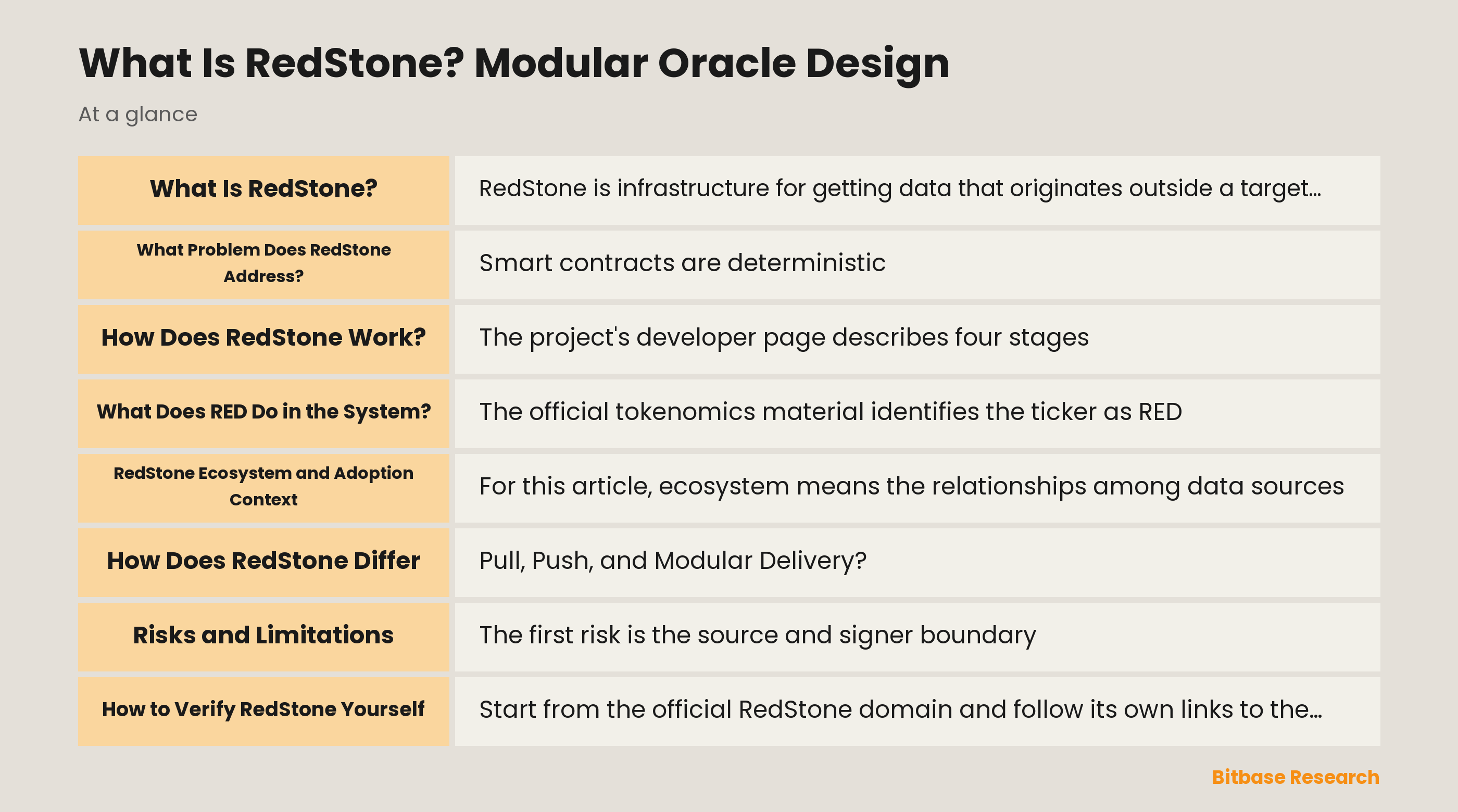
For this article, ecosystem means the relationships among data sources, data providers or nodes, distribution services, relaying mechanisms, consumer contracts, developers, and the RED incentive layer. RedStone's current developer and product pages present pull and push feeds as available delivery choices. That is useful context for understanding the vocabulary, but it is not an independent audit of every integration that may appear around the project.
Adoption should be verified one deployment at a time. A logo, a feed catalogue, or a public statement does not prove that a particular contract is live, configured correctly, or currently relying on a given delivery model. The most reliable question is narrower: on a named chain, which contract is deployed, which data package or feed does it read, and what validation conditions does that contract enforce?
How Does RedStone Differ: Pull, Push, and Modular Delivery?
Pull and push differ mainly in when the target chain receives the data. With pull delivery, the data package arrives when an application transaction asks for it. Freshness is linked to that transaction and to the consumer's acceptance rules. If no transaction carries a valid package, there is no automatic new state written just because time has passed. This can be useful for an application that needs a value only at specific moments, but the integration has to handle missing or stale data deliberately.
With push delivery, an updater places values into an onchain feed based on its configured update conditions. A later contract call can read the stored feed without embedding the package in that call. The trade-off is not a universal ranking: the updater, the protocol, or another arrangement must pay for and monitor updates, while the consuming protocol must still set its own freshness and fallback rules. A value that is stored onchain can still be old, misconfigured, or read from the wrong address.
Modular delivery means the same broad data pipeline can be paired with more than one relay style instead of forcing every application into the same moment of delivery. It does not mean every feed exists in both forms on every chain, or that an integration can swap modes without code review. What is redstone crypto, in this narrower technical sense? It is an oracle design whose components can be separated; it is not a claim that one delivery mode is always faster, cheaper, safer, or appropriate for every application.
Risks and Limitations
The first risk is the source and signer boundary. A signature can show that an approved signer produced a message; it cannot independently establish that the underlying observation was complete, timely, correctly aggregated, or economically appropriate for a particular protocol. A consumer should know which signers and data sources its configuration accepts, what aggregation is used, and which kinds of market or infrastructure disruption the design assumes.
The second risk is delivery and availability. A pull integration depends on obtaining a valid package at the moment of a transaction, while a push integration depends on the updater and on the stored feed remaining within the consumer's acceptable age. Network disruption, a delayed relay, a wrong chain, an endpoint problem, or an outdated integration can leave an application without the data it expected. Modular architecture creates choices; it does not remove operational dependencies.
The third risk sits in the consumer contract. Wrong decimals, a mismatched feed identifier, an overly loose timestamp check, a missing fallback, an upgrade, or a mistaken contract address can produce harmful application behavior even if an oracle component behaves as designed. Audit claims require a report with a clear scope and version from the auditing firm's own site. This article deliberately makes no audit-status claim for RedStone as a whole or for any particular deployment.
How to Verify RedStone Yourself
Start from the official RedStone domain and follow its own links to the developer material, token material, and public code repository. Check that the project name is associated with the exact ticker RED in the official tokenomics page, rather than relying on a search result or an asset with a similar name. Treat social posts, advertisements, and lookalike domains as leads to investigate, not proof.
For a chain-specific token or feed, compare the chain and contract address against current official material, then inspect the address in the relevant block explorer. Read the contract name and verified source code where available, and confirm that the symbol and address match the intended deployment. The Ethereum explorer entry for RED is a useful cross-check target, but an explorer label alone is not a substitute for an official address announcement.
For a consuming application, inspect the read-only code or documentation for the feed identifier, signer or provider policy, timestamp checks, decimal handling, fallback behavior, and pause or upgrade controls. If an audit is claimed, find the report on the auditor's own domain and compare its scope and commit or deployment with the code being used. Do not connect a wallet, sign a message, or follow a claim prompt merely to perform these checks.
Conclusion
RedStone is best understood as a modular oracle design. Data can be sourced, distributed, relayed, and consumed as separate concerns. Pull delivery brings signed material with a transaction that needs it; push delivery places values onchain under an update policy. The differences matter because they change when data arrives and what the consuming application must validate.
RED is the documented utility-token ticker for the RedStone network, while a feed is a data-delivery mechanism. Keeping those concepts separate prevents a common error: confusing the mechanics of a price-related oracle feed with a statement about a token. The safe next step is read-only verification of the official domain, exact chain and contract, block-explorer code, and the consumer's own validation logic.
Related market pages
- RED: View price · Spot market · Perpetual market
Disclaimer: This article is educational content from Bitbase Academy, provided for information only. It explains what a project does and what role its token plays in that system; it does not constitute investment, trading, tax, or financial advice, and it is neither a recommendation nor an endorsement of any project or token. Bitbase has not carried out due diligence on the project described here, and mentioning it does not mean Bitbase lists or supports the asset. Crypto assets carry significant risk, including price volatility, thin liquidity, smart-contract failure, regulatory uncertainty, and the possible loss of their entire value. Written as of August 2026; a project's status, tokenomics, team, and contracts can change at any time. Verify everything yourself through official channels, the contract address, and a block explorer, and beware of imitation sites and phishing links.
References
[1] RedStone Developers: Modular Architecture www.redstone.finance
[2] Pull oracles vs Push oracles blog.redstone.finance
[3] RedStone Oracles Monorepo README github.com
[4] Introducing RED Tokenomics blog.redstone.finance
[5] $RED Token www.redstone.finance
[6] Price Feeds www.redstone.finance
[7] Redstone (RED) ERC-20 explorer entry etherscan.io