Renzo is documented as an onchain staking and liquid-restaking platform; REZ is its governance token, while the documented token products represent distinct restaking contexts rather than a guaranteed outcome.
The Renzo protocol is often discussed through the phrase liquid restaking. That label can make a multi-layered arrangement sound simpler than it is. This profile explains the roles described in Renzo’s own documentation, separates the governance token from liquid-restaking representations, and keeps operational instructions, performance claims, and financial promises outside its scope.
What Is Renzo?
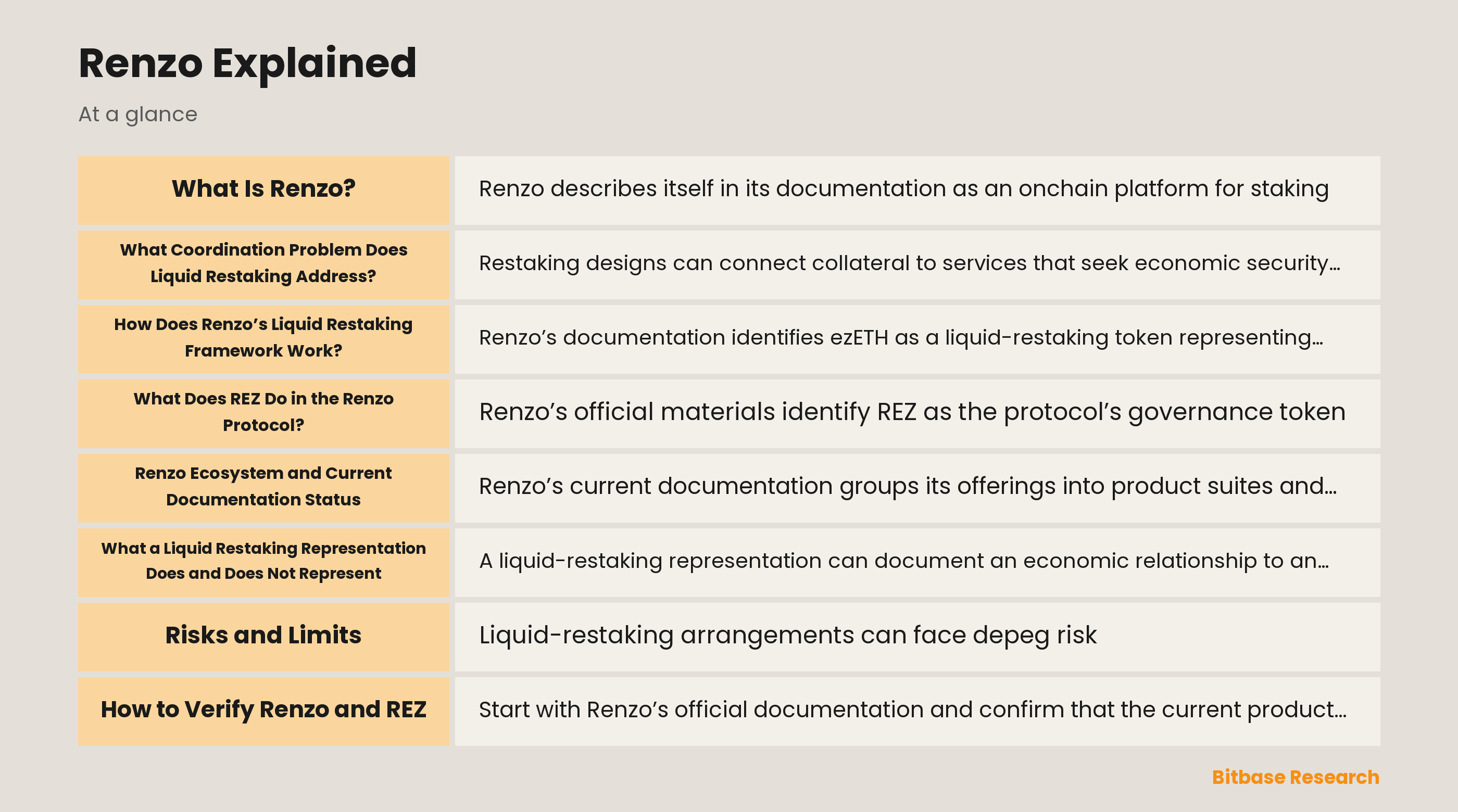
Renzo describes itself in its documentation as an onchain platform for staking, restaking, and capital deployment across crypto ecosystems. In the narrower liquid-restaking context, it presents a protocol layer that organizes a position associated with an underlying restaking ecosystem and expresses that position through a tokenized representation. The description is about protocol structure, not a statement that every product surface has identical rules or availability.
Liquid restaking combines two ideas that should be kept separate. Restaking concerns how economic security can be associated with additional services, while liquidity concerns whether a representation of a position can circulate separately from the underlying arrangement. Combining the ideas does not remove the dependencies beneath them. It can instead add contracts, service-selection assumptions, accounting, and liquidity conditions to the risk picture.
Renzo’s materials use several product names, so a careful reader should not treat the word Renzo as one interchangeable asset. A liquid-restaking representation is a documented product relationship with its own collateral context, accounting method, and exit conditions. The current documentation is the appropriate source for identifying which representation, network context, and terms are being described at a particular time.
What Coordination Problem Does Liquid Restaking Address?
Restaking designs can connect collateral to services that seek economic security beyond a base network. As the number of services and the choices among them expand, the relationships among collateral, service exposure, risk parameters, and protocol controls can become difficult to describe in a single position. Renzo documents its role as a layer intended to abstract part of that complexity.
Abstraction is not the same as disappearance of risk. A liquid-restaking arrangement can still depend on the underlying restaking system, the assets represented, the services receiving economic security, contract logic, and the conditions under which liquidity is available. A reader should therefore distinguish a simplified interface or token representation from a simplified risk profile.
The coordination question also has a governance dimension. Decisions about supported collateral, concentration, service selection, and risk frameworks can influence how a protocol evolves. Those decisions are not timeless properties of a token. They are policy and implementation matters that may be changed through the project’s documented controls or through updates to the surrounding ecosystem.
How Does Renzo’s Liquid Restaking Framework Work?
Renzo’s documentation identifies ezETH as a liquid-restaking token representing an EigenLayer restaked position in the Renzo context. It also describes pzETH as a liquid-restaking token associated with a position in the Symbiotic context. These descriptions establish that the named products refer to different underlying arrangements; they should not be assumed to have identical technical, economic, or timing characteristics.
At a high level, a representation token is meant to make an underlying position legible within another onchain context. Its relationship to collateral is maintained by contracts and protocol accounting rather than by a promise that a holder can ignore the condition of the underlying systems. The relevant relationships may include the underlying assets, the restaking environment, the service exposures, and the protocol’s own configuration.
Renzo’s documentation also describes contract upgradeability and governance-related controls. These are important design facts because they identify authority and change-management considerations, not because they prove an arrangement is immune to faults. A sound explanation of the framework must leave room for software defects, configuration changes, external protocol changes, and the possibility that documentation is revised.
What Does REZ Do in the Renzo Protocol?
Renzo’s official materials identify REZ as the protocol’s governance token. The documentation associates its governance scope with proposals about matters such as risk-management frameworks, collateral and concentration parameters, service-related whitelisting, treasury matters, and community grants. This is the documented function of the ticker REZ, rather than a claim about ownership of every asset or activity connected with the protocol.
Governance can shape a protocol’s parameters, but it does not erase the separate risks of the underlying restaking arrangements. A governance token should not be confused with a liquid-restaking representation such as ezETH or pzETH, and a token’s governance role does not establish a fixed technical state, an immutable policy, or a particular financial result.
Published tokenomics may describe allocations, vesting, supply, or governance design. Those are data points that can be updated, interpreted differently across documentation versions, or altered by later governance and implementation events. This article therefore explains REZ at the stable functional level and leaves current token data, identifiers, and governance status for a fresh publication-day check.
Renzo Ecosystem and Current Documentation Status
Renzo’s current documentation groups its offerings into product suites and separately documents liquid-restaking products, governance material, contract records, and security material. That ecosystem view is useful because it shows that a project name can cover more than one product configuration. It is not evidence that every listed feature is active in every jurisdiction, chain environment, or collateral context.
The documentation’s references to EigenLayer and Symbiotic identify distinct restaking environments associated with different product representations. Each environment can have its own security assumptions, supported assets, service exposure, and timing conditions. Describing those environments together should not be read as a comparison, an endorsement, or a statement that their risks are interchangeable.
Current availability, supported assets, contract records, governance procedures, audit coverage, protocol pauses, and product terms are all time-sensitive. Before publication, those facts should be checked in the latest official materials. This article deliberately avoids treating an older documentation page, an unaffiliated listing, or a copied social post as proof of present status.
What a Liquid Restaking Representation Does and Does Not Represent
A liquid-restaking representation can document an economic relationship to an underlying position while remaining subject to the systems that maintain that relationship. It is not a standalone guarantee about collateral quality, service behavior, software operation, or the time required for a position to change state. The word liquid describes a design objective and a possible transferability property, not certainty of immediate or frictionless liquidity.
The relation between a representation and its underlying assets can be affected by protocol accounting, service exposure, delays, external conditions, and changes in configuration. This is why a liquid-restaking token should not be described as a cash equivalent or as a permanent fixed-value instrument. Its documented mechanics need to be read alongside the current risk and product materials.
It is also important not to turn a token representation into an implied operating instruction. The protocol’s public materials may describe many product functions, but this educational profile does not direct anyone to enter, exit, convert, claim, or delegate a position. It focuses on how the documented components fit together and on what needs independent verification.
Risks and Limits
Liquid-restaking arrangements can face depeg risk: the relationship between a representation and its underlying collateral may change under stress, delay, market conditions, or protocol-specific events. Liquidity can be limited when demand, available buffers, or underlying settlement conditions change. A liquid label does not ensure a stable relationship or immediate access in every circumstance.
Slashing risk is another material consideration where a restaking design connects economic security to external services. Renzo’s own documentation also identifies smart-contract risk, and linked systems can introduce additional dependencies. A flaw, incorrect configuration, security event, or unexpected behavior in any relevant layer can affect an arrangement even when the high-level design is documented clearly.
Audits, governance processes, and risk frameworks can be informative, but none of them is a warranty that a system will operate without loss, interruption, or change. There can also be legal, tax, data, governance, and documentation risks. Nothing in this profile is a promise of profitability, liquidity, safety, or a particular result.
How to Verify Renzo and REZ
Start with Renzo’s official documentation and confirm that the current product page, governance material, token-information page, risk disclosures, and contract documentation identify the same project and ticker REZ. Where the project publishes a contract address for a given network, compare that address with the corresponding block explorer and confirm the chain context before relying on it. An absent or conflicting official record is a reason not to infer an answer.
Also check the latest official wording for the relevant liquid-restaking representation, supported environment, pause or timing conditions, security documentation, and governance process. Verification means checking whether a current primary source supports a precise statement; it is not an instruction to use a protocol or an assurance that a listed feature will remain available.
Conclusion
Renzo is best understood as a documented onchain platform with liquid-restaking products that relate to distinct underlying contexts. REZ is described as the governance token, while ezETH and pzETH are product-specific liquid-restaking representations. Keeping those roles separate makes it easier to avoid overstating what a project label or token name alone proves.
For publication, reconfirm the current official status of the relevant product, its network and contract record, risk disclosures, governance information, and any changing parameters. The stable mechanism explanation in this profile is deliberately narrower than a claim about present availability, financial outcomes, or technical safety.
Related market pages
- REZ: View price · Perpetual market
Disclaimer: This article is educational content from Bitbase Academy, provided for information only. It explains what a project does and what role its token plays in that system; it does not constitute investment, trading, tax, or financial advice, and it is neither a recommendation nor an endorsement of any project or token. Bitbase has not carried out due diligence on the project described here, and mentioning it does not mean Bitbase lists or supports the asset. Crypto assets carry significant risk, including price volatility, thin liquidity, smart-contract failure, regulatory uncertainty, and the possible loss of their entire value. Written as of August 2026; a project's status, tokenomics, team, and contracts can change at any time. Verify everything yourself through official channels, the contract address, and a block explorer, and beware of imitation sites and phishing links.
References
[1] Renzo Protocol Overview (official documentation) docs.renzoprotocol.com
[2] Understanding Liquid Restaking (official documentation) docs.renzoprotocol.com
[3] REZ Basic Info (official documentation) docs.renzoprotocol.com
[4] REZ Tokenomics and Governance Scope (official documentation) docs.renzoprotocol.com
[5] Renzo FAQs and stated risk context (official documentation) docs.renzoprotocol.com
[6] Renzo Audits (official documentation) docs.renzoprotocol.com