RLUSD is the ticker for Ripple USD, an issuer-based U.S.-dollar stablecoin described in Ripple materials as supported by segregated reserve assets. It is distinct from Ripple, XRP, and the XRP Ledger, while issuer details, reserve reports, network representations, legal terms, and availability all require a publication-day check.
The question “what is rlusd” is best answered by separating a documented design from a changing operating context. Ripple is the company associated with the product materials, XRP is a separate digital asset, and XRP Ledger is a separate ledger network. Keeping those names separate prevents a ticker from being mistaken for a company share, a native network asset, or a general promise about access or outcomes.
What Is RLUSD
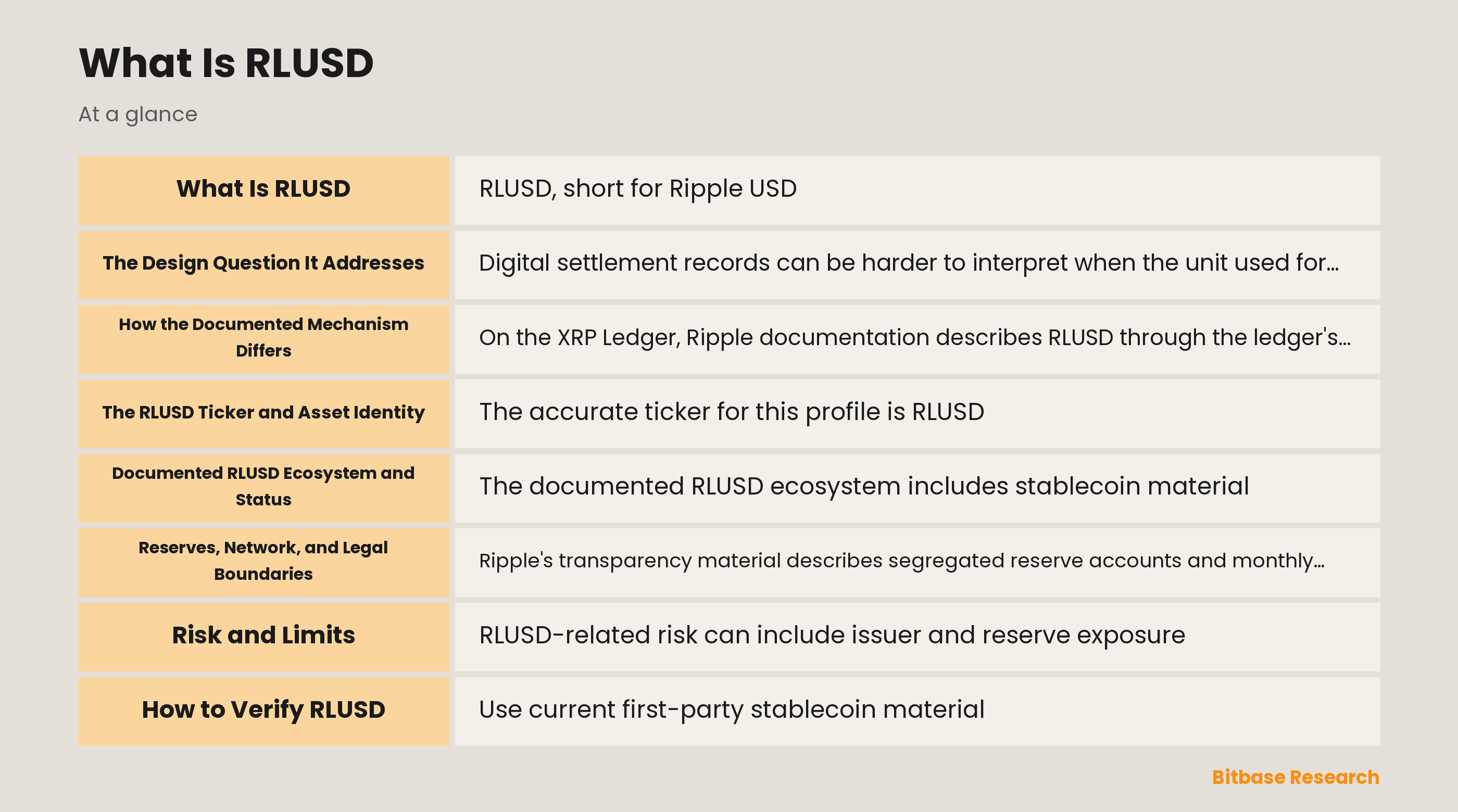
RLUSD, short for Ripple USD, is documented as a stablecoin intended to reference the U.S. dollar. An issuer-based stablecoin connects a token recorded on a ledger with an issuer's offchain reserve arrangements, policies, and legal documentation. The intended reference is part of the design description; it does not independently establish a current condition or a holder's particular right. The relationship also has an issuance and governance layer: the relevant issuer and legal documents define the scope of the instrument, the parties covered by it, and the conditions that may apply under law. A recorded representation is therefore different from a conclusion that a particular person or entity is eligible, that an issuer-side settlement or redemption right applies in a given jurisdiction, or that the same terms govern every network representation.
Ripple's stablecoin terms describe RLUSD as a digital token for a payment mechanism on supported ledger systems. That description is useful because it frames the asset as an issued instrument with contractual and operational boundaries. It is not XRP, it is not the XRP Ledger's native asset, and it should not be treated as an ownership interest in Ripple.
The Design Question It Addresses
Digital settlement records can be harder to interpret when the unit used for accounting changes independently of the obligation being described. A dollar-referencing token is one way an issuer may organize a documented accounting unit for payment, treasury, or settlement contexts. The design does not remove issuer, legal, reserve, custody, counterparty, or network uncertainty.
The model also joins two distinct layers. A ledger can record an asset representation under its own rules, while reserve composition, custody arrangements, attestations, participant eligibility, and contractual language sit outside that ledger. A ledger record alone therefore cannot establish the scope or current status of the offchain framework.
How the Documented Mechanism Differs
On the XRP Ledger, Ripple documentation describes RLUSD through the ledger's issued-token functionality. That differs from XRP, which is described separately as the XRP Ledger's native digital asset. An issued representation depends on an identified issuer relationship, so the network, its native asset, the issuer, and the issued token must not be collapsed into one identity.
Official material has also described RLUSD in more than one ledger environment. An EVM-style representation can depend on a smart contract, whereas an XRPL representation involves issued-currency mechanics and an issuer account. A chain label, contract address, issuer account, bridge reference, and token name are separate identifiers that need current official confirmation.
The RLUSD Ticker and Asset Identity
The accurate ticker for this profile is RLUSD. It identifies Ripple USD, not Ripple the company, not XRP, and not the XRP Ledger. The same ticker should not be used as shorthand for every similarly named asset or every representation that may appear in a different ledger environment.
Ripple's public materials connect the issuance and reserve framework to Standard Custody & Trust Company, LLC, while other Ripple material describes the broader product context. That issuer-versus-brand distinction matters. The applicable entity, legal language, reserve framework, supported representation, and any contractual rights are dynamic matters that must be checked from the current official record. Public descriptions of custody and reserves should be read as dated, separable claims rather than as a single label. A careful review identifies the legal issuer, the stated custodian role, the reserve categories described, the report period, and whether the wording concerns circulating units, issuer obligations, or both. A change in a service provider, agreement, jurisdiction, or representation can change the scope of a statement without changing the RLUSD ticker.
Documented RLUSD Ecosystem and Status
The documented RLUSD ecosystem includes stablecoin material, transparency material, user terms, and technical documentation for supported ledger environments. These sources discuss payment, settlement, and integration contexts. The phrase “RLUSD stablecoin use cases” is useful for research, but it should be read as a prompt to distinguish documented scope from current availability.
An announcement, a technical page, or an integration reference does not establish that a feature is currently available to every person, entity, or region. Current counterparties, geography, supported networks, product scope, circulation information, and access conditions can change. Publication should describe them only after a date-specific check of first-party material. Status needs the same discipline as identity: a token can be named in technical documentation while a particular legal entity, region, ledger version, or participant category is outside the documented scope. Current eligibility, issuer terms, reserve-report timing, custody language, network support, and any applicable legal notices are separate publication-day questions, not details that can safely be inferred from an earlier announcement.
Reserves, Network, and Legal Boundaries
Ripple's transparency material describes segregated reserve accounts and monthly independent CPA attestations concerning management's assertions about circulating RLUSD and reserve composition. An attestation has a defined date, scope, and methodology; it is not a blanket conclusion about every legal, operational, or counterparty risk. Current reserve-report wording, the relevant entity, participant eligibility, and contract-defined rights require separate review. A monthly transparency report is most useful when treated as a point-in-time document: its date, reporting entity, reserve categories, independent attestation provider, methodology, and stated conclusion should be read together. The existence of a report does not answer matters outside its stated scope, such as a later amendment to governing terms, a change in custody arrangements, or the status of a representation in a particular legal region.
Multiple ledger environments create additional identity boundaries. On XRPL, an issuer account and issued-token mechanics are relevant; on an EVM-compatible network, a smart-contract or proxy address and the selected chain are relevant. Custody arrangements, bridge relationships, canonical representation, regional restrictions, and any stated support are publication-day facts rather than permanent assumptions.
Risk and Limits
RLUSD-related risk can include issuer and reserve exposure, legal and participant-eligibility constraints, custody and counterparty dependencies, smart-contract defects, bridge failures, network congestion, counterfeit-token confusion, and deviation from the intended reference. A reserve report, legal term, or product announcement cannot settle every current risk question by itself.
There are interpretation risks as well. Terms such as “backed,” “regulated,” “available,” or “supported” have defined meanings in official materials and can vary with jurisdiction, participant type, documentation date, and representation. They should not be read as a conclusion about safety, liquidity, legal treatment, or any particular outcome.
How to Verify RLUSD
Use current first-party stablecoin material, transparency material, and user terms to compare the ticker, issuer wording, reserve-report date and scope, participant-eligibility language, regional notices, and stated legal boundaries. This is a research review of identity and documentation, not a sequence for interacting with a product.
For a network-specific identity check, compare the current official technical documentation with the relevant block explorer and the official token-address material. Confirm that the chain, issuer account or contract address, address type, representation, and official support statement agree. Treat any mismatch, old capture, or unaffiliated copy as a reason to seek a dated official clarification.
Conclusion
RLUSD is the official ticker for Ripple USD, an issuer-based stablecoin documented around a U.S.-dollar reference and reserve framework. It is separate from Ripple, XRP, and the XRP Ledger, and that distinction is the starting point for an accurate project profile.
The useful boundary is between documented mechanism and current state. Reserve reports, issuer arrangements, legal terms, participant conditions, network identifiers, contract or issuer accounts, bridges, counterparties, integrations, and availability can all change and need source-by-source confirmation on the publication date.
This profile explains identity, documentation boundaries, and risk questions without making a value assessment, a suitability conclusion, or an access recommendation. Its purpose is to make the next research check more precise: identify the issuer, identify the representation, read the current reserve and legal materials, and keep documented design separate from current status.
Related market pages
- RLUSD: View price · Spot market
Disclaimer: This article is educational content from Bitbase Academy, provided for information only. It explains what a project does and what role its token plays in that system; it does not constitute investment, trading, tax, or financial advice, and it is neither a recommendation nor an endorsement of any project or token. Bitbase has not carried out due diligence on the project described here, and mentioning it does not mean Bitbase lists or supports the asset. Crypto assets carry significant risk, including price volatility, thin liquidity, smart-contract failure, regulatory uncertainty, and the possible loss of their entire value. Written as of August 2026; a project's status, tokenomics, team, and contracts can change at any time. Verify everything yourself through official channels, the contract address, and a block explorer, and beware of imitation sites and phishing links.
References
[1] Ripple USD stablecoin overview ripple.com
[2] Ripple USD transparency reports ripple.com
[3] RLUSD Stablecoin User Terms ripple.com
[4] RLUSD on the XRP Ledger docs.ripple.com
[5] RLUSD token addresses docs.ripple.com