Secret Network is documented as a smart-contract network that combines encrypted contract data with Trusted Execution Environments, or TEEs, to support private inputs, outputs, and state.
The search phrase secret network crypto can refer to several different things at once: a network, a privacy-oriented smart-contract design, Secret Contracts, and the native coin identified as SCRT. Those terms are related but not interchangeable. Secret Network is most accurately described through the architecture in its documentation: a Cosmos-based network whose design combines encrypted contract data, key-management methods, and Trusted Execution Environments. That description is more precise than treating the name as a blanket promise that every fact, action, or identity associated with the network is hidden.
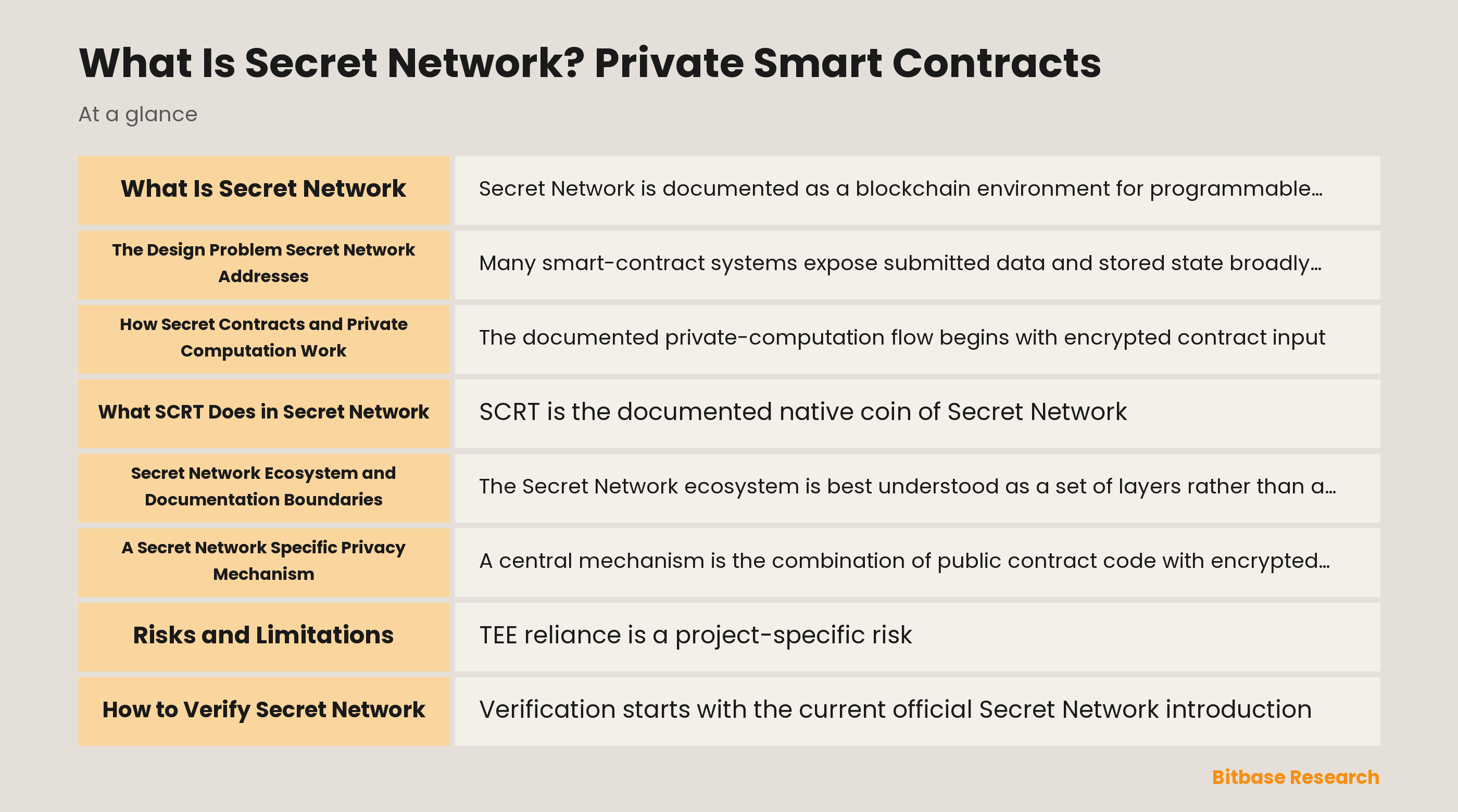
What Is Secret Network
Secret Network is documented as a blockchain environment for programmable private computation. Its materials describe a network built with the Cosmos SDK and Tendermint-oriented Byzantine fault tolerant consensus, alongside a contract model called Secret Contracts. The core idea is not merely to place encrypted files on a ledger. It is to let contract logic process protected data under defined technical conditions while the durable contract state is recorded in encrypted form. The network name identifies that architecture and its documentation scope, rather than every application or service that may be associated with it.
A Secret Contract is the network's privacy-oriented adaptation of the CosmWasm smart-contract model. The contract binary is designed to be public, so the code intended to run can be inspected, while selected contract metadata is handled as encrypted input, encrypted output, and encrypted state. This separation matters. Public code can make a program's stated logic reviewable, but it does not automatically prove that the code is free of defects or that every surrounding component behaves as expected. Private metadata also does not make every observable property of a network interaction disappear.
The Design Problem Secret Network Addresses
Many smart-contract systems expose submitted data and stored state broadly because validators must independently evaluate the same transition. Secret Network addresses the design question of how a distributed validator set can reach agreement on contract results without treating the contract's sensitive payload as ordinary public ledger data. Its documented answer combines encryption with a hardware-backed execution boundary. The data is meant to be processed in an enclave, while consensus records encrypted results and encrypted state rather than publishing their plaintext form as a general network record.
That goal has important limits. Encryption of inputs, outputs, and state describes particular data layers; it is not the same thing as universal anonymity. Timing, public contract code, fee-related information, transaction structure, network-level behavior, or an application's own intentional disclosures can still reveal context. A careful explanation should therefore say what the design protects under its stated assumptions, not claim that the architecture erases all metadata or prevents every possible correlation between a person, an address, and an event.
How Secret Contracts and Private Computation Work
The documented private-computation flow begins with encrypted contract input. Validator infrastructure passes that protected data to a Trusted Execution Environment, where the relevant key material and contract execution are intended to be available inside the enclave. The enclave decrypts the input, runs the Secret Contract over plaintext during that confined execution, reads or updates the relevant state, then encrypts the resulting output and state for recording. The important nuance is that computation occurs on plaintext inside the TEE, not on ciphertext through an unconditional cryptographic black box.
Consensus is organized around matching results produced by participating validators, with encrypted output and encrypted state committed after agreement. The TEE layer is therefore part of the security model, not a decorative add-on. Official documentation describes remote attestation as a way to establish claims about the enclave application identity, integrity, and execution on an eligible platform. Those claims depend on the trusted hardware, attestation process, implementation, key handling, validator operation, and software supply chain. They should be read as explicit trust assumptions rather than as proof that the system is immune to hardware, implementation, or operational failure.
What SCRT Does in Secret Network
SCRT is the documented native coin of Secret Network. Official materials associate it with fees for network computation and transactions, a role in the network-security model, and protocol governance. These are role descriptions, not instructions for using the coin and not an economic forecast. They identify why SCRT appears in the protocol's own documentation: it is the named native unit connected to the operation and administration of the network rather than another name for Secret Contracts or for encrypted application data.
The distinction between SCRT and private contract data is especially useful. Secret Network documentation characterizes the native coin as public on-chain, while Secret Contracts are designed to protect specified input, output, and state metadata. Consequently, the presence of a private-computation layer should not be stretched into a claim that every protocol-layer fact involving SCRT is confidential. The current description of fees, security participation, governance procedures, chain parameters, supply information, and related policy boundaries should all be checked in first-party material on the publication date.
Secret Network Ecosystem and Documentation Boundaries
The Secret Network ecosystem is best understood as a set of layers rather than a single product claim. Those layers include the base network, the Secret Contract runtime, privacy and encryption documentation, validator-side infrastructure, and independent application work that may rely on the architecture. A statement about the base protocol does not automatically establish the function, availability, security posture, or legal status of an application. Likewise, a general overview page is not evidence that a particular integration, feature, or organization remains active at a later date.
Documentation boundaries are particularly important for a privacy-focused system. An overview can explain the intended architecture, a technical page can describe a mechanism, and an application page can describe a project-specific feature, yet none substitutes for the others. Current application coverage, connected-network support, code versions, implementation choices, audits, partnerships, and service status are dynamic facts. They require publication-day confirmation from suitable first-party materials instead of being inferred from the existence of the Secret Network ecosystem or from a historical technical description.
A Secret Network Specific Privacy Mechanism
A central mechanism is the combination of public contract code with encrypted contract metadata. Making the binary public gives reviewers an object to examine, while keeping input, output, and state encrypted aims to limit general visibility of sensitive values. The TEE provides the narrowly defined place where decryption and contract execution occur. This model is distinct from saying that the chain performs arbitrary computation without ever handling plaintext anywhere. The security proposition is that plaintext is confined to the trusted enclave according to the documented design.
That mechanism also creates application-level responsibilities and limits. Contract logic determines how it handles data after it is available within the enclave, so a poorly designed contract can expose information through its behavior, outputs, permissions, or related public signals. The protocol documentation also discusses implementation constraints associated with encrypted state and privacy-preserving contract design. Encryption at rest, access controls, and enclave isolation can reduce exposure, but they do not replace careful code review, sound data minimization, or an understanding of which information remains observable outside the protected execution boundary.
Risks and Limitations
TEE reliance is a project-specific risk. The privacy model depends on assumptions about hardware isolation, enclave software, attestation, firmware and platform maintenance, cryptographic key management, and the validator systems that operate the code. Hardware vulnerabilities, side-channel research, compromised infrastructure, supply-chain failures, or flaws in the surrounding implementation can weaken assurances that would not arise in exactly the same way in a design based on different privacy technology. Describing data as encrypted does not remove those dependencies.
There are also ordinary distributed-systems and smart-contract risks. A bug in contract logic can mishandle sensitive data; a protocol change can alter behavior; consensus or validator incidents can affect network operation; and observable metadata can still support inference in some settings. Documentation itself can become stale. No architecture should be described as delivering unconditional security, complete anonymity, permanent confidentiality, or a guarantee against every disclosure path. The correct claim is narrower: the documentation describes a privacy model with specific protections and specific trust assumptions.
How to Verify Secret Network
Verification starts with the current official Secret Network introduction, privacy-technology materials, private-computation explanation, and SCRT documentation. A reviewer should confirm that the page is first-party, identify its update date and scope, and separate statements about protocol design from statements about present deployment or application status. The relevant technical questions include whether the documents still describe encrypted input, output, and state, whether the TEE model and attestation explanation remain the same, and whether SCRT is still identified with the stated protocol roles.
Before publication, recheck implementation version, network status, TEE and attestation details, supported hardware assumptions, validator information, code repositories, audit statements, governance procedures, current fee policy, connected-network claims, application coverage, partnerships, legal terms, and regional limitations. Any contract identity, supply figure, allocation statement, security certification, or integration claim needs a current primary source with a clearly matching scope. That is a verification standard for factual writing, not a procedure for interacting with the network.
Conclusion
Secret Network can be explained as an attempt to make selected smart-contract data private by combining encrypted input, output, and state with TEE-based execution. Secret Contracts retain public code while the documented model confines plaintext processing to trusted enclaves and commits encrypted results for consensus. This is a distinctive mechanism-level description, and it is more accurate than using privacy as a vague label.
The architecture is meaningful only together with its assumptions. Encryption helps protect designated data layers, but the system also relies on hardware isolation, remote attestation, key management, validator behavior, software correctness, and sound contract design. Publicly visible metadata and an application's own choices can remain relevant. Privacy in this setting is therefore a conditional property of a specified design, not an automatic guarantee of anonymity or invulnerability.
For a durable profile, keep the nouns separate: Secret Network is the protocol architecture, Secret Contracts are its private smart-contract model, and SCRT is the native coin with documented fee, network-security, and governance roles. Reconfirm time-sensitive claims in current official material before publication. That discipline preserves the difference between explaining how a privacy mechanism is designed and making unsupported claims about a changing technical system.
Related market pages
- SCRT: View price · Spot market · Perpetual market
Disclaimer: This article is educational content from Bitbase Academy, provided for information only. It explains what a project does and what role its token plays in that system; it does not constitute investment, trading, tax, or financial advice, and it is neither a recommendation nor an endorsement of any project or token. Bitbase has not carried out due diligence on the project described here, and mentioning it does not mean Bitbase lists or supports the asset. Crypto assets carry significant risk, including price volatility, thin liquidity, smart-contract failure, regulatory uncertainty, and the possible loss of their entire value. Written as of August 2026; a project's status, tokenomics, team, and contracts can change at any time. Verify everything yourself through official channels, the contract address, and a block explorer, and beware of imitation sites and phishing links.
References
[1] Secret Network Introduction, Secret Network documentation docs.scrt.network
[2] Privacy Technology, Secret Network documentation docs.scrt.network
[3] Private smart contracts overview, Secret Network documentation docs.scrt.network
[4] How Secret Network Uses SGX, Secret Network documentation docs.scrt.network
[5] The SCRT coin, Secret Network documentation docs.scrt.network