Minima's official material frames the protocol around resource-efficient full nodes, including a mobile-phone design goal, while the cited sources do not confirm Rubi as a current Minima sidechain.
Minima is presented in its own technical material as a blockchain designed around a resource-efficient full-node model. Its whitepaper uses the phrase Complete node, while current node documentation uses full node and says that Minima node types validate transactions and contribute to the chain. The project also describes a goal of fitting that model on a mobile phone. That is a protocol and documentation framing. It is not a blanket statement that every handset, operating-system version, connection, or current release will provide the same experience.
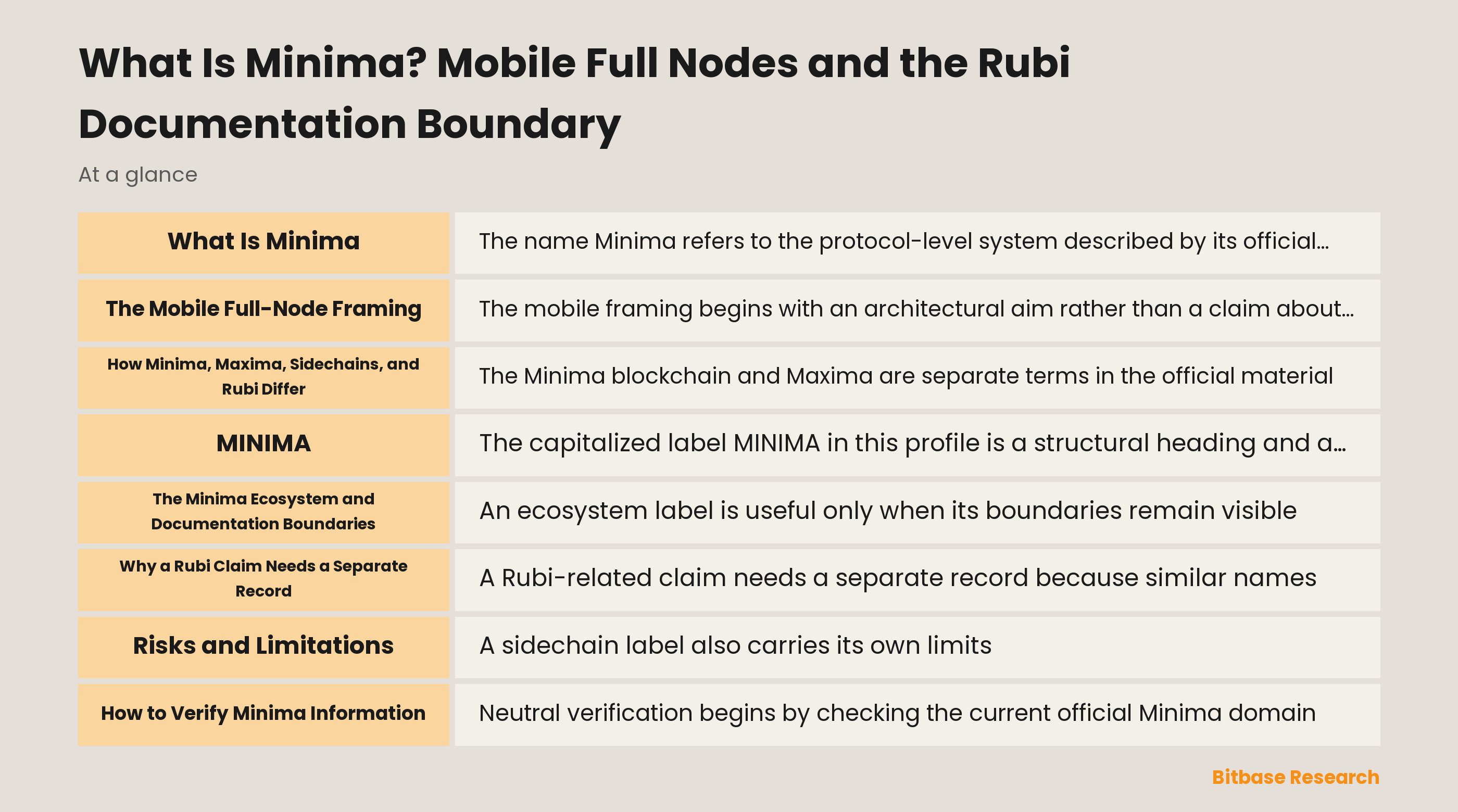
What Is Minima
The name Minima refers to the protocol-level system described by its official documentation, rather than to one device or one application screen. Current materials distinguish a default full node, a Mega MMR node, and an archive node. The historical whitepaper's Complete-node language and the current full-node language should be read as related documentation terms, not as a reason to assume that every node type stores the same data or has the same recovery role. Readers asking what is Minima blockchain or looking for a Minima mobile node blockchain explanation should distinguish the protocol architecture from a particular minima wallet application; this profile does not review or direct use of any wallet.
The current node-type page says that all listed Minima node types are full nodes, and it identifies the default full node as the option intended for Android users and small devices. That supports the mobile and full-node framing used here. It does not establish a permanent hardware specification, a promise of support for a particular phone, or a present availability statement for an app, download, region, or device configuration.
The Mobile Full-Node Framing
The mobile framing begins with an architectural aim rather than a claim about consumer hardware. The relevant documents describe a node that validates transactions and contributes to block creation while seeking to keep resource use low. This is different from saying that a mobile device is merely a remote display for another operator's node. It is also different from guaranteeing a particular battery impact, storage footprint, network condition, security level, or performance result on an individual device.
Minima's current documentation explains that a default full node keeps recent transaction information, prunes older material, retains a compact Cascade record, and keeps proofs relevant to its user. That description helps explain why the project can frame a full node as suitable for smaller devices. It is a description of the stated data model, not evidence that any current device has sufficient resources, that every implementation behaves identically, or that historical documentation remains unchanged after publication.
How Minima, Maxima, Sidechains, and Rubi Differ
The Minima blockchain and Maxima are separate terms in the official material. The whitepaper describes Minima transactions as on-chain and Maxima messages as off-chain, point-to-point communication over a peer-to-peer backbone. This distinction concerns the role assigned to the base protocol and its messaging layer. It should not be compressed into a claim that every message is a settlement event, that every application has identical trust assumptions, or that an off-chain message proves a separate chain is operating.
Sidechains appear in the cited Minima whitepaper as a generic example of a Layer 2 protocol category that could use the Maxima communication layer. The cited material does not, by that mention alone, identify a particular deployed sidechain, its validators, bridge design, asset terms, security model, or operational state. A generic architectural reference is therefore not a confirmation that any named chain is live, connected, audited, available, or governed in a particular way.
MINIMA
The capitalized label MINIMA in this profile is a structural heading and a project name reference. It is not used here to assert a token ticker, contract identifier, supply, allocation, distribution rule, or current economic function. Those are separate, changing categories of information. They need their own dated official evidence and must not be inferred from a protocol name, a node description, an application label, or an unrelated page that uses similar wording.
Rubi is treated here as a naming and verification ambiguity. In the current official Minima sources cited for this profile, Rubi is not identified as an operational Minima sidechain. That scoped absence does not prove that no relationship can ever exist. It means this profile has no primary-source basis to state such a relationship as fact. The phrase Rubi sidechain is therefore handled as a claim that would need explicit, current first-party documentation before publication.
The Minima Ecosystem and Documentation Boundaries
An ecosystem label is useful only when its boundaries remain visible. For Minima, official materials can support a high-level description of the base blockchain, node types, Maxima messaging, and MiniDapp-related development context. They do not create a permanent inventory of all applications, integrations, organizations, hardware routes, or external networks. A project ecosystem is broader than any one source page, but every current assertion within it still needs a source that matches its scope.
Documentation has different evidentiary roles. The node-type page supports a current description of node categories and stated capabilities. The whitepaper introduction supports the project's design rationale and mobile Complete-node ambition. The Maxima section supports the on-chain and off-chain terminology and its generic Layer 2 discussion. The official code repository supports the existence of maintained source material. None of those sources alone proves a Rubi deployment, current token terms, an audit conclusion, a partnership, or a legal status.
Why a Rubi Claim Needs a Separate Record
A Rubi-related claim needs a separate record because similar names, search results, community posts, or a page operated by another project do not establish a protocol relationship. A suitable record would have to identify the exact Rubi entity and then locate current first-party material that expressly describes its relationship, if any, to Minima. It would also have to distinguish a concept, test environment, proposal, application, bridge, or production network rather than treating those states as interchangeable.
The same caution applies to mobile wording. A claim that a protocol is designed for mobile full nodes does not prove a current application is installable on a specific device or that it can perform a particular task under local conditions. Hardware models, operating-system support, permissions, distribution channels, connectivity, storage, and energy use are implementation facts. They can change independently of the protocol architecture and require release-day confirmation from the applicable official documentation.
Risks and Limitations
A sidechain label also carries its own limits. A separate chain may have different validation, data, message, asset, and failure assumptions from a base chain, even when a source discusses Layer 2 in general. The cited Minima material provides a generic architectural context for sidechains, not a complete security analysis of a named implementation. It would be misleading to turn that context into a guarantee about interoperability, finality, access, funds, resilience, or the activity of an unspecified network.
Minima-related risks include ordinary protocol and implementation risks. Software can contain defects, documentation can lag behind a release, a node can be offline or inadequately resourced, and peer-to-peer connectivity can vary. The stated pruning and proof model also means that node type, synchronisation state, and recovery context matter. These observations do not decide whether a given setup is safe or suitable. They explain why a general profile cannot substitute for current technical, security, or operational evidence.
How to Verify Minima Information
Neutral verification begins by checking the current official Minima domain, the page version or publication context, and the precise claim a page actually makes. If a current official contract address is relevant to an editorial fact check, compare the stated contract address with the applicable official documentation and a block explorer, while preserving the source date and chain context. This is a record-comparison principle only. It is not an instruction to connect a wallet, move assets, or use a service.
For Rubi, the decisive verification question is narrower: does a current first-party Minima source expressly name the exact Rubi entity and define a sidechain relationship? If not, retain the ambiguity rather than filling the gap with inference. On the publication date, separately recheck project identity, official domains, documentation versions, node support, product availability, any contract address, a relevant block explorer record, token and supply statements, audits, governance, legal disclosures, and claimed external relationships.
Conclusion
The most conservative description is that Minima is documented as a protocol pursuing a resource-efficient full-node model, with a mobile-phone design ambition and a distinction between its on-chain layer and Maxima off-chain messaging. Its whitepaper gives sidechains a generic Layer 2 place in that discussion. Those points explain an architectural vocabulary. They do not prove the status of a particular device, application, sidechain, asset, or external service at the time a reader sees this page.
Rubi should remain a documentation boundary in this profile until a current primary source explicitly supports more. That choice is not a judgment about a similarly named project or a prediction about future development. It simply keeps a Minima protocol profile within the evidence actually available. Separating confirmed protocol design from unconfirmed operational claims makes the article more useful than repeating a keyword association as though it were a technical fact.
For release, describe Minima's documented architecture in separate sentences, identify the source scope behind each statement, and preserve the Rubi caveat. Treat all dynamic facts as items for a same-day check rather than as timeless background. This approach can explain the protocol's mobile and full-node framing, its Layer 2 vocabulary, and its documentation limits without implying a current Rubi deployment, a token condition, a hardware guarantee, or a recommendation to use any product.
Related market pages
- MINIMA: View price
Disclaimer: This article is educational content from Bitbase Academy, provided for information only. It explains what a project does and what role its token plays in that system; it does not constitute investment, trading, tax, or financial advice, and it is neither a recommendation nor an endorsement of any project or token. Bitbase has not carried out due diligence on the project described here, and mentioning it does not mean Bitbase lists or supports the asset. Crypto assets carry significant risk, including price volatility, thin liquidity, smart-contract failure, regulatory uncertainty, and the possible loss of their entire value. Written as of August 2026; a project's status, tokenomics, team, and contracts can change at any time. Verify everything yourself through official channels, the contract address, and a block explorer, and beware of imitation sites and phishing links.
References
[1] Minima Docs: Node Types docs.minima.global
[2] Minima Whitepaper: Introduction docs.minima.global
[3] Minima Whitepaper: Maxima docs.minima.global
[4] Minima Whitepaper v11 docs.minima.global
[5] Minima Global official source repository github.com