Solana Seeker is documented as a Solana Mobile Android device; Seed Vault, a wallet app, the dApp Store, onchain identifiers, and SKR are separate layers with separate evidence boundaries.
Solana Seeker is described in Solana Mobile documentation as its flagship Android device built for crypto-related mobile use. In this profile, Seeker means the device. It is not the name of a key-custody system, wallet application, app catalogue, token, or token-distribution program. Official material separately names Seed Vault, the Solana dApp Store, Mobile Wallet Adapter, the Seeker Genesis Token, and SKR. A careful introduction starts by keeping those labels and the claims attached to them separate.
What Is Solana Seeker
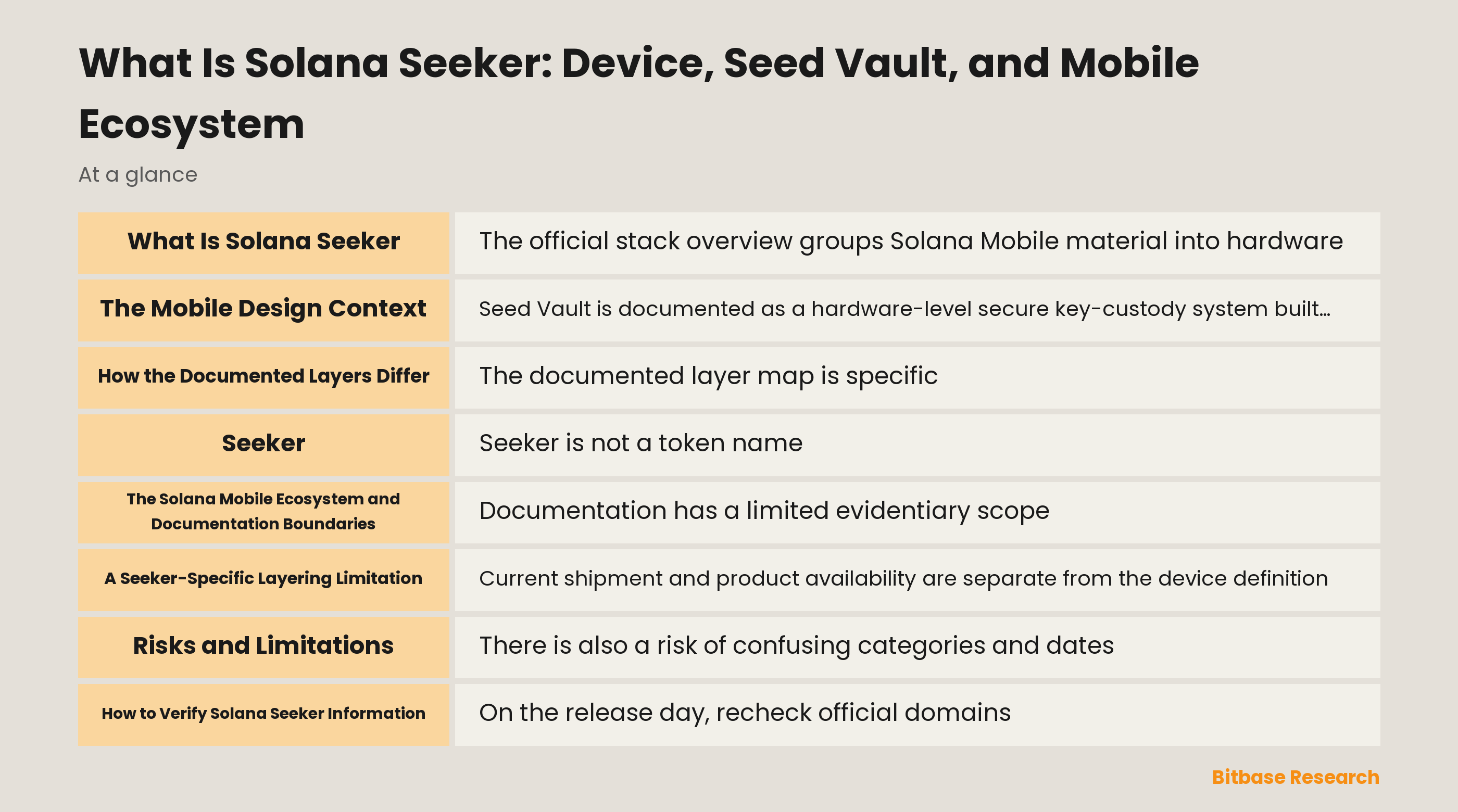
The official stack overview groups Solana Mobile material into hardware, software, and onchain elements. That map helps a reader match a claim to the source that actually supports it. A hardware page can support a hardware description, while a software page can support a description of a service or protocol. The map does not establish that every feature, application, policy, external relationship, or regional condition remains unchanged after publication.
The mobile design context is phone-centered: a device, a protected key service, wallet software, and mobile applications can work together. The documentation presents these as elements of a stack, not as one interchangeable product. This explains an intended organization. It does not prove that every application is available to every person, that every app uses the same wallet path, or that a device removes the normal technical and security constraints of mobile computing.
The Mobile Design Context
Seed Vault is documented as a hardware-level secure key-custody system built into Seeker. The documentation describes a system service for wallet apps that uses secure execution environments available on the device. It says keys, seeds, and secrets remain in the protected environment while Android interface components handle signing interaction. This supports a narrow custody-model description. It is not an independent audit, a guarantee about all phone software, or assurance that a proposed action is safe or appropriate.
The custody model needs another distinction. Seed Vault is the system service, while Seed Vault Wallet is the built-in wallet application that interfaces with it. Mobile Wallet Adapter is documented as a protocol through which mobile apps communicate with wallet apps. A wallet app, a protocol, and an underlying secure service do different work. The presence of one layer does not prove the current security, availability, configuration, or behavior of another.
How the Documented Layers Differ
The documented layer map is specific. Seeker names the hardware device; Seed Vault names a key-custody service; Seed Vault Wallet names a wallet application; the dApp Store names an app discovery and publishing channel; Mobile Wallet Adapter names an app-to-wallet protocol; the Seeker Genesis Token names an onchain device-ownership identifier; and SKR is described as a separate ecosystem asset. Readers who search for what is Solana Seeker crypto are asking about a device-centred stack: seeker crypto is not the name of a single asset, and Solana Seeker ecosystem and use cases are best understood by separating the device, Seed Vault security layer, applications, Seeker Genesis Token, and SKR. This prevents a device description from becoming a statement about token rights, wallet custody, app quality, or future distribution terms.
A statement about Seeker should remain a statement about the hardware product. Official sources call it a Solana Mobile Android device and may publish product descriptions or specifications at a given time. Such material can identify the product category and features stated on that page at that time. It does not by itself establish a permanent firmware state, universal service level, particular app experience, or continuing entitlement associated with a device.
Seeker
Seeker is not a token name. Official documentation separately describes the Seeker Genesis Token as an onchain identifier connected to verified device ownership and describes SKR as an ecosystem asset. Those are different objects with different source scopes. Device possession, product shipment, a wallet record, or app visibility must not be converted into a claim that someone has a token allocation, reward, governance role, or other economic benefit. Such terms are release-day facts, not durable device properties.
The ecosystem section concerns software and distribution context, not a promise about an individual application. Solana Mobile documentation describes the dApp Store as a crypto-friendly store for the Solana ecosystem and, in the consulted version, says it is pre-installed on Seeker. It also describes Mobile Wallet Adapter as a protocol connecting mobile apps and wallets. Those sources support a high-level account of discovery and communication layers, not a claim that a particular app is active, suitable, secure, or available everywhere.
The Solana Mobile Ecosystem and Documentation Boundaries
Documentation has a limited evidentiary scope. The dApp Store material says app listings are represented as onchain records and describes categories of software that may be published. That supports a publishing-model description. It does not prove that a listed app has been independently audited, that its current code behaves as described, that it has a particular legal status, or that it remains available. Every app, wallet, and service needs its own current primary evidence and cannot inherit assurances from the device or store.
A Seeker-specific limitation is coordination between independently changing layers. Device hardware, system updates, the secure service, wallet software, a mobile protocol, the app catalogue, and onchain records may have different release cycles and control points. A statement about one layer cannot settle the state of another. In particular, a hardware-protected custody design does not remove the need to assess the current wallet interface, app request, network conditions, or meaning of a user approval.
A Seeker-Specific Layering Limitation
Current shipment and product availability are separate from the device definition. An official product page or store can show a time-sensitive state, but stock, shipping times, destinations, taxes, warranty coverage, device variant, and service conditions can change. This profile does not turn a page-state observation into a timeless availability claim. A release-day reviewer should consult then-current official product and store material before saying that a particular Seeker can be obtained or supported in a particular location.
Risks and limitations span the full stack. A device can be lost, damaged, or affected by defects and updates; wallet software can contain errors; an app can make a difficult-to-understand request; and a network or third-party service can change. Seed Vault's documented protected environment is an important design boundary, but no overview can establish complete security for every transaction, app, recovery process, device condition, or user decision. Security claims need a source whose scope actually matches the claim.
Risks and Limitations
There is also a risk of confusing categories and dates. A product description is not a token-distribution statement. A device-ownership identifier is not a fungible ecosystem asset. An app listing is not evidence of endorsement, audit, partnership, or legal effect. Software releases, feature wording, governance arrangements, security reviews, regional access, and dynamic token data can change. The conservative approach describes only the role that the current official source explicitly supports and marks the remaining questions for rechecking.
Neutral verification begins by comparing the official hardware, Seed Vault, dApp Store, Mobile Wallet Adapter, and onchain documentation while preserving each page's scope and last-modified information. If a contract address is relevant to a factual review, compare the current official issuer material with a public block explorer as records only. That is a record-comparison check, not an instruction to interact with a wallet, asset, or app. Also distinguish the device name from the Genesis Token and SKR before recording any result.
How to Verify Solana Seeker Information
On the release day, recheck official domains, page revisions, device-model description, software and security release notes, dApp Store policy and catalogue status, and current store conditions for the relevant location. Reconfirm the exact wording and status of the Seeker Genesis Token, SKR, any token terms, and any governance or incentive statement from current primary material. Capture the date of each check. Do not use one product page as evidence for wallet behavior, onchain terms, or application quality.
Solana Seeker is most accurately introduced as mobile hardware within a wider Solana Mobile stack. Seed Vault is the documented hardware-level custody service, Seed Vault Wallet is a wallet application, the dApp Store and Mobile Wallet Adapter are software-facing layers, and the onchain identifiers are separate objects. This vocabulary gives readers a clearer map than treating every mobile, wallet, and token-related reference as the same thing.
Conclusion
The central interpretive rule is separation. A protected key service does not make every mobile app trustworthy. A wallet application does not establish a right to a token. Device shipment does not establish an onchain status, and an onchain identifier does not establish the current availability or safety of a product or app. Each conclusion should remain attached to the component and source that actually support it.
A publication-ready profile should state the documented device role, explain the narrow Seed Vault custody framing, and describe the application ecosystem without converting it into a quality guarantee. It should separately identify the Genesis Token and SKR as onchain concepts, avoid fixed claims about their dynamic terms, and flag shipment, availability, software versions, and legal or governance information for release-day review. This method is informative without overstating the documentation.
The lasting point is modest but useful: Seeker is the hardware label in a layered mobile system. The cited primary material can explain the designed relationship among the device, secure key service, wallet software, application ecosystem, and onchain identifiers. It cannot freeze their future condition or substitute for current evidence about a specific product, application, security question, or token-related statement.
Disclaimer: This article is educational content from Bitbase Academy, provided for information only. It explains what a project does and what role its token plays in that system; it does not constitute investment, trading, tax, or financial advice, and it is neither a recommendation nor an endorsement of any project or token. Bitbase has not carried out due diligence on the project described here, and mentioning it does not mean Bitbase lists or supports the asset. Crypto assets carry significant risk, including price volatility, thin liquidity, smart-contract failure, regulatory uncertainty, and the possible loss of their entire value. Written as of August 2026; a project's status, tokenomics, team, and contracts can change at any time. Verify everything yourself through official channels, the contract address, and a block explorer, and beware of imitation sites and phishing links.
References
[1] Seeker, Solana Mobile Docs docs.solanamobile.com
[2] Seed Vault, Solana Mobile Docs docs.solanamobile.com
[3] dApp Store, Solana Mobile Docs docs.solanamobile.com
[4] Mobile Wallet Adapter, Solana Mobile Docs docs.solanamobile.com
[5] Seeker Genesis Token, Solana Mobile Docs docs.solanamobile.com
[6] SKR, Solana Mobile Docs docs.solanamobile.com
[7] Solana Seeker official product page solanamobile.com
[8] Solana Seeker official store store.solanamobile.com
[9] Seeker Release Notes, Solana Mobile Docs docs.solanamobile.com