Solv Protocol documents a Bitcoin-reserve architecture centred on SolvBTC, while SOLV is identified as the protocol’s native utility token; neither description removes the separate risks of reserves, contracts, settlement, and third parties.
Readers searching for solv ecosystem and use cases, solv protocol, or how does solv work need to separate the project’s documentation from a guarantee about any asset, network, reserve, or future product state. This educational profile describes the mechanism boundaries stated in first-party materials and does not provide a path for obtaining, moving, converting, or using an asset.
What Is Solv Protocol?
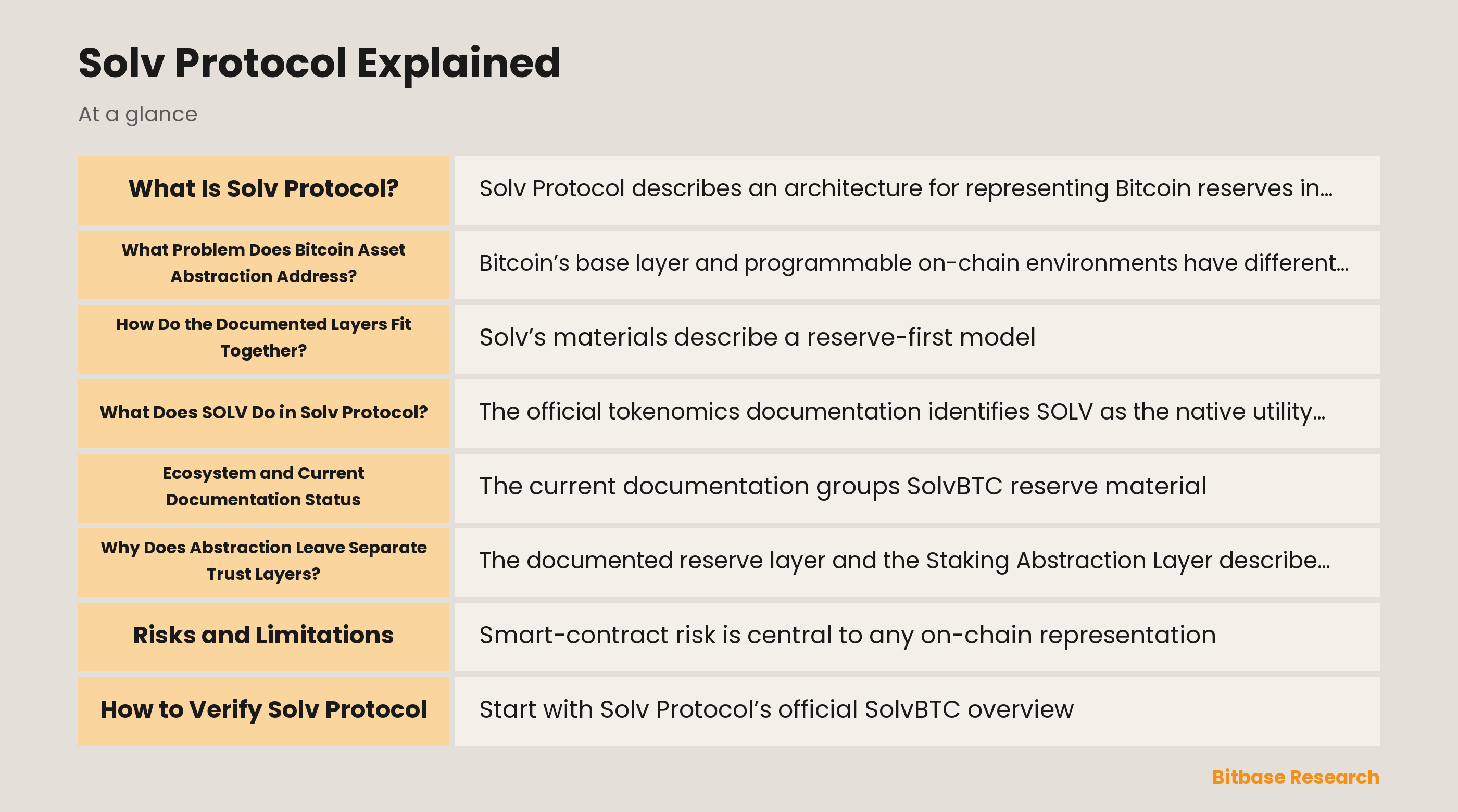
Solv Protocol describes an architecture for representing Bitcoin reserves in programmable on-chain environments. Its documentation presents SolvBTC as an on-chain Bitcoin reserve asset and frames Bitcoin mainnet as the final settlement anchor. In that framing, the protocol is not simply a token name: it includes reserve concepts, custody and signing rules, contract-based representations, and documentation about how those parts are meant to relate.
It is useful to distinguish three labels that are easy to blur together. Solv Protocol is the broader protocol and product documentation; SolvBTC is the documented reserve representation; and SOLV is the protocol’s native utility token according to the official tokenomics material. A statement about one of those labels is not automatically a statement about the other two.
Bitcoin asset abstraction means expressing a reserve relationship in a form that other on-chain systems can recognize. It does not mean that an abstraction has the same trust model as holding native Bitcoin directly, nor that every environment involved in the representation inherits Bitcoin’s security properties. The scope of a representation, its conversion conditions, and the parties involved remain material to the risk assessment.
What Problem Does Bitcoin Asset Abstraction Address?
Bitcoin’s base layer and programmable on-chain environments have different design constraints. The documentation describes a need for a consistent reserve representation that can be recognized across heterogeneous systems while keeping Bitcoin as the settlement reference. This is an interoperability and accounting problem: systems need a common way to reason about a reserve without treating every chain, contract, or wrapped asset as identical.
The abstraction is therefore best understood as a set of documented rules and records, rather than a claim that all Bitcoin-related assets are interchangeable. Reserve composition, custody arrangements, supported networks, cross-chain components, and settlement conditions can differ. A consistent name or a common interface does not erase those differences.
How Do the Documented Layers Fit Together?
Solv’s materials describe a reserve-first model. The SolvBTC pages explain reserve backing, categorized reserve assets, proof-of-reserve information, and a unified reserve logic across more than one on-chain environment. The design-principles material also describes structured custody and signing rules, with reserve movement subject to documented execution paths.
Those layers should be evaluated separately. A cryptographic or accounting proof can be useful evidence about a defined reserve relationship, but its meaning depends on what assets, accounts, timing, and liabilities the proof actually covers. Smart contracts, signing arrangements, cross-chain messaging, and any third-party representations introduce their own assumptions even when they sit beneath a single protocol brand.
What Does SOLV Do in Solv Protocol?
The official tokenomics documentation identifies SOLV as the native utility token of Solv Protocol. It connects the token to protocol governance and other protocol-level utility descriptions. That is the project’s stated role for the ticker SOLV, and it should be read as a functional description rather than a statement about performance, availability, or an outcome for a holder.
SOLV is not the same thing as the documented Bitcoin reserve representation. Holding a utility token does not independently verify a reserve, change the behavior of a smart contract, or establish a right to a particular settlement result. Token parameters, governance arrangements, and the live implementation of any utility are changeable facts that need confirmation from current official materials before publication.
Ecosystem and Current Documentation Status
The current documentation groups SolvBTC reserve material, reserve transparency, design principles, a Staking Abstraction Layer, and SOLV token material within the Solv Protocol ecosystem. These pages are useful for understanding the vocabulary and intended separation of roles. They are not a substitute for a publication-day check of which components are available, on which networks, and under which current terms.
The project’s documentation can evolve alongside contracts, reserve categories, supported representations, security arrangements, governance, and product naming. An article should not turn a historical page, a roadmap statement, or a list of integrations into proof that a component remains active, independently reviewed, or appropriate for a particular use. Current status needs to be verified directly from the relevant official record.
Why Does Abstraction Leave Separate Trust Layers?
The documented reserve layer and the Staking Abstraction Layer describe different roles. Reading them as separate layers is more accurate than treating the word “abstraction” as a single security property. A reserve representation may have one set of backing and settlement assumptions, while an additional strategy or protocol layer can have different contracts, counterparties, rules, and failure modes.
This separation matters because risk can be layered rather than replaced. Even where the documentation describes proof of reserves or structured signing, a reader still needs to consider contract logic, custody controls, accounting scope, cross-chain dependencies, timing, and third-party components. The existence of one control does not eliminate the need to examine the others.
Risks and Limitations
Smart-contract risk is central to any on-chain representation. Code, permissions, upgrade arrangements, oracle or message dependencies, and integration assumptions can behave differently from their documentation or contain vulnerabilities. A description of rules or an external review is not an unconditional security guarantee, and a protocol label does not make every connected contract equivalent.
Reserve representations can also face a loss-of-parity or redemption risk. The official materials describe reserve backing and redemption rules, but market liquidity, operational timing, reserve eligibility, settlement conditions, and the scope of a proof can affect whether a representation behaves as expected in a particular situation. This is a risk explanation, not a procedure for converting or redeeming any asset.
Third-party risk remains relevant where the documented architecture relies on custodial arrangements, signing participants, bridge or messaging systems, wrapped Bitcoin assets, infrastructure providers, or external protocols. Legal terms, technical dependencies, governance decisions, and incident responses may also change. No documentation page can remove the need to review current official disclosures and the scope of every dependency.
How to Verify Solv Protocol
Start with Solv Protocol’s official SolvBTC overview, reserves page, design-principles page, SAL overview, and SOLV tokenomics page. The project name, the distinction between SolvBTC and SOLV, and the stated role of each component should remain consistent across those primary materials. Treat copied summaries, social posts, and unrelated directories as secondary information rather than proof.
For a current on-chain identifier, compare an official contract address with the matching record on the relevant block explorer, and confirm the chain, token name, and official publication context match. Separately examine the current proof-of-reserve scope and the official disclosures for the particular representation. A missing, stale, or conflicting identifier is a reason to stop and seek an authoritative clarification, not a reason to infer an answer.
Conclusion
Solv Protocol is best understood from its documentation as a layered Bitcoin-reserve architecture, not as a single undifferentiated asset claim. SolvBTC is described as the reserve representation, while SOLV is described as the protocol’s native utility token. Their documented roles are useful context, but they do not collapse the distinct risks of reserve scope, contracts, settlement, and third parties.
Before publication, re-check the official ticker, applicable contract or equivalent identifiers, reserve composition and proof scope, supported-network status, governance information, security disclosures, and the current terms surrounding redemption. Keeping those changeable facts separate from the stable architectural explanation helps prevent the profile from overstating what the first-party materials establish.
Related market pages
- SOLV: View price · Perpetual market
Disclaimer: This article is educational content from Bitbase Academy, provided for information only. It explains what a project does and what role its token plays in that system; it does not constitute investment, trading, tax, or financial advice, and it is neither a recommendation nor an endorsement of any project or token. Bitbase has not carried out due diligence on the project described here, and mentioning it does not mean Bitbase lists or supports the asset. Crypto assets carry significant risk, including price volatility, thin liquidity, smart-contract failure, regulatory uncertainty, and the possible loss of their entire value. Written as of August 2026; a project's status, tokenomics, team, and contracts can change at any time. Verify everything yourself through official channels, the contract address, and a block explorer, and beware of imitation sites and phishing links.
References
[1] SolvBTC (official Solv Protocol documentation) docs.solv.finance
[2] Reserves (official Solv Protocol documentation) docs.solv.finance
[3] Design Principles (official Solv Protocol documentation) docs.solv.finance
[4] What is SAL? (official Solv Protocol documentation) docs.solv.finance
[5] SOLV Tokenomics (official Solv Protocol documentation) docs.solv.finance
[6] Governance (official Solv Protocol documentation) docs.solv.finance