Somnia is an EVM-compatible Layer 1 whose documentation presents a high-throughput architecture for real-time, consumer-facing applications such as games, social experiences, and virtual worlds. For readers searching “what is somnia crypto,” the useful starting point is to separate the network's published technical design from its native coin, SOMI, and from claims that still need to be checked against current official materials.
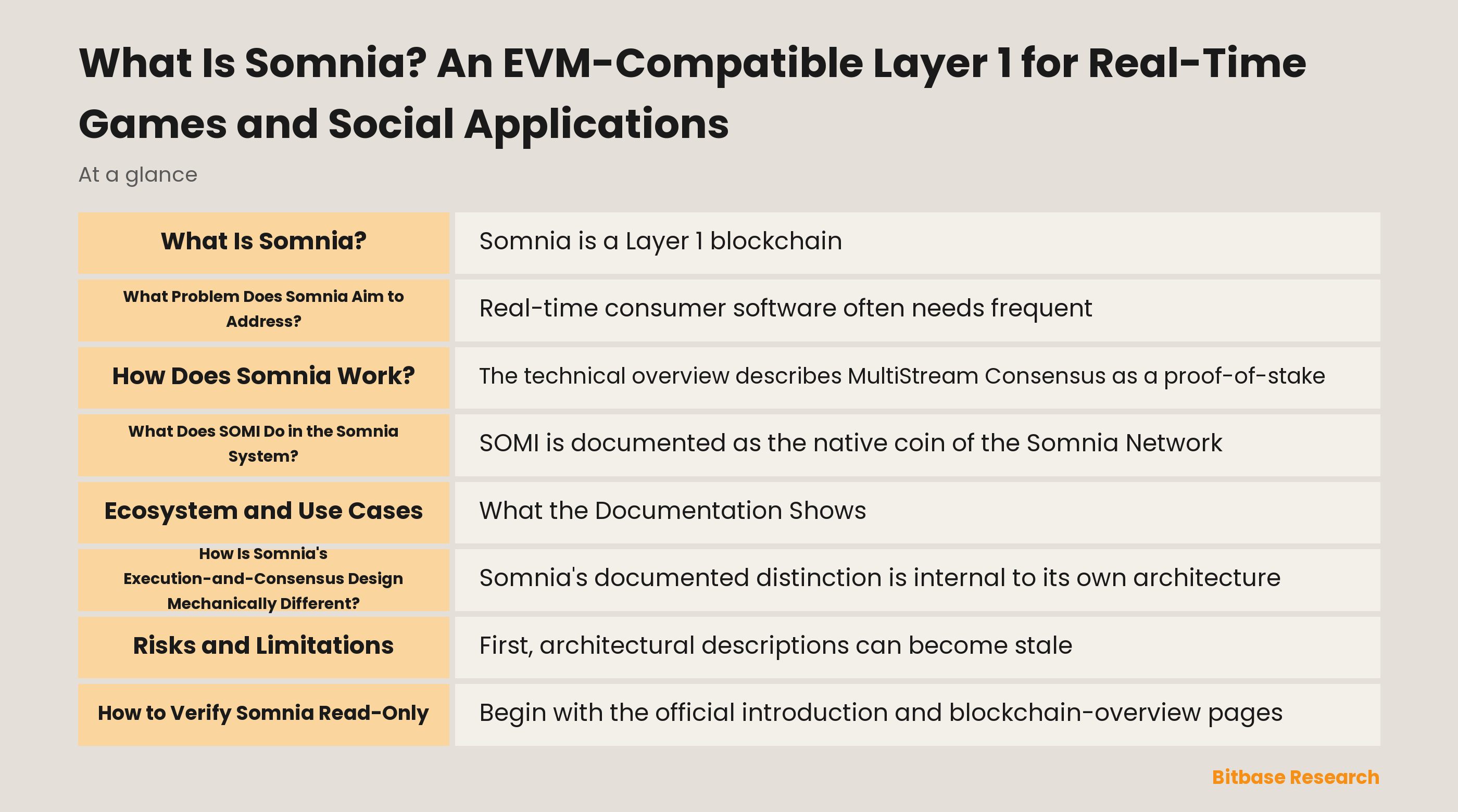
What Is Somnia?
Somnia is a Layer 1 blockchain: it has its own network, consensus process, execution environment, and native coin. Its official documentation describes it as EVM-compatible, meaning smart contracts and developer patterns designed for the Ethereum Virtual Machine can be relevant to the Somnia environment. That compatibility is an interface and execution-property claim; it does not mean that every contract, tool, or deployment will behave safely or identically without current testing.
The project frames its design around real-time applications, including games, social applications, and virtual worlds. Those categories commonly create many small state changes, interactions, and messages rather than a few occasional transfers. Somnia's materials therefore focus on how data is produced, ordered, executed, compressed, and finalized. This is a description of the design problem the protocol says it addresses, not evidence that every application will reach a particular scale.
Official pages use high-throughput and sub-second-finality language, including a stated capability above one million transactions per second. Such figures should be read as documentation claims about the architecture and its intended performance conditions, not as an unconditional guarantee of live capacity, user experience, fees, or application results. Actual performance depends on the version, configuration, workload, validator operation, and network conditions present at the time being assessed.
What Problem Does Somnia Aim to Address?
Real-time consumer software often needs frequent, ordered updates. A game may coordinate many actions; a social experience may record events, identities, or permissions; a virtual-world application may combine objects, rules, and changing state. If an application chooses to put parts of that activity on a blockchain, it must account for execution capacity, data movement, finality, and the cost of retaining or changing state. These are related constraints, but they are not one single metric.
Somnia's published approach is to make an EVM-oriented Layer 1 capable of handling a large volume of on-chain activity while retaining a familiar smart-contract environment. The architectural premise is useful to understand because it distinguishes a network-level design from any particular game or social product. A protocol can document a target workload while individual applications still have their own code, data models, permissions, dependencies, and operational choices to review.
Searches phrased as “somnia crypto” often compress the network and the coin into one label. A more precise reading keeps them apart: Somnia is the network and technical architecture, while SOMI is the native coin documented for specific system roles. Likewise, the phrase “somnia tokenomics and use cases” should lead a reader to inspect the current tokenomics pages and the documented application model rather than infer usefulness, adoption, or value from a ticker alone.
How Does Somnia Work?
The technical overview describes MultiStream Consensus as a proof-of-stake, partially synchronous Byzantine-fault-tolerant design. In the documented model, validators maintain independent data chains, while a separate consensus chain aggregates the relevant chain heads and coordinates agreement. The important idea is a division between producing or moving data and reaching network-wide consensus. This is an architectural explanation, not a substitute for reviewing the currently deployed client, validator set, or consensus parameters.
Somnia also documents compiled bytecode as an execution technique. Instead of treating EVM bytecode only as something to interpret instruction by instruction, the materials describe translating it into optimized native code. The documentation links this choice to faster execution, but the practical effect of any implementation still depends on contract behavior, compiler and client versions, hardware, security assumptions, and the workload being measured.
The same overview describes a custom database called IceDB, streaming compression, and BLS signature aggregation. These components address different parts of the system: storage and access patterns, the amount of data moved between participants, and the compact representation of signatures. They should not be blended into one headline number. A reader evaluating a current deployment should distinguish the published design, the released software, and the observable state of the network.
What Does SOMI Do in the Somnia System?
SOMI is documented as the native coin of the Somnia Network. The network-information and SOMI-coin pages describe it as the unit used to pay for transactions, with Wei as the smallest base denomination. Calling SOMI a native coin identifies a protocol-level role; it is not a statement about an unrelated token with a similar name, nor is it an instruction to obtain, hold, transfer, or use it.
The tokenomics overview also documents gas-payment, network-security-related, and governance-related roles for SOMI. Some of those descriptions are conditional or forward-looking, particularly where governance arrangements are still intended to evolve. It is therefore more accurate to say that the documentation assigns or proposes these roles than to present every listed function as a permanent, fully settled feature of the network.
The allocation-and-unlocks material contains categories and a release plan for the token supply. Those pages are useful for identifying what the project has published, but allocations, unlock schedules, circulating-status assumptions, and associated interfaces should always be checked at the relevant date. This article deliberately does not turn those documents into a participation guide, a supply forecast, or a conclusion about the coin.
Ecosystem and Use Cases: What the Documentation Shows
Somnia's public positioning emphasizes games, social applications, metaverses, and other real-time mass-consumer uses. The documentation also describes composable virtual-world concepts in which addresses, smart contracts, and data components can be combined into application rules. These examples help explain why a project might care about frequent on-chain updates, but they do not establish that any named application is active, secure, popular, or suitable for a particular user.
EVM compatibility is relevant to this ecosystem framing because it can make Solidity contracts and common Ethereum-oriented development concepts more familiar. Familiarity does not remove the need for application-specific review. A contract may have upgrade controls, external dependencies, data-oracle assumptions, or bugs regardless of the virtual machine that executes it.
The documentation should also be read as a map of categories rather than an adoption scorecard. A list of games, social ideas, developer tools, or virtual-world primitives cannot prove transaction volume, decentralization, availability, or long-term support. For a specific current application, the meaningful questions are which network it uses, which contract or code version is relevant, who can change it, and what the current official sources actually confirm.
How Is Somnia's Execution-and-Consensus Design Mechanically Different?
Somnia's documented distinction is internal to its own architecture. A conventional description of a blockchain often treats block data production, ordering, and consensus as one tightly serialized flow. MultiStream instead separates individual validator data chains from a consensus chain that agrees over their heads. That division is meant to let data handling and consensus coordination be addressed as connected but separate tasks; it does not prove that the resulting system is automatically faster, safer, or more decentralized in every setting.
At the execution layer, compiled bytecode is different from merely describing an EVM environment: it concerns how the client runs contract code. IceDB concerns database behavior, while compression and aggregated signatures concern data representation and transmission. Each mechanism has its own assumptions and possible trade-offs. Treating the set as a design stack is more useful than treating it as one interchangeable performance feature.
The same caution applies to finality and throughput. Finality concerns when the network regards a result as settled under its rules; throughput concerns how much work the system can process over time; an application's responsiveness includes additional factors such as client design, indexing, availability, and user interface behavior. The official documents identify goals and components, but a current technical assessment needs versioned measurements and deployment-specific evidence.
Risks and Limitations
First, architectural descriptions can become stale. Network configuration, software releases, validator composition, tokenomics pages, and roadmap language may change after a page is read. A published technical overview is valuable context, but it does not replace current source code, current network information, or a review of a particular deployment.
Second, EVM compatibility does not certify application safety. Smart contracts can contain vulnerabilities, proxy or upgrade mechanisms, privileged administrative controls, oracle dependencies, and integration errors. High-level network documentation cannot establish the security posture of a game, social protocol, asset, contract address, or third-party interface running on the network.
Third, native-coin utility should not be confused with an outcome for a holder or participant. The documentation can explain a gas and system role without proving availability, liquidity, price, governance status, or future rules. This article makes no recommendation to acquire or use SOMI and does not provide a route for interacting with the network.
How to Verify Somnia Read-Only
Begin with the official introduction and blockchain-overview pages. Check their update context and separate statements about EVM compatibility, the intended application categories, MultiStream Consensus, compiled execution, database design, and compression. This establishes what the project currently documents at a high level without asking a reader to sign, connect, or transact.
Next, compare the official network-information page with the SOMI-coin and tokenomics-overview pages. The purpose is to confirm the current network context, the SOMI ticker and native-coin role, and which roles the tokenomics documentation presents as current, intended, or still to be determined. For allocation and unlock information, read the relevant official page as a dated disclosure and note that a diagram or schedule may require rechecking before it is used in any analysis.
If a question concerns a particular live deployment, obtain the precise network and contract context from the current official materials before opening an explorer in read-only mode. Compare the network label, address, source-verification status where available, and any disclosed proxy or administrative relationship. A mismatch, an unexpected redirect, an unverified source, or a request to connect a wallet is a reason to stop and re-check the provenance rather than proceed.
The Bottom Line
Somnia is best understood as an EVM-compatible Layer 1 whose public design joins a real-time application focus with MultiStream Consensus, compiled execution, database and compression techniques, and a native gas coin called SOMI. The project documentation describes high throughput and low latency ambitions, but those statements remain claims to verify against the current implementation and network context.
For “what is somnia crypto,” that distinction matters: the network architecture, the native coin's documented system role, and any individual application are separate objects of analysis. The careful next step is not an action or value judgment; it is a read-only comparison of the current official architecture, network, coin, and tokenomics materials with the exact deployment or fact being assessed.
Related market pages
- SOMI: View price · Perpetual market
Disclaimer: This article is educational content from Bitbase Academy, provided for information only. It explains what a project does and what role its token plays in that system; it does not constitute investment, trading, tax, or financial advice, and it is neither a recommendation nor an endorsement of any project or token. Bitbase has not carried out due diligence on the project described here, and mentioning it does not mean Bitbase lists or supports the asset. Crypto assets carry significant risk, including price volatility, thin liquidity, smart-contract failure, regulatory uncertainty, and the possible loss of their entire value. Written as of August 2026; a project's status, tokenomics, team, and contracts can change at any time. Verify everything yourself through official channels, the contract address, and a block explorer, and beware of imitation sites and phishing links.
References
[1] Somnia documentation introduction docs.somnia.network
[2] Somnia blockchain overview docs.somnia.network
[3] SOMI coin (official network information) docs.somnia.network
[4] SOMI tokenomics overview docs.somnia.network
[5] SOMI allocation and unlocks docs.somnia.network
[6] Somnia gas-fee documentation docs.somnia.network
[7] Somnia current network information docs.somnia.network