Spark is documented as an onchain capital-allocation architecture for stablecoin liquidity, with Spark Savings, SparkLend, Spark Liquidity Layer, and SPK described as separate but related parts of its documented scope.
The searches what is Spark SPK crypto and spk crypto can point to a protocol name, several documented product categories, a stablecoin-capital architecture, and the ticker SPK. Those references are connected, but they are not interchangeable. Spark is best introduced through the boundaries set by its official materials: an onchain architecture that organizes stablecoin capital and liquidity under documented governance and risk frameworks. That description is narrower and more useful than treating Spark as a single application, or treating SPK as another name for every Spark component.
What Is Spark SPK
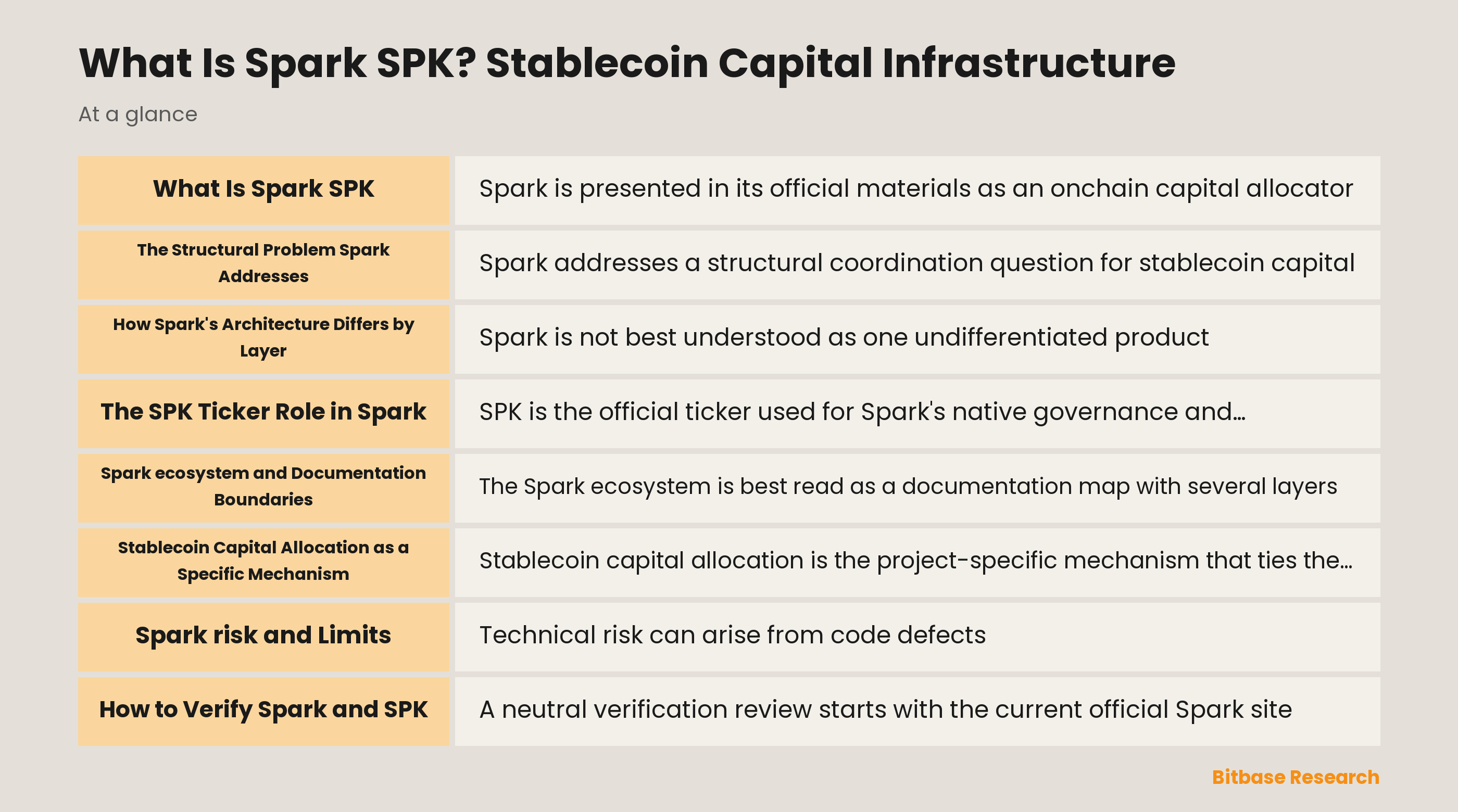
Spark is presented in its official materials as an onchain capital allocator. At an architectural level, that means it organizes how stablecoin capital can be directed among defined protocol layers and allocation contexts. The emphasis is on coordination, visibility, and parameters rather than an assertion that every use of capital has identical conditions. Spark is therefore a protocol and infrastructure description, not a guarantee about a particular market outcome, a particular implementation, or a permanent set of supported connections.
The documentation separates Spark Savings, SparkLend, and Spark Liquidity Layer. These names identify distinct documented categories within the larger Spark design. Spark Savings should not be collapsed into SparkLend, and neither should be treated as a synonym for the Spark Liquidity Layer or for SPK. Keeping those nouns separate matters because an explanation of the overall architecture does not establish the exact behavior, current availability, technical configuration, or risk setting of any one category at a later date.
The Structural Problem Spark Addresses
Spark addresses a structural coordination question for stablecoin capital: how can capital be organized across changing onchain contexts without reducing the system to disconnected pools of liquidity? The official framing emphasizes allocation and liquidity infrastructure. In a high-level project profile, the relevant point is the intended coordination problem, not a conclusion that fragmentation has disappeared or that a given capital route is always available. The scope, routes, and parameters behind that coordination are time-sensitive facts.
A stablecoin-oriented architecture also has to distinguish an accounting unit from the conditions under which it is used. Capital may face different technical interfaces, risk constraints, liquidity conditions, and governance decisions across layers. Spark's design language makes allocation a protocol concern rather than merely a collection of isolated balances. That does not mean the architecture can eliminate external dependencies, market changes, configuration errors, or judgment embedded in the rules that govern where capital is directed.
How Spark's Architecture Differs by Layer
Spark is not best understood as one undifferentiated product. Its documented structure places named categories beside a governance layer and a data-oriented documentation surface. Spark Savings, SparkLend, and Spark Liquidity Layer describe different parts of the system's architecture, while governance materials describe how protocol evolution and parameters are organized. SPK belongs to the governance and security side of that picture. This layered reading prevents a label for one component from being mistaken for a description of the entire system.
At a conceptual level, the capital-allocation mechanism is a coordination layer. It can connect a stablecoin-capital base with defined liquidity contexts while rules, permissions, and risk settings guide how the architecture changes. A public onchain design may make some activity inspectable, but inspectability is not the same as simplicity or safety. The current contracts, parameter values, decision procedures, and implementation details remain matters for publication-day confirmation in official material and public records.
The SPK Ticker Role in Spark
SPK is the official ticker used for Spark's native governance and security-related token role. Official documentation associates SPK with protocol governance and a security model for the Spark ecosystem. This is a role description: it explains why the ticker appears in Spark materials. It is not a statement that the ticker is the protocol itself, that every Spark component is controlled by SPK, or that the presence of SPK automatically grants anyone access, control, compensation, or a financial result.
The distinction between SPK and the Spark architecture is especially important. Spark Savings, SparkLend, and Spark Liquidity Layer are named system categories; SPK is the ticker for a governance and security-related role documented alongside them. Governance rules, voting weight, security arrangements, token distribution, contract identities, and the practical effect of any decision are dynamic matters. They should be rechecked from current first-party documentation on the publication date instead of being inferred from a ticker name or a historical description.
Spark ecosystem and Documentation Boundaries
The Spark ecosystem is best read as a documentation map with several layers: the main protocol description, product-category pages, governance materials, technical material for integrators, and a data surface. That map helps distinguish an official explanation of the architecture from statements about an individual implementation. It does not by itself confirm that a particular integration, organization, network, audit scope, or feature is current. Those are separate facts with their own dates and sources.
Documentation boundaries are useful because they limit overstatement. A page that defines Spark Savings, SparkLend, or Spark Liquidity Layer can establish the project's own vocabulary, while the governance pages can establish the intended decision framework and the SPK page can establish the ticker's stated role. None of those pages alone proves the live condition of every contract or capital route. Current integration status, supported networks, audits, and operational parameters must be checked again at publication time.
Stablecoin Capital Allocation as a Specific Mechanism
Stablecoin capital allocation is the project-specific mechanism that ties the layers together. In architecture terms, Spark describes a system that can organize liquidity and capital across defined contexts under protocol rules. It does not establish that all stablecoins have the same properties, that all allocation contexts share one risk profile, or that a documented route is immutable. The exact composition of capital, eligibility of assets, and active configuration are dynamic and should not be converted into permanent prose.
This mechanism also creates boundaries. Allocation rules need assumptions about liquidity, counterparties, data inputs, technical execution, and governance authority. A framework may make the location and purpose of capital more legible, yet it cannot convert each external dependency into an internal guarantee. The current risk parameters, permissions, supported networks, integrations, and review processes are all publication-day verification items. A static profile should describe the mechanism without pretending to settle those changing details.
Spark risk and Limits
Technical risk can arise from code defects, implementation mistakes, infrastructure failure, configuration changes, or unexpected interactions between components. Economic risk can arise when a system's rules, incentives, costs, or capital assumptions no longer fit prevailing conditions. Market risk refers to changing conditions that can affect the assumptions behind an allocation design. These are explanatory categories, not forecasts and not a judgment that any particular outcome will occur.
Liquidity risk, counterparty risk, oracle risk, and governance risk deserve separate treatment. Liquidity conditions may change when capital needs to move between contexts. Counterparty exposure may matter where an allocation path depends on another entity or service. Oracle risk concerns incorrect, delayed, or manipulated reference data where current architecture relies on such inputs. Governance risk includes concentrated influence, disputed decisions, slow response, or parameter changes. Their relevance and current mitigations must be verified from contemporaneous official material.
How to Verify Spark and SPK
A neutral verification review starts with the current official Spark site, the documentation portal, the SPK governance material, and the official data surface. It should separate architecture descriptions from statements about live deployment. Where an official contract address is published, the address can be compared with the corresponding public onchain record without treating that comparison as proof of every surrounding statement. The document version, scope, and publication date matter as much as the name of a page.
On the publication date, a block explorer can be used as a public record to cross-check a currently documented contract identity against official documentation, while avoiding assumptions drawn from a ticker alone. The same review should reconfirm governance status, allocation and supply disclosures, audit scope, active risk parameters, supported networks, integrations, and product status. This is a fact-checking standard for a project profile, not a set of directions for using any Spark product.
Conclusion
Spark can be described as an onchain stablecoin-capital architecture with distinct documented categories named Spark Savings, SparkLend, and Spark Liquidity Layer. Its central idea is coordination of capital and liquidity through protocol-defined structures. That explanation remains deliberately architectural: it does not turn an overview of the system into a promise about a particular configuration, external relationship, or economic outcome.
SPK is best kept distinct from those categories. Official materials identify SPK as Spark's native governance and security-related ticker, while the protocol documentation identifies the broader layers it sits alongside. The ticker's existence does not automatically create access, authority, compensation, or a specified result. The governing rules and security arrangements need current, source-specific confirmation.
A durable Spark profile therefore separates identity, architecture, ticker role, and changing operational facts. It explains stablecoin capital allocation at a high level, names the documented layers, acknowledges technical, economic, market, liquidity, counterparty, oracle, and governance risk, and reserves dynamic statements for release-day verification. That boundary preserves the difference between describing a protocol design and making unsupported statements about an evolving system.
Related market pages
- SPK: View price · Spot market · Perpetual market
Disclaimer: This article is educational content from Bitbase Academy, provided for information only. It explains what a project does and what role its token plays in that system; it does not constitute investment, trading, tax, or financial advice, and it is neither a recommendation nor an endorsement of any project or token. Bitbase has not carried out due diligence on the project described here, and mentioning it does not mean Bitbase lists or supports the asset. Crypto assets carry significant risk, including price volatility, thin liquidity, smart-contract failure, regulatory uncertainty, and the possible loss of their entire value. Written as of August 2026; a project's status, tokenomics, team, and contracts can change at any time. Verify everything yourself through official channels, the contract address, and a block explorer, and beware of imitation sites and phishing links.
References
[1] Spark official site spark.fi
[2] Spark Documentation Portal docs.spark.fi
[3] SPK Token, Spark Docs docs.spark.fi
[4] Spark Governance, Spark Docs docs.spark.fi
[5] Spark SPK Data Hub data.spark.fi