Stable's official documentation describes an EVM-compatible Layer 1 in which USDT0 has a dual role: it is the native asset used for gas and value transfer, while also exposing an ERC-20 interface.
Stable Network is best described from its official documentation as an EVM-compatible Layer 1 whose fee design uses USDT0 as the native gas asset. That statement is narrower than calling Stable a stablecoin, an issuer, a wallet, or a general-purpose promise about payments. The documentation separates the network role, the asset used to denominate fees, the execution behavior of the chain, and the public information available at a given time. Keeping those categories apart is necessary for a precise profile.
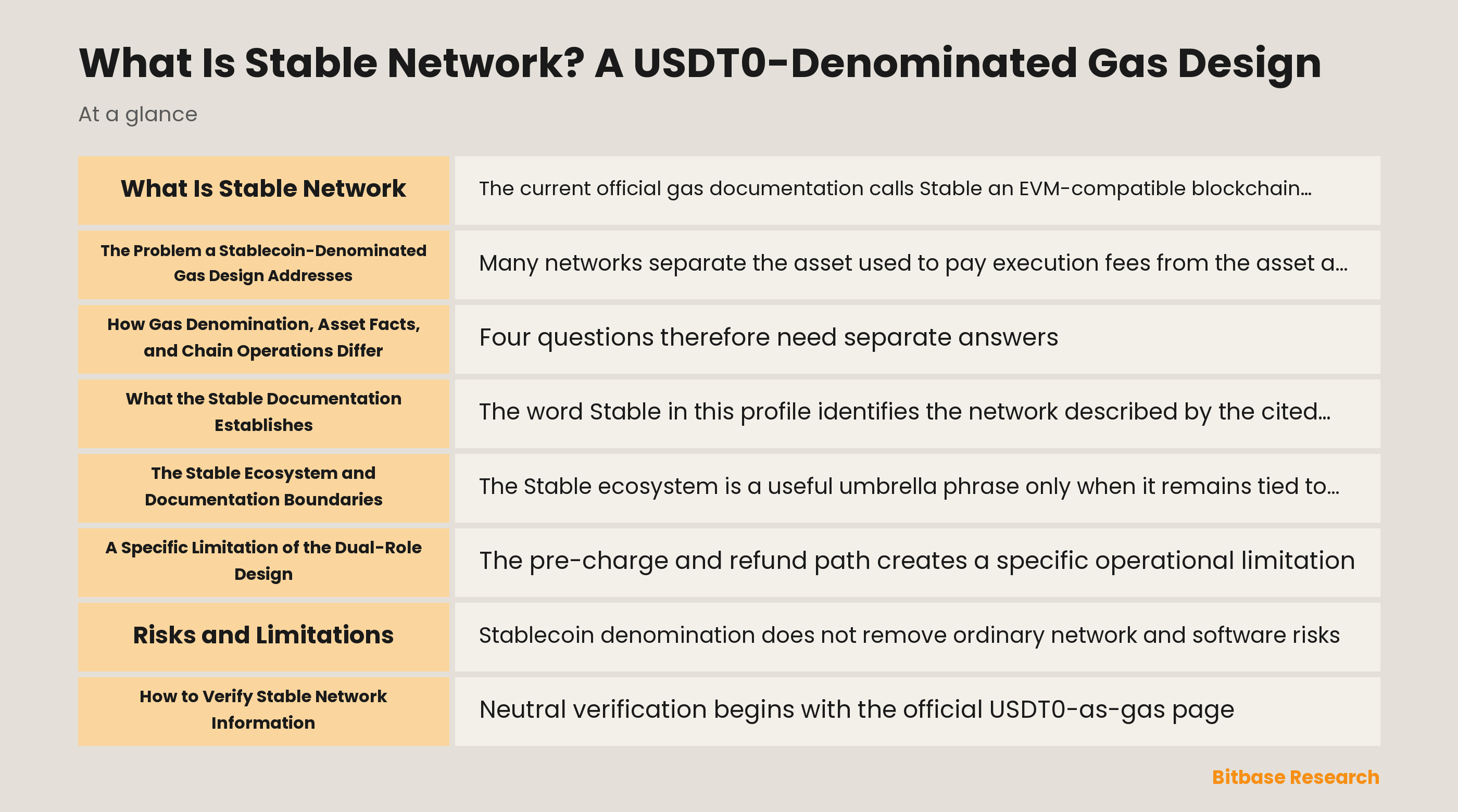
What Is Stable Network
The current official gas documentation calls Stable an EVM-compatible blockchain and says that USDT0 functions as the native asset for gas payment and value transfer while also supporting an ERC-20 interface. This supports a description of a network design in which the fee asset and the transferred native value share one documented asset role. It does not turn Stable itself into an asset, nor does it establish every economic, technical, or legal fact that might be associated with USDT or USDT0 elsewhere.
A source-scoped description must also distinguish documented design from ongoing service status. The official pages explain intended protocol behavior and list network information, but a page can be revised, superseded, or temporarily unavailable. The existence of documentation does not by itself prove uninterrupted access, suitability for a particular user, regional availability, or the continued operation of every connected service. Those are separate, time-sensitive questions.
The Problem a Stablecoin-Denominated Gas Design Addresses
Many networks separate the asset used to pay execution fees from the asset a person wishes to transfer or account for. Stable's documentation presents a different arrangement: USDT0 is used for both gas and native value transfer, with an ERC-20 surface on the same underlying balance. The design goal is a smaller number of asset roles to reason about. This is a mechanism description, not a statement that all assets, applications, or payment situations have identical properties. Readers asking what is Stable blockchain are asking about a stablecoin-native chain design, not a claim that the network name itself establishes a particular asset issuer, token term, or economic outcome.
A stablecoin-denominated fee can make the unit used for accounting more familiar, but denomination does not make the final fee permanently fixed. The official gas page describes an EIP-1559-style model with a dynamically adjusting base fee, so actual fees still depend on the documented execution model and conditions at the time. Nor does a dollar-denominated framing establish issuer obligations, reserve composition, redemption conditions, legal treatment, or an always-available service. Each of those needs a source with that exact scope.
How Gas Denomination, Asset Facts, and Chain Operations Differ
Four questions therefore need separate answers. Gas denomination asks which asset the network documentation names for fees. Asset facts ask what the relevant issuer or asset documentation currently says about the asset. Chain operations ask how validation, execution, accounting, and settlement are implemented. Availability asks whether a particular network environment, endpoint, feature, or region is presently accessible. A statement that is accurate for one question should not be used as evidence for the other three.
The official Stable gas page describes all transaction fees as denominated in USDT0 and explains a pre-charge and refund settlement model. In that description, validation considers the value and the maximum potential fee, the maximum fee is charged before execution, actual gas use is recorded, and the unused portion is returned after execution. This is a protocol-processing account. It does not describe asset issuance, reserve management, issuer policy, or the present availability of an external service.
What the Stable Documentation Establishes
The word Stable in this profile identifies the network described by the cited documentation. That documentation expressly supports the narrower claim that USDT0 is the native gas asset and that it also has the stated ERC-20 behavior. Its version note is evidence that implementation details can change over time. A careful introduction may repeat the documentation's identifier USDT0, but it should not invent another identifier or extend a network-design claim into a timeless claim about separate asset terms. Within the cited documentation, Stable names the network, USDT0 names the documented native asset used for gas and value transfer, and STABLE names the documented governance token. These are document-time role labels only, not promises about token terms, availability, rights, issuer, reserves, redemption, or outcomes.
Stable's documentation also describes USDT0 as an omnichain version of USDT. That is the scope of the network's own description of the asset relationship. It is not, by itself, a current determination of an issuer, reserves, redemption rights, circulation, legal classification, or financial condition. Those are asset-level matters with their own official materials and dates. Treating the gas designation as proof of any of them would blur the line between a chain mechanism and facts about the underlying stablecoin arrangement. The cited official gas documentation describes v1.2.0 as a historical gUSDT-to-USDT0 transition. It is not a current-version claim, and the applicable version plus any version-specific implementation details must be rechecked in current official release material on the release day.
The Stable Ecosystem and Documentation Boundaries
The Stable ecosystem is a useful umbrella phrase only when it remains tied to the document being read. A gas-mechanism page supports the dual-role fee design; a behavior page supports particular balance and event semantics; network-information pages support the configuration fields they display. None of those pages alone is a permanent catalogue of applications, providers, integrations, partners, or supported use cases. A profile should name the source scope instead of turning the word ecosystem into an all-purpose claim.
The official Mainnet Information and Connect pages currently label a mainnet and a testnet and display corresponding configuration fields. That supports a documentation-time statement that the publisher presents those network environments. It does not guarantee that a particular endpoint is reachable at every moment, that a feature is active in every place, or that access is appropriate for a particular situation. Current availability must be checked again on the release day rather than inferred from a static profile.
A Specific Limitation of the Dual-Role Design
The pre-charge and refund path creates a specific operational limitation: the documented validation step considers the maximum potential fee before execution, while final settlement reflects actual gas use. This differs from a simple mental model in which only the final amount matters at the start. It is relevant to integrators and to readers who want to understand why a fee balance and a post-execution balance can be discussed at different stages. It is an explanation of the published mechanism, not a direction to perform an action.
The dual role has another documented consequence. Stable's behavior page says that the native and ERC-20 views use the same balance, while their different decimal representations require fractional-balance reconciliation. It also says allowance-based ERC-20 operations can affect a contract's native USDT0 balance without executing that contract's code, and that auxiliary Transfer events can occur. These are technical integration boundaries, not a security certification or a universal statement about every application built on the network.
Risks and Limitations
Stablecoin denomination does not remove ordinary network and software risks. The official material describes a design, but implementation defects, incorrect integrations, data-indexing mistakes, changing dependencies, consensus or infrastructure incidents, and documentation changes can still matter. The dual-role balance behavior adds assumptions that developers and reviewers must handle carefully. No short profile can establish that a deployment is secure, audited, suitable, legally effective, or available for a reader's own circumstances.
Dynamic facts require special restraint. Network parameters, documentation versions, asset terms, access conditions, software releases, audit statements, governance arrangements, legal descriptions, and third-party relationships can change after a page is read. The profile therefore does not present them as enduring facts. If a release needs any such detail, it should cite a current primary source that covers the precise detail, with the publication date and the source's own caveats kept visible.
How to Verify Stable Network Information
Neutral verification begins with the official USDT0-as-gas page, the behavior page, and the current network-information pages, while keeping each page's scope separate. As a record-comparison check, compare the contract address disclosed on the current official gas page with the corresponding entry in the official block explorer. The point is to compare current records that identify the same documented asset role, not to infer facts from similarly named assets, copied identifiers, or unrelated pages.
Before release, compare the current version note, the network labels, and the documentation dates or update indicators across the official pages. Recheck availability through current official status material, and keep asset-level issuer material separate from Stable's chain documentation. Where a contract address and a block explorer record are cited, record the date and the exact page scope for both. This is a publication-quality control, not an instruction to connect a wallet, move assets, or use a service.
Conclusion
Stable Network can therefore be introduced conservatively as a documented EVM-compatible network design in which USDT0 is used as the native gas asset and for native value transfer, with an ERC-20 interface on the same balance. The official pages also describe an EIP-1559-style base-fee model and a pre-charge and refund settlement path. These points explain the design without overstating what the documentation proves about the asset or present operations.
The central interpretive rule is separation. Gas denomination is not an issuer statement. An asset description is not a guarantee of reserve, redemption, or legal conditions. A chain-operation explanation is not proof of current availability. A mainnet label is not a promise of uninterrupted access. Each claim needs a current primary source whose scope matches the claim, especially when the claim concerns a changing implementation or external arrangement.
For a publication-ready profile, state the network role, the documented USDT0 gas designation, the mechanism difference, and the documentation boundary in separate sentences. Keep issuer-level and asset-level facts out unless their current official sources are cited directly. Recheck time-sensitive configuration, availability, identifiers, audit statements, governance descriptions, legal status, and relationships on the release day. That approach explains Stable Network without converting changing documentation into a promise.
Related market pages
- USDT0: View price
Disclaimer: This article is educational content from Bitbase Academy, provided for information only. It explains what a project does and what role its token plays in that system; it does not constitute investment, trading, tax, or financial advice, and it is neither a recommendation nor an endorsement of any project or token. Bitbase has not carried out due diligence on the project described here, and mentioning it does not mean Bitbase lists or supports the asset. Crypto assets carry significant risk, including price volatility, thin liquidity, smart-contract failure, regulatory uncertainty, and the possible loss of their entire value. Written as of August 2026; a project's status, tokenomics, team, and contracts can change at any time. Verify everything yourself through official channels, the contract address, and a block explorer, and beware of imitation sites and phishing links.
References
[1] Stable Docs: USDT0 as gas docs.stable.xyz
[2] Stable Docs: USDT0 behavior on Stable docs.stable.xyz
[3] Stable Docs: Mainnet information docs.stable.xyz
[4] Stable Docs: Connect docs.stable.xyz
[5] USDT0 Network technical documentation docs.usdt0.to
[6] Tether official FAQs tether.to
[7] Stable Docs: Tokenomics (document-time STABLE governance-token role) docs.stable.xyz
[8] Stable Docs: Mainnet Version History (release-version record) docs.stable.xyz