STBL is the protocol's named ecosystem token, distinct from USST, the documented stablecoin unit, and YLD, the documented yield-claim NFT.
STBL describes a Money-as-a-Service architecture for ecosystem-specific stablecoins. The project documentation presents a three-part model: USST represents the principal-side stablecoin unit, YLD represents a separate claim linked to yield from specified collateral, and STBL is the ecosystem token. Asking what is stbl crypto therefore needs a role-based answer, rather than treating every item bearing the STBL name as the same asset.
What Is STBL
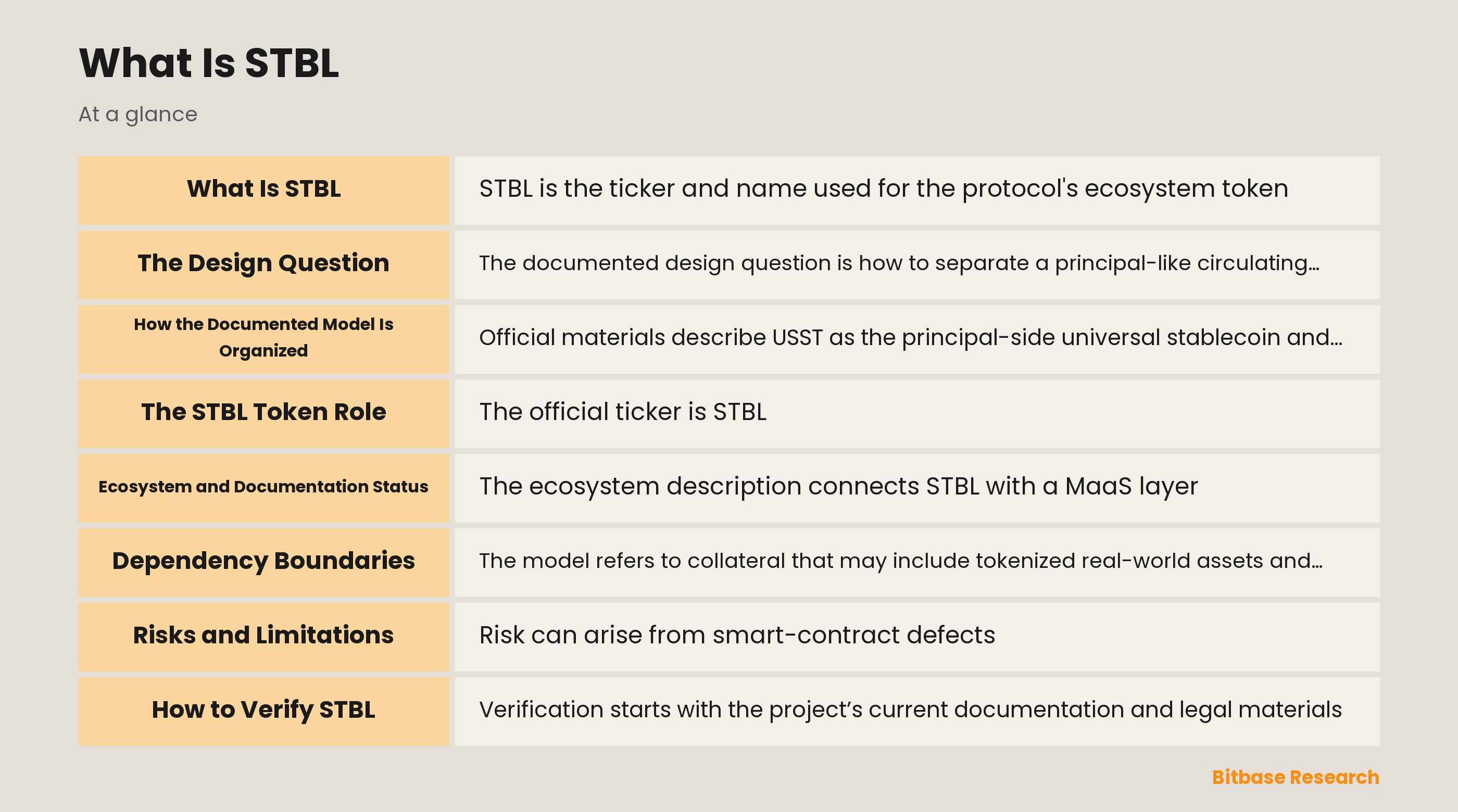
STBL is the ticker and name used for the protocol's ecosystem token. Its documentation calls it a utility token, while the official site and terms also call it a governance token. The defensible identity is thus STBL, not a dollar unit, collateral receipt, or yield instrument.
The broader project describes infrastructure for institutions and ecosystems that may design their own stablecoin arrangements. That description is architectural and should not be read as a statement that any particular product, asset, market, or jurisdiction is currently available.
The Design Question
The documented design question is how to separate a principal-like circulating unit from economic proceeds associated with underlying collateral. In the project model, the separation is intended to make those roles legible instead of combining them in one token representation. Conceptually, a principal-side unit and a separate claim described in relation to collateral-linked economics answer different questions. One asks what the circulating unit is intended to represent; the other asks how an economic component is characterized, allocated, and bounded. STBL adds a third question: what role an ecosystem token has in the documented architecture. These labels help organize a model, but they do not settle whether a particular asset exists, what legal rights attach to it, or how any external arrangement operates. A reader should therefore avoid carrying an assumption from one role to another. A statement about USST is not automatically a statement about YLD, and a statement about either is not automatically a statement about STBL. The distinction is useful because it makes the underlying dependencies visible rather than hiding them behind a single token name. Collateral quality, custodial arrangements, valuation methodology, issuer obligations, contract logic, and applicable terms remain separate matters that must be evaluated from current source material. Even where the labels appear straightforward, their meaning can depend on definitions, scope conditions, and updates made in the project's own documentation. The architecture should be read as a vocabulary for analyzing those relationships, not as proof that every relationship has a fixed or identical status across products, networks, or jurisdictions.
This does not remove the dependencies behind either role. Issuer arrangements, collateral selection, custody, valuation, legal rights, and operational controls can each affect how a system functions, and each requires current-source verification.
How the Documented Model Is Organized
Official materials describe USST as the principal-side universal stablecoin and YLD as a non-fungible yield claim. STBL sits apart from those two units as the token associated with ecosystem access, incentives, and governance language in different official materials.
The principal-yield split is a documented mechanism, not a promise about performance. It depends on the quality and treatment of tokenized real-world assets, the relevant issuer and custody chain, valuation inputs, contract behavior, and whatever legal terms govern the particular arrangement. In practical analysis, the split means that a description of the principal side should not be used to infer the nature of YLD, and a description of YLD should not be used to infer the nature of STBL. The three labels identify different positions in a conceptual design rather than interchangeable claims. They may be linked within an ecosystem narrative, yet their conditions, documentation, and risk boundaries can still differ. For example, a technical description may explain how a contract records categories, while legal materials may define who bears obligations and what limitations apply. A separate disclosure may describe collateral composition or custody, while a governance document may identify the scope of parameter changes. None of these items should be assumed from a high-level diagram or a token ticker. The appropriate reading is layered: first identify the unit being described, then identify the relevant documentation, and finally examine the dependencies that support that description. This approach prevents a name such as stablecoin, utility token, or yield claim from being treated as a complete account of economic substance. It also leaves room for publication-day changes in documentation, contract deployment, audit scope, parameterization, applicable terms, or availability. The role separation can improve conceptual clarity, but it cannot remove the need to verify the underlying facts that give each role its meaning.
The STBL Token Role
The official ticker is STBL. The documentation says STBL is intended to support functional utility across the ecosystem; the terms define STBL as a governance token for proposals and votes on matters such as risk parameters, collateral standards, upgrades, and treasury allocation.
Neither description makes STBL the project’s dollar-denominated stablecoin. USST is the separately named stablecoin unit, while YLD is separately described as a yield-claim NFT. Readers should preserve this distinction when interpreting stbl tokenomics and use cases or references to an stbl coin.
Ecosystem and Documentation Status
The ecosystem description connects STBL with a MaaS layer, Ecosystem-Specific Stablecoins, USST, and YLD. Documentation frames some STBL utilities as planned or generic, with exact operational constructs and mechanics to be finalized when product features are ready.
That wording matters because a design description is not proof of a current integration, entitlement, or feature state. It is prudent to treat documentation about partners, incentives, governance scope, and product availability as time-sensitive publication-day facts.
Dependency Boundaries
The model refers to collateral that may include tokenized real-world assets and to a separation between principal and yield. The source, custody, enforceability, valuation, and transfer restrictions of those underlying assets are external dependency boundaries, not properties created merely by a token label.
Oracle inputs and governance-set controls are another boundary. A price or eligibility input can influence accounting and risk controls, while a governance decision can alter parameters or approved categories. The exact operating configuration is therefore not assumed here.
Risks and Limitations
Risk can arise from smart-contract defects, administrative or governance changes, oracle failures, collateral impairment, custody or issuer failure, and mismatches between on-chain records and off-chain legal claims. A principal-yield split can clarify representation without eliminating these sources of uncertainty.
Legal and geographic restrictions may affect who can access a service and what rights attach to an asset. Liquidity, redemption conditions, audit scope, and protocol availability can also change or be limited. None should be inferred from the general architecture or from a token name.
How to Verify STBL
Verification starts with the project’s current documentation and legal materials, read together. A current contract address should be matched against the official deployed-contract listing and then inspected through the relevant block explorer, with the network and token identity kept explicit.
The same review should distinguish STBL from USST and YLD, and should check current governance documents, collateral disclosures, oracle design, audit reports, restrictions, and announced product state. A careful review records which statement is supported by which type of first-party material. Identity claims call for the project's current terminology and, where relevant, published network information. Statements about collateral or reserves call for the applicable disclosures and legal context. Statements about technical behavior call for documentation and independently inspectable deployment data. Statements about governance call for the current documents that define its remit and any limits. Audit references require attention to scope, date, version, and exceptions; a general mention of an audit is not a substitute for examining those details. When sources use future-oriented language, that language should be kept distinct from a live-status claim. The same caution applies to references to integrations or other ecosystem participants, because a relationship described in a diagram may be conditional, limited, or superseded. If an item cannot be connected to a current primary source, the article should state no more than can be supported. This keeps the analysis focused on identification and boundaries instead of implying a current right, feature, or outcome. This is a research standard, not an instruction to interact with any product.
Conclusion
STBL is the official ticker for the project’s ecosystem token. Official sources use both utility-token and governance-token language, so the safest concise description is an ecosystem token with documented utility and governance roles, subject to current documentation.
USST and YLD are separate parts of the published architecture: the former is described as the principal-side stablecoin unit and the latter as a yield claim. They should not be collapsed into STBL or used to infer rights, availability, liquidity, or outcomes.
For publication, current first-party materials should be checked again for the issuer, collateral and reserve arrangements, legal rights, contract and network identity, oracle configuration, audits, jurisdictional limits, integrations, token parameters, and live protocol status.
Related market pages
- STBL: View price · Perpetual market
Disclaimer: This article is educational content from Bitbase Academy, provided for information only. It explains what a project does and what role its token plays in that system; it does not constitute investment, trading, tax, or financial advice, and it is neither a recommendation nor an endorsement of any project or token. Bitbase has not carried out due diligence on the project described here, and mentioning it does not mean Bitbase lists or supports the asset. Crypto assets carry significant risk, including price volatility, thin liquidity, smart-contract failure, regulatory uncertainty, and the possible loss of their entire value. Written as of August 2026; a project's status, tokenomics, team, and contracts can change at any time. Verify everything yourself through official channels, the contract address, and a block explorer, and beware of imitation sites and phishing links.
References
[1] STBL Docs, Introduction to STBL docs.stbl.com
[2] STBL Docs, The Three Tokens docs.stbl.com
[3] STBL Docs, STBL Token Utility docs.stbl.com
[4] STBL Protocol Terms and Conditions www.stbl.com
[5] STBL Docs, Developer Overview docs.stbl.com