Story is a purpose-built Layer 1 network for programmable intellectual-property records, while IP is its native network token and not an IP Asset, NFT, IP Account, or legal right by itself.
Story Protocol is a name often used for the technology and documentation surrounding Story's intellectual-property network. Its published concepts describe a way to represent specified creative or other intellectual-property material through on-chain records and software components. That description is useful for studying how the system is organized, but it does not turn every record into proof of real-world ownership, permission, authorship, or legal enforceability. Those are separate questions that depend on the underlying work, the parties, the governing terms, and the relevant jurisdiction.
What Is Story
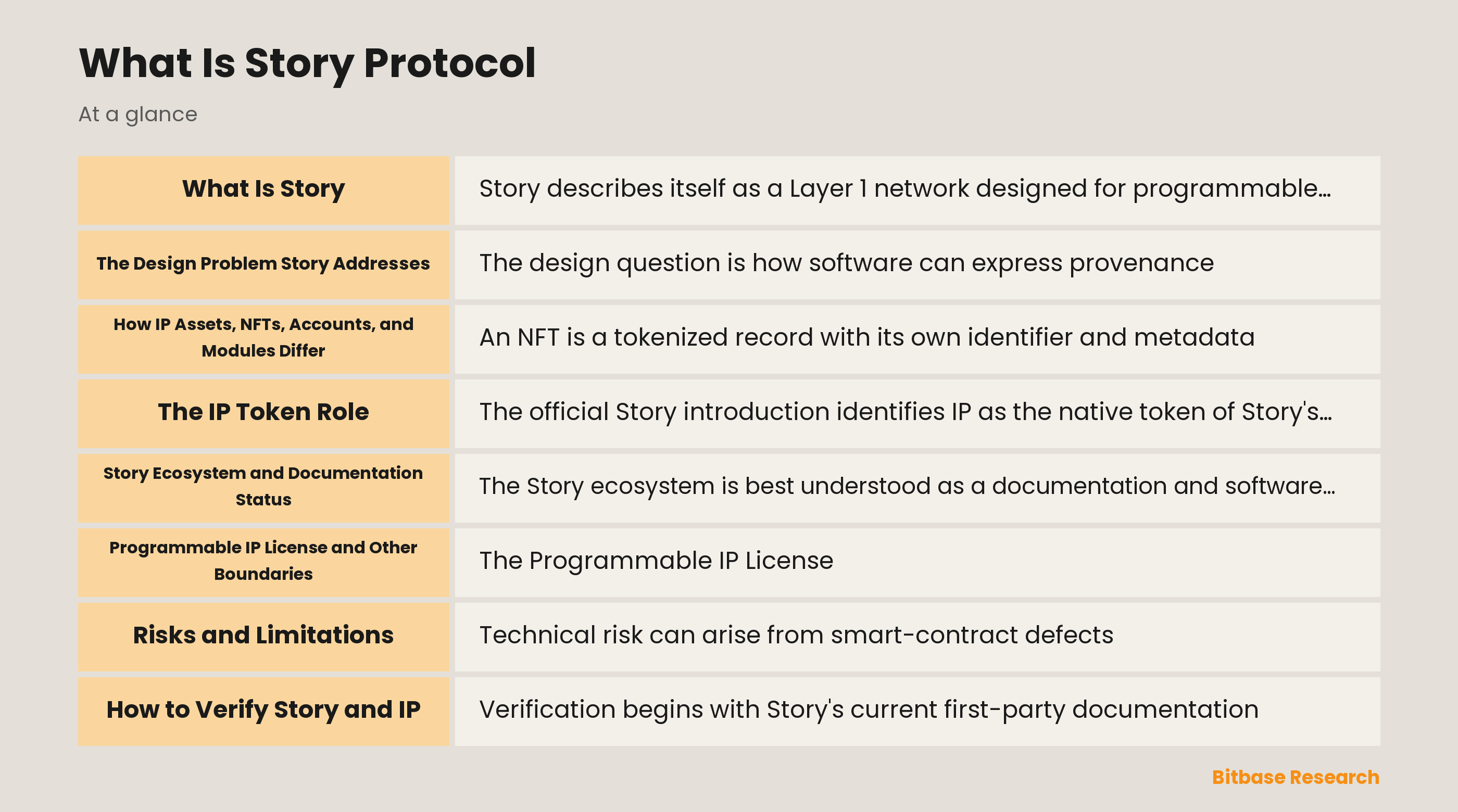
Story describes itself as a Layer 1 network designed for programmable intellectual property. In its conceptual model, an intellectual-property item can be represented through an IP Asset with associated metadata and protocol components. The purpose is to give software a structured way to refer to relationships, permissions, and other information connected with a recorded asset. It is an infrastructure description, not a conclusion that the recorded subject is original, valid, unencumbered, or usable by every reader.
The word IP has several meanings in this context. It can mean intellectual property in ordinary legal language, an IP Asset in Story's protocol terminology, an IP Account associated with that asset, or the ticker of Story's native token. These meanings are related only by naming. A careful explanation keeps them separate, because a statement about a token or a smart-contract record does not automatically establish a fact about a copyright, trademark, patent, data right, character, image, song, model, or other real-world subject.
The Design Problem Story Addresses
The design question is how software can express provenance, attribution, permitted reuse, and relationships among creative works without reducing all of those questions to a single database field. Intellectual-property material often changes through versions, adaptations, collaborations, or linked works. Story's documentation presents a set of protocol primitives intended to make selected relationships legible to applications and to preserve references that can be independently inspected on the network.
That technical goal has a boundary. A network record can show that an address submitted information under a particular protocol rule, but it cannot by itself determine whether the submitter held every necessary right or whether a later use complies with law. Identity, authorship, chain of title, consent, applicable terms, and evidence outside the network remain material. The architecture therefore should be read as a coordination layer for stated information and rules, rather than as a universal registry that resolves every intellectual-property dispute.
How IP Assets, NFTs, Accounts, and Modules Differ
An NFT is a tokenized record with its own identifier and metadata. Story documentation describes an IP Asset as an ERC-721 NFT registered through the protocol, together with IP-specific metadata and relationships. The NFT-level metadata and the IP metadata can describe different things. Neither label should be mistaken for the underlying creative work itself, nor should an NFT record alone be treated as a complete statement of the real-world rights connected with that work.
When an IP Asset is created, the protocol associates it with an IP Account. Documentation describes that account as a modified token-bound account used to hold asset-related information and to coordinate interactions with modules. Modules provide distinct protocol functions such as licensing, royalty, dispute, grouping, and metadata functions. A module is not the same as an IP Asset, and an IP Account address is not the same as an NFT identifier, a human author, or a legal owner. Their relationships must be read from current first-party materials and the relevant on-chain record.
The IP Token Role
The official Story introduction identifies IP as the native token of Story's Layer 1 network. Its published description assigns IP network-level roles, including network-fee and governance language. That narrow identity should not be expanded into a claim that IP represents a particular IP Asset, grants rights in a work, or proves an entitlement under a Programmable IP License. It is also distinct from an NFT used to represent an asset and from any address associated with that asset.
The phrases story tokenomics and use cases and story crypto can be ambiguous if they combine the network token with the protocol's IP records. The careful answer is that IP is the officially named native token, while Story's IP Assets, NFT records, IP Accounts, and license terms are separate layers with different functions. Current token contract information, supply and allocation disclosures, governance parameters, network configuration, availability, and legal treatment are time-sensitive facts. They require a publication-day review rather than an inference from a ticker or a high-level diagram.
Story Ecosystem and Documentation Status
The Story ecosystem is best understood as a documentation and software environment built around IP Assets, IP Accounts, registries, and modules. The documentation describes modules for licensing, royalty-related records, dispute handling, grouping, and metadata. These components help applications express relationships within the protocol. They do not make every external dataset, application, creative work, or claimed integration part of Story merely because it uses similar terms or is mentioned in a presentation.
Documentation may describe plans, examples, templates, developer interfaces, or ecosystem participants at a particular time. Such descriptions should not be converted into assertions about current product status, audit scope, permissions, partnerships, or geographic availability. The current implementation, deployed contracts, supported modules, administrative permissions, and third-party connections all need direct first-party confirmation on the publication date. A reader should distinguish a documented design from a live and verified condition.
Programmable IP License and Other Boundaries
The Programmable IP License, commonly abbreviated as PIL, is described in Story materials as a legal license framework whose terms can be mapped to on-chain protocol representations. The mapping can make stated conditions easier for software to reference, but the existence of an on-chain term does not settle the legal scope of a right, the authority of a person who supplied it, or the result of a disagreement. A license template, a license term, a license-related token record, and the underlying intellectual property remain different concepts.
This distinction is especially important for real-world IP rights. A chain record can preserve data and a program can apply protocol logic, while copyright, contract, privacy, publicity, consumer, data, and other laws may apply differently across places and facts. Story's own documentation discusses an off-chain legal dimension for PIL. Whether a particular license is valid, enforceable, complete, applicable, or recognized in a given jurisdiction is not determined by this overview. Current legal texts, jurisdictional scope, and the exact factual context must be checked at publication time.
Risks and Limitations
Technical risk can arise from smart-contract defects, unexpected module behavior, inaccurate metadata, compromised permissions, network changes, and mistakes in how an application interprets a record. A relationship recorded between assets may be technically valid under a protocol rule while still being incomplete, disputed, misleading, or unsupported outside that rule. The existence of a visible identifier should therefore not be treated as a quality guarantee, an authorship finding, or a conclusion that every linked assertion has been independently verified.
Legal and practical risk can arise when users confuse a record with a right. An NFT, IP Asset, IP Account, license term, and IP token may be connected in a technical system yet confer different kinds of information or authority. Third-party metadata, rights assertions, module status, audit references, intellectual-property provenance, regional restrictions, and availability can change. Smart-contract addresses, supply and allocation information, protocol permissions, audit materials, integration status, and product state are all publication-day verification items rather than fixed facts for this article.
How to Verify Story and IP
Verification begins with Story's current first-party documentation. Compare the official description of the IP token with the protocol-concept pages for IP Assets, IP Accounts, modules, and the PIL. For a claimed deployment, match a current official contract address with the stated network and inspect the corresponding block explorer record. This is an evidence-reading method, not an instruction to use a product, and it should preserve the difference between a technical identifier and a legal conclusion.
The same review should identify what each source actually supports. A token document can support the ticker and a stated network role; a protocol page can support a concept definition; an account or module page can support a software relationship; and a legal text can state its own terms and limits. It cannot be assumed that one source proves all of those things. Check dates, versions, scope, named entities, permissions, audit coverage, official deployment listings, and whether a document speaks about a plan, an example, or an active condition.
Conclusion
Story is a network and protocol framework for expressing selected intellectual-property information through on-chain records and programmable components. An IP Asset is a protocol representation associated with an NFT and metadata; an IP Account is an associated software account; and modules provide separate functions around those records. These objects help organize a technical model, but none is interchangeable with the real-world intellectual property it may reference.
IP is the official ticker for Story's native network token. It should be kept distinct from IP Assets, NFT records, IP Accounts, and Programmable IP License terms. A token description cannot by itself establish authorship, ownership, a license scope, or the enforceability of a particular right. Likewise, an on-chain record is not a substitute for checking the source material, the relevant parties, and the legal setting.
Before publication, review the current official token and protocol materials, contract addresses and network identity, deployed-module status, administrative permissions, audit scope, legal texts, jurisdictional limits, intellectual-property provenance, metadata accuracy, third-party relationships, and availability. Those checks are necessary because the technology, documentation, legal context, and factual circumstances can change independently of the Story name or the IP ticker.
Related market pages
- IP: View price
Disclaimer: This article is educational content from Bitbase Academy, provided for information only. It explains what a project does and what role its token plays in that system; it does not constitute investment, trading, tax, or financial advice, and it is neither a recommendation nor an endorsement of any project or token. Bitbase has not carried out due diligence on the project described here, and mentioning it does not mean Bitbase lists or supports the asset. Crypto assets carry significant risk, including price volatility, thin liquidity, smart-contract failure, regulatory uncertainty, and the possible loss of their entire value. Written as of August 2026; a project's status, tokenomics, team, and contracts can change at any time. Verify everything yourself through official channels, the contract address, and a block explorer, and beware of imitation sites and phishing links.
References
[1] Story, Introducing $IP www.story.foundation
[2] Story Documentation, Protocol Concepts Overview docs.story.foundation
[3] Story Documentation, IP Asset Overview docs.story.foundation
[4] Story Documentation, IP Account docs.story.foundation
[5] Story Documentation, Licensing Module docs.story.foundation
[6] Story Documentation, How Story Protects IP docs.story.foundation