Succinct is a project family built around SP1, a zero-knowledge virtual machine, and the Succinct Prover Network, which coordinates proof requests with independent proving capacity. In common search language, what is succinct crypto? It is not one application or a generic token label: the name can refer to SP1, the proving network, and the PROVE token. This guide separates those layers. For readers researching succinct tokenomics and use cases, the official material establishes functional roles for PROVE, not a reason to infer value, allocation, or future availability.
What Is Succinct?
Succinct is an applied-cryptography project whose documentation distinguishes two connected ideas. SP1 is the technical layer: a zero-knowledge virtual machine, or zkVM. The Succinct Prover Network is the coordination layer: a protocol on Ethereum that links applications needing proofs with provers that can generate them. Keeping those labels separate is useful because a proof system and a network for obtaining proofs solve different parts of the same workflow.
According to the SP1 documentation, SP1 can prove the correct execution of programs compiled for the RISC-V architecture. That matters because software written in languages such as Rust, C++, or C can be compiled into a form the zkVM can execute and prove. The resulting proof is a compact cryptographic claim about an execution; it is not a claim that the program's specification, inputs, or real-world premise were wise or correct.
The decentralized proving network is the part that coordinates demand and supply for those proofs. A requester is an application that needs a zero-knowledge proof. A prover is an entity that performs the computation needed to produce it. The official protocol description calls the arrangement a two-sided marketplace. That description identifies a mechanism for matching roles; it should not be read as evidence that every type of software, prover, or application has the same availability or outcome.
What Problem Does It Try to Solve?
Zero-knowledge proofs can let one party verify that a program executed correctly without every verifier repeating the full computation. Generating those proofs can be technically demanding, however. An application team may need specialized hardware, proving software, and operational capacity if it handles every request on its own. Succinct's stated approach is to make proof generation a networked service layer rather than leaving each application to arrange all of that capacity independently.
The problem therefore has two layers. First, a zkVM makes ordinary program logic more amenable to proving than a custom circuit-only workflow. Second, a proving network can coordinate applications that need proofs with operators able to generate them. Neither layer removes the need to inspect the program being proved, the input data, the requested deadline, or the settlement rules. A proof can establish correct execution of the specified computation while still leaving those surrounding choices open to scrutiny.
How Does Succinct Work?
SP1 supplies the general-purpose proving component. A developer's program is compiled for the relevant architecture, executed in the proving system, and turned into a proof of that execution. The verifier can then check the proof without reproducing the full work. In this article, it is important not to collapse that local proving capability into the network: SP1 explains how a program can be proven, while the Prover Network explains how a proof request may be coordinated among multiple participants.
The network documentation describes a request as more than a program name. Its fields can include the program and inputs, a computational limit expressed in prover gas units, a maximum fee in PROVE, a minimum PROVE stake for eligible provers, a deadline, and a verification key. Those fields give the request a technical and economic shape. They do not guarantee that a proof will arrive, that an application chose sensible limits, or that the surrounding application safely consumes the proof.
For matching, the architecture uses an off-chain auctioneer service and on-chain settlement contracts on Ethereum. The auctioneer handles incoming requests, bids, assignments, and proof fulfillments, while the contracts settle state roots and proofs of correct execution. A prover that wins an assignment generates and submits a proof by the request deadline. This separation is a central mechanism difference: decentralized participation and verifiable settlement do not mean that there is no off-chain service component to assess.
What PROVE Does in the System
The official token overview identifies PROVE as the native token of the Succinct Prover Network and gives its ticker as PROVE. It documents three system roles: payments for proof requests, staking connected to prover participation and economic security, and governance connected to network parameters. The overview also identifies an Ethereum ERC-20 deployment. These are roles inside the stated protocol design, not an assertion about a holder's return or the availability of a particular venue.
In the documented request model, a maximum fee and a minimum stake are expressed in PROVE. The staking mechanism affects a prover's eligibility and concurrent auction participation, while the governance documentation describes a security-council-led starting arrangement with a later transition described for voting through PROVE stake. That is the evidence-based answer to succinct tokenomics and use cases: the official sources explain functional utility. They do not by themselves establish a complete allocation record, an unlock schedule, a valuation, or a recommendation.
Ecosystem and Adoption Context
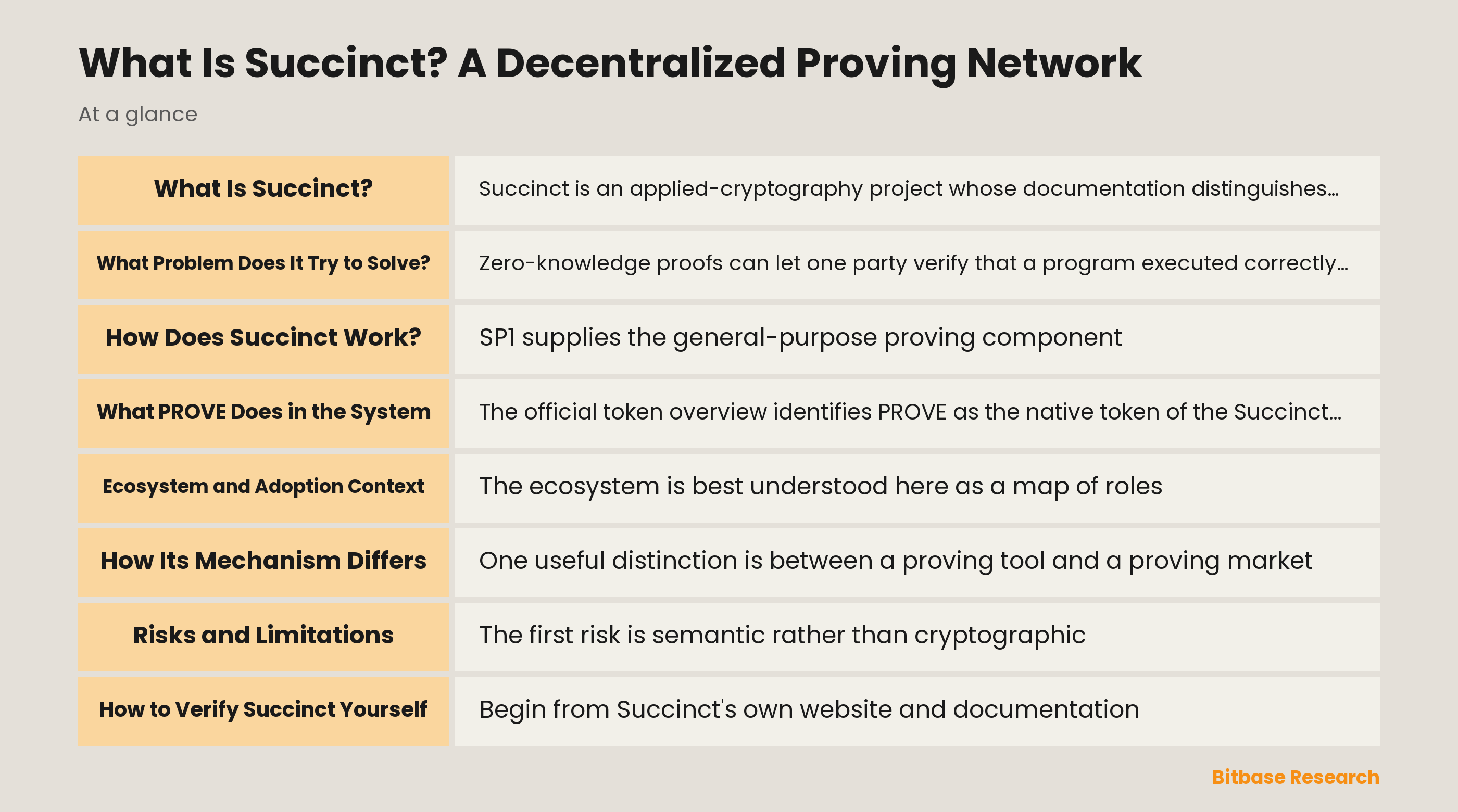
The ecosystem is best understood here as a map of roles, not as a count of integrations. Succinct's protocol documentation lists possible requester categories such as blockchains, rollups, bridges, oracles, AI agents, and games. Those are examples of software that might need proof generation. They are not a substitute for checking whether a named application actually uses a particular version of SP1 or the Prover Network.
The official documentation also exposes a network explorer and deployment pages, which make some claims more inspectable than a presentation alone. A reader can distinguish an architectural description from a live operational claim by checking the relevant official page, chain, deployment, program version, or publicly visible request record at the time of review. That discipline matters because infrastructure documentation, contracts, and parameters can change independently.
How Its Mechanism Differs
One useful distinction is between a proving tool and a proving market. SP1 is a zkVM that turns a program execution into a proof. The Succinct Prover Network adds a coordination system in which requesters submit work and provers compete to fulfill it. A project may use a zkVM without using this specific network, and a network statement should not be automatically attributed to every SP1 program.
Another distinction is between real-time processing and settlement. The official architecture describes the auctioneer and its verifiable database as off-chain, with periodic proofs and state roots settled on Ethereum. This can support fast request handling while preserving a path to verify network state. It also creates a clear boundary to examine: request matching, data availability, software versions, settlement timing, and contract rules are not all the same thing, and each can affect the user-facing result.
Risks and Limitations
The first risk is semantic rather than cryptographic. A proof demonstrates correct execution of the program and inputs supplied to it under the applicable proof system assumptions. It does not independently establish that the program has no bug, that its inputs correspond to the intended real-world facts, or that the application will use the verified output safely. Succinct's own security material places responsibility on developers for program safety and correct use of the toolchain.
The second risk is operational. The network uses an off-chain auctioneer for matching and documents an evolving data-availability design. A request can have a deadline, technical constraints, and eligibility conditions; a proof workflow can therefore be affected by software compatibility, infrastructure availability, request configuration, or a failure to meet the stated requirements. On-chain settlement improves verifiability of the documented state transition, but it does not make every off-chain dependency disappear.
The third risk is governance and economic-rule change. Official documentation describes stake, potential slashing for missed requirements, parameter setting, and an initial security-council arrangement before a described governance transition. Those rules are protocol facts that should be reread when they matter, not assumed from an older article. Cryptographic systems also retain implementation, trusted-setup, and security-assumption limits; a reader should treat a claim of proof as a claim with a defined scope.
How to Verify Succinct Yourself
Begin from Succinct's own website and documentation, then separately read the SP1 introduction, protocol architecture, proof lifecycle, token overview, and security model. Check that a page is reached from an official domain rather than from a similarly named search result. For a claim about a particular implementation, identify the relevant software version and whether the claim concerns SP1 itself, the Prover Network, a requester application, or a smart contract.
For the token and contracts, take the contract address only from the official Smart Contracts or PROVE documentation, confirm the named chain, and inspect that exact contract address in a block explorer. Compare the deployment description, verified source-code status when shown, and the explorer record rather than relying on a ticker search. For security statements, look for the underlying report on the named auditor's own site and check its scope and version. These are read-only checks; a page requesting credentials, a signature, or a token action is not evidence that its claim is genuine.
The Bottom Line
Succinct combines SP1, a zkVM for proving program execution, with a Prover Network that coordinates requests and proving capacity through off-chain matching and Ethereum settlement. PROVE is the official ticker used for documented payment, staking, and governance roles in that network. The most useful way to understand what is Succinct crypto is to separate the proof system, the request market, the token's stated functions, and the limits that remain around code, inputs, infrastructure, and changing protocol rules.
Related market pages
- PROVE: View price · Perpetual market
Disclaimer: This article is educational content from Bitbase Academy, provided for information only. It explains what a project does and what role its token plays in that system; it does not constitute investment, trading, tax, or financial advice, and it is neither a recommendation nor an endorsement of any project or token. Bitbase has not carried out due diligence on the project described here, and mentioning it does not mean Bitbase lists or supports the asset. Crypto assets carry significant risk, including price volatility, thin liquidity, smart-contract failure, regulatory uncertainty, and the possible loss of their entire value. Written as of August 2026; a project's status, tokenomics, team, and contracts can change at any time. Verify everything yourself through official channels, the contract address, and a block explorer, and beware of imitation sites and phishing links.
References
[1] Succinct Docs: SP1 Introduction docs.succinct.xyz
[2] Succinct Docs: Protocol Introduction docs.succinct.xyz
[3] Succinct Docs: Protocol Architecture docs.succinct.xyz
[4] Succinct Docs: Proof Lifecycle docs.succinct.xyz
[5] Succinct Docs: PROVE Token Overview docs.succinct.xyz
[6] Succinct Docs: Smart Contracts docs.succinct.xyz
[7] Succinct Docs: SP1 Security Model docs.succinct.xyz