SuperVerse is a Web3 gaming and community ecosystem; SUPER is its officially documented token, not the name of every game, NFT, or governance body associated with the ecosystem.
SuperVerse is best understood as an umbrella for an evolving ecosystem rather than as a single game or a single collectible series. Its public materials connect a gaming community, game projects, and an ecosystem narrative around the token identified as SUPER. That framing matters because a project name can describe a network of relationships, while a specific game, an NFT collection, the SuperVerse DAO, and the SUPER token each remain separate objects with their own documentation and boundaries.
What Is SuperVerse
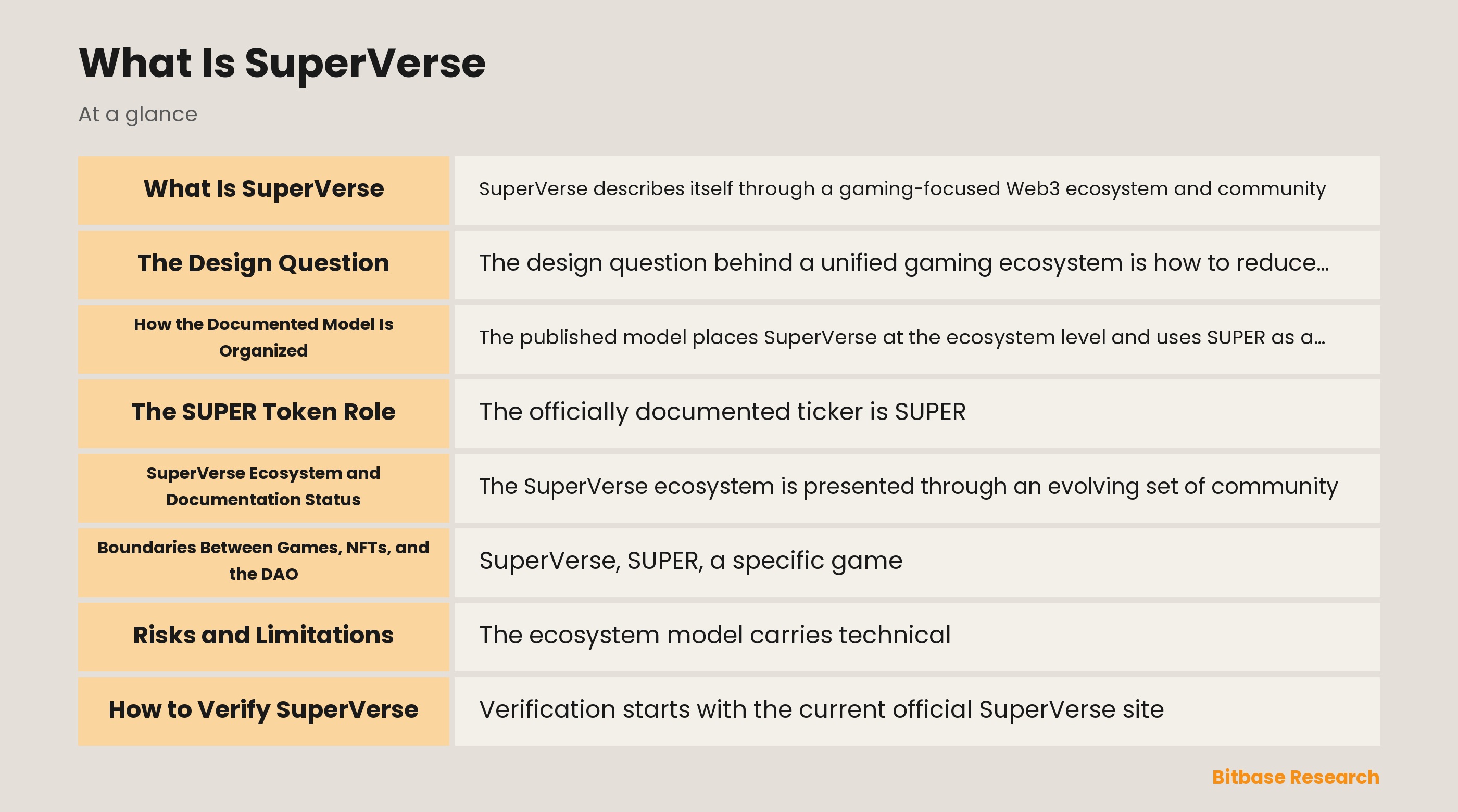
SuperVerse describes itself through a gaming-focused Web3 ecosystem and community. Its public site presents the idea of bringing games and a shared community together, while the documentation characterizes itself as a living document that can evolve as information changes. The most careful short description is therefore an ecosystem and documentation framework for gaming-related projects, rather than a promise that every named component has the same technical design, legal status, or current availability.
The name also has a narrower service context in the project’s own legal materials. Those materials distinguish the website and related services from the SuperVerse smart contract, the SUPER token, and blockchain networks. This distinction is useful: a web service, a token record, a smart contract, and a network are related concepts, but none should be silently substituted for another when describing what SuperVerse is.
The Design Question
The design question behind a unified gaming ecosystem is how to reduce fragmentation without pretending that independent games, collections, and communities are identical. A shared ecosystem can give a common vocabulary to participants and projects, but a game still has its own creative design, technical dependencies, terms, and operating status. An NFT may be associated with a collection or experience, yet it is not automatically the same thing as a game account, a license, a community membership, or a right in underlying intellectual property.
This distinction helps explain why the word “unified” should be read as an ecosystem ambition, not as evidence of universal interoperability. A relationship described on an ecosystem page can be limited in scope, updated, or governed by separate documentation. Code, controls, third-party services, local law, and a project’s own terms can all introduce boundaries that a broad community narrative does not remove. Careful analysis names those boundaries instead of compressing them into a single label.
How the Documented Model Is Organized
The published model places SuperVerse at the ecosystem level and uses SUPER as a token identifier within that broader setting. The official materials also discuss games, integrations, community activity, and a DAO in different contexts. These are connected parts of an evolving account of the ecosystem, but they are not interchangeable categories. A game is a particular creative and technical project; an NFT is a blockchain-recorded digital asset or collection item; and a DAO is a governance arrangement with a defined remit.
The documentation’s living status is important for interpreting every layer. A stated integration, a listed project, or a planned mechanism may describe a point in time rather than a permanent condition. It should not be used to infer that every game supports the same functions, that every NFT has the same attributes, or that a governance discussion applies to all projects using the SuperVerse name. Scope, source date, and the governing materials must remain explicit.
The SUPER Token Role
The officially documented ticker is SUPER, often written as $SUPER in first-party materials. SuperVerse documentation states that the existing SUPER ERC20 token remains the token of the ecosystem, while also describing the materials as subject to continuing updates. The ticker identifies the token discussed in this article; it does not identify every digital asset, NFT, game, or service connected with the SuperVerse name.
Official materials associate SUPER with ecosystem and governance language. That is a documented role description, not a blanket statement about rights, technical behavior, or current features. Questions framed as “superverse tokenomics and use cases” should first separate the confirmed token identity from dynamic items such as supply, distribution, governance scope, contract deployment, network support, integrations, and available functions. Those matters require publication-day checking from current first-party sources rather than inference from the ticker alone.
SuperVerse Ecosystem and Documentation Status
The SuperVerse ecosystem is presented through an evolving set of community, gaming, and project relationships. The public site uses a broad unification narrative, while the documentation says it is continually updated. That combination makes the ecosystem useful as a map for understanding how the project describes itself, but it does not establish that a named relationship, feature, or project status remains unchanged at every later date.
NFTs and individual games need their own reading. An NFT can be a blockchain-recorded item associated with a collection, but its metadata, permissions, utility, intellectual-property treatment, and connection to a game must be assessed from the applicable current materials. Likewise, a game mentioned alongside SuperVerse remains a distinct project with its own design and terms. The ecosystem description does not convert an NFT into a general license or make a game’s state an attribute of SUPER.
Boundaries Between Games, NFTs, and the DAO
SuperVerse, SUPER, a specific game, an NFT collection, and the SuperVerse DAO should be treated as five different nouns. The ecosystem can describe a relationship among them, but the relationship does not erase their separate sources of authority. A statement about a token does not automatically describe a game’s content. A statement about a game does not automatically describe an NFT’s rights. A statement about a collection does not automatically describe what the DAO can govern.
The official governance materials frame the DAO as a community governance body and discuss a treasury and community input. That establishes a governance context, not a universal ownership or control statement for every ecosystem participant. Governance authority, proposal status, administrative controls, and the scope of any applicable smart contracts are all dynamic matters. They should be verified from current official records before publication, especially when a description could otherwise imply a power or entitlement that the source does not clearly define.
Risks and Limitations
The ecosystem model carries technical, operational, and interpretation risks. Smart-contract defects, changes to administrative or governance arrangements, blockchain-network dependencies, third-party service issues, and inaccurate or stale documentation can affect how a component operates. NFT metadata or associated game content may change or become unavailable, and an ecosystem relationship can be narrower than a headline suggests. A shared brand or token identifier does not eliminate the distinct failure modes of each component.
There are also legal and practical limits. A token record, an NFT, a game, a website service, and an intellectual-property license can be governed by different materials and may have different geographic or eligibility constraints. The project’s terms say that services can change or be discontinued, and that other related projects may have separate terms. This is why neither a community description nor a token label should be used as proof of current availability, legal rights, audit scope, integration status, or a particular technical outcome.
How to Verify SuperVerse
Verification starts with the current official SuperVerse site, documentation, governance materials, and legal terms, read as separate source types. The exact current SUPER contract address should be taken from an official project source and matched against the relevant block explorer, with the network clearly identified. This is a research check for identity and scope, not an instruction to interact with any product or service.
The same review should distinguish the ecosystem label from the named game, NFT collection, DAO record, and token. Check the date and status of each first-party page; then verify whether current documents still support any statement about integrations, governance remit, contract identity, audits, or availability. Third-party summaries may help locate a topic, but they do not replace current project materials. The question “what is superverse crypto” is answered most safely by preserving these distinctions rather than reducing them to a single claim.
Conclusion
SuperVerse is an evolving gaming and community ecosystem described through first-party site, documentation, governance, and legal materials. SUPER is the officially documented token ticker within that setting. The concise answer to “what is superverse crypto” is therefore not a description of a single game or NFT, but a token-centered ecosystem narrative whose individual components must be examined separately.
For clear coverage, keep five concepts apart: SuperVerse as the umbrella ecosystem, SUPER as the token, individual games as distinct projects, NFTs as separate blockchain-recorded items, and the DAO as a governance framework. This separation avoids turning an ecosystem association into a claim about a game, treating an NFT as a general intellectual-property right, or assuming that governance language extends across every project.
Before publication, confirm the current official token identity, contract address and network, supply and distribution materials, governance scope, smart-contract and audit information, named integrations, project status, legal terms, territorial restrictions, and availability. These are publication-day facts, not conclusions that can be fixed from an older overview. This approach keeps the article explanatory and makes the boundaries of the SuperVerse ecosystem visible.
Related market pages
- SUPER: View price · Perpetual market
Disclaimer: This article is educational content from Bitbase Academy, provided for information only. It explains what a project does and what role its token plays in that system; it does not constitute investment, trading, tax, or financial advice, and it is neither a recommendation nor an endorsement of any project or token. Bitbase has not carried out due diligence on the project described here, and mentioning it does not mean Bitbase lists or supports the asset. Crypto assets carry significant risk, including price volatility, thin liquidity, smart-contract failure, regulatory uncertainty, and the possible loss of their entire value. Written as of August 2026; a project's status, tokenomics, team, and contracts can change at any time. Verify everything yourself through official channels, the contract address, and a block explorer, and beware of imitation sites and phishing links.
References
[1] SuperVerse Docs, Introduction docs.superverse.co
[2] SuperVerse Docs, Living Document and Links docs.superverse.co
[3] SuperVerse Docs, DAO Governance docs.superverse.co
[4] SuperVerse, Terms of Use superverse.co
[5] SuperVerse, Home www.superverse.co