Towns Protocol is a programmable communication layer for communities that need durable spaces, focused channels, and rules that can be expressed in software.
Online communities need more than a running chat feed when membership, context, continuity, and stewardship matter. Towns Protocol describes an open protocol for forming programmable community spaces where conversations can be organized into channels, represented as streams, and governed through defined access and ownership relationships. It is useful to view the protocol as shared infrastructure for community communication rather than as a single website or a promise that every community will use the same rules.
What Is Towns Protocol
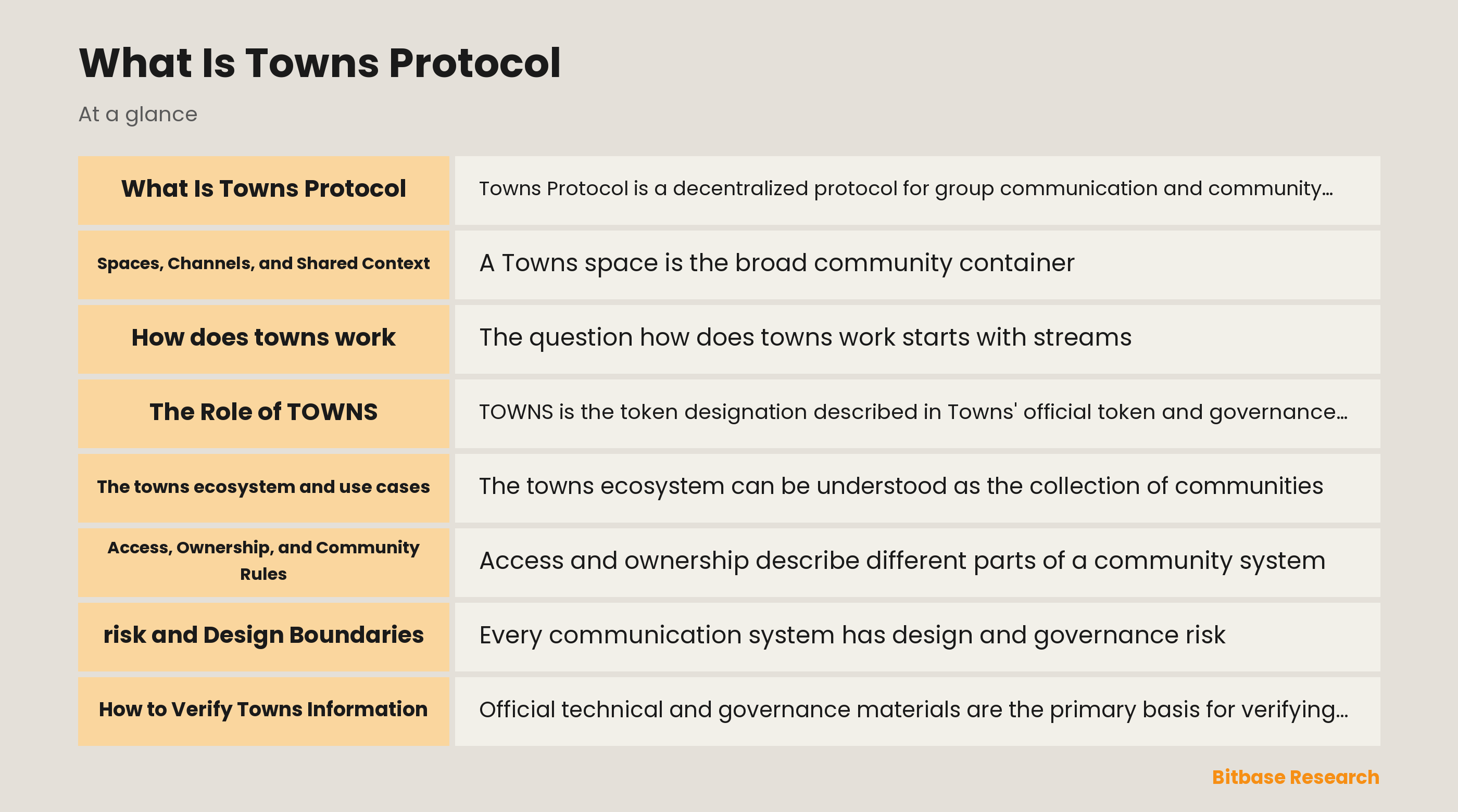
Towns Protocol is a decentralized protocol for group communication and community coordination. Its design gives a community a space in which people can gather, publish messages, and keep different conversations distinct, while protocol rules provide a common way to describe identity, permissions, message history, and changes to shared state. Programmability matters because a community can make its own organizational choices instead of treating every discussion area as an identical room with identical membership logic.
The protocol is separate from a product interface. A product may present a familiar way to read, write, moderate, or navigate a Towns space, but that interface is not the whole protocol. The protocol concerns the underlying rules and data relationships that can support community experiences; a product concerns how one experience exposes those capabilities. Keeping that distinction clear avoids mistaking a changing interface choice for a permanent property of the network.
Spaces, Channels, and Shared Context
A Towns space is the broad community container. It can give a group a recognizable boundary, a history, and a place to express who may participate under that community's rules. A space can include several channels so that announcements, working discussions, social conversation, and topic-specific material do not all compete in one undifferentiated timeline. The structure lets a group preserve context without forcing every member to follow every subject with the same level of attention.
Channels are not simply labels placed on messages after the fact. They are distinct conversational contexts within the space, with their own stream of activity and potentially their own access expectations. This distinction helps a community set the right degree of visibility and responsibility for a conversation. A public-facing channel, a member discussion, and a tightly scoped working channel can all belong to one community while still serving different social purposes.
How does towns work
The question how does towns work starts with streams. A stream is an ordered body of community events and related state, such as messages and changes that belong to a particular conversational context. Protocol participants can use streams to follow an evolving record rather than relying on one central operator to define the only authoritative copy. The protocol's technical rules aim to make those events interpretable across compatible implementations while maintaining the relationships between a space, its channels, and its participants.
Network nodes support the availability and synchronization of stream data under protocol rules. In plain terms, nodes are network participants that help distribute and serve the information needed for a compatible community experience. This does not erase the importance of client design, moderation policy, or community judgment. It means the communication layer is designed around a networked model, while the exact active technical state remains something a publisher should confirm against current official material.
The Role of TOWNS
TOWNS is the token designation described in Towns' official token and governance material. The documented role belongs to the protocol's economic design, network security model, and governance framework. That role map is narrower than a blanket set of personal permissions. It should not be read as a substitute for a space's own access policy, its ownership configuration, or the decisions made by the people responsible for that community.
The relevant question is therefore not whether TOWNS creates a universal community status, but how official protocol materials define its current mechanism-level roles. A token record does not by itself settle entry to a particular space, authority over a channel, or control of a community's rules. Contract identifiers, supply, allocation, governance parameters, and the current scope of network functions are time-sensitive facts that require publication-date review.
The towns ecosystem and use cases
The towns ecosystem can be understood as the collection of communities, compatible products, technical contributors, and social practices that may form around the protocol. Its use cases are communication-centered: a creator community can separate announcements from discussion, a project group can maintain focused working channels, a local organization can preserve a shared history, and a membership community can express its own rules for participation. The important common thread is not a particular industry label but the need for a programmable, persistent community context.
An ecosystem is more than a list of named organizations. It includes the choices communities make about channel design, participation norms, identity, ownership, and moderation. A useful Towns space has a clear reason for each channel and a comprehensible rule set for the people it serves. Different products can make those structures easier to experience, yet the protocol layer remains the shared foundation that makes the community model portable across compatible implementations.
Access, Ownership, and Community Rules
Access and ownership describe different parts of a community system. Access answers who may see, contribute to, or take part in a space or channel under the rules chosen for it. Ownership describes who has the recognized authority to configure or steward the community structure within the protocol model. Those relationships may be connected in a particular community, but they should not be collapsed into one vague idea of status.
This separation gives communities room to express nuance. A space can distinguish broad visibility from participation, and a channel can be organized around a narrower purpose than the space as a whole. It also prevents an inaccurate inference that an official protocol asset automatically grants community admission or administrative authority. Community rights arise from the rules attached to the relevant space and channel, not from a generic assumption about the network.
risk and Design Boundaries
Every communication system has design and governance risk. Permission rules can be unclear, client experiences can present the same underlying structure differently, and community norms can be poorly defined even when the protocol is functioning as intended. Privacy, security, moderation, and continuity all depend on choices made across the protocol, the product experience, and the community itself. A technical architecture can create options, but it cannot automatically supply good stewardship.
Protocol evolution is another boundary to keep in view. Audits, active network status, technical features, governance settings, product availability, named relationships, and regional or legal context can change after a draft is written. A publication should frame stable concepts such as spaces, channels, streams, nodes, access, and ownership clearly, while treating changeable operational details as facts to recheck on the publication date. That editorial discipline keeps a general introduction accurate without freezing a living system in time.
How to Verify Towns Information
Official technical and governance materials are the primary basis for verifying Towns descriptions. The official contract address and a block explorer are relevant verification terms when identifying a current token record, while the technical overview and technical whitepaper provide context for spaces, channels, streams, and nodes. A product screen can illustrate an experience, but it should not replace the protocol documentation when a claim concerns underlying architecture or governance.
Verification also means separating durable concepts from current facts. The official contract identifier, supply, allocation, governance parameters, audit material, protocol and product status, named relationships, and regional or legal context should be rechecked at publication time. This is a scope check rather than a set of actions: it keeps the article aligned with official records and prevents temporary details from being presented as timeless features of Towns Protocol.
Conclusion: Towns as Community Infrastructure
Towns Protocol provides a vocabulary and technical model for communities that want more structure than an isolated chat room. Spaces establish a community boundary, channels give conversations purpose, streams preserve ordered context, and nodes support a networked communication layer. Together, those elements describe how a community can be organized without reducing it to one product interface or one universal social rule.
The protocol and the product experience should remain distinct in any explanation. A product can make Towns legible and usable for people, while the protocol supplies the shared concepts that compatible experiences can implement. TOWNS belongs in that explanation as an official mechanism-level element of the economic, security, and governance framework, not as a shortcut to community permissions or authority.
For readers evaluating the topic, the most durable insight is that Towns is about programmable community communication. The practical meaning of a space depends on its channels, stream structure, access rules, ownership model, and stewardship. Current operational facts deserve publication-date review, but the core idea remains clear: Towns Protocol is infrastructure for communities to define, maintain, and evolve their own communication spaces.
Related market pages
- TOWNS: View price · Perpetual market
Disclaimer: This article is educational content from Bitbase Academy, provided for information only. It explains what a project does and what role its token plays in that system; it does not constitute investment, trading, tax, or financial advice, and it is neither a recommendation nor an endorsement of any project or token. Bitbase has not carried out due diligence on the project described here, and mentioning it does not mean Bitbase lists or supports the asset. Crypto assets carry significant risk, including price volatility, thin liquidity, smart-contract failure, regulatory uncertainty, and the possible loss of their entire value. Written as of August 2026; a project's status, tokenomics, team, and contracts can change at any time. Verify everything yourself through official channels, the contract address, and a block explorer, and beware of imitation sites and phishing links.
References
[1] Towns Technical Overview docs.towns.com
[2] Towns Technical Whitepaper docs.towns.com
[3] TOWNS Token docs.towns.com
[4] Towns Governance Framework docs.towns.com
[5] Towns Official Site towns.com