Venice AI is a product for AI inference with several documented privacy modes and an onchain funding design associated with VVV. The phrases ‘venice tokenomics and use cases’, ‘venice token’, and ‘what is venice crypto’ are best answered by separating product design, runtime privacy conditions, and token roles rather than treating a private label as an unconditional promise.
What Is Venice AI?
Venice AI describes a product for AI inference that combines a proxy layer, a set of selectable model privacy modes, and a separate onchain funding design. A useful explanation begins by separating those layers. A product name does not itself identify a particular model, a provider condition, or the protection that applies to every interaction.
The official privacy material distinguishes Anonymous, Private, TEE, and E2EE modes. Those labels describe different request paths and trust assumptions. They should not be collapsed into one broad assertion that every Venice interaction is private in the same way or protected by the same technical control.
Venice also has an onchain token layer. VVV is the ticker named in Venice’s current official token materials, while DIEM is described separately as a tokenized compute unit. Explaining those labels is different from making a claim about service availability, a model’s output, or a person’s data-handling decision.
What Product Problem Does Venice AI Address?
AI products often require a reader to understand several boundaries at once: where a request is relayed, which party runs the selected model, whether information is retained, and which features are active. Venice’s product design puts those questions in view by presenting privacy modes rather than presenting a single privacy statement as sufficient for every model.
According to the official documentation, the Venice proxy relays requests and selected models add different protections at the runtime layer. The point of this architecture is not that a brand label settles every question. The applicable mode, model, provider policy, and product state remain material to the scope of a privacy claim.
This distinction also matters for a token explanation. A token role can describe an economic or funding relationship in a product design, but it cannot prove that a model configuration is active, that a particular feature is available, or that a third-party interface has adopted the same conditions.
How Does the Privacy Design Work?
Venice’s official privacy documentation presents Anonymous as a mode in which identity is obscured from a model provider while the provider may still see content. Private is described as inference on Venice-controlled or zero-data-retention partner infrastructure, with the stated protection enforced through contractual commitments rather than a universal hardware property.
TEE is described as inference inside a hardware-isolated environment with remote-attestation support. E2EE adds client-side encryption so that the selected verified environment, rather than Venice’s relay, decrypts the protected content. These are materially different mechanisms and should be described with their conditions, not as interchangeable marketing terms.
The current documentation also states that stronger modes can have narrower feature availability; for example, the listed TEE and E2EE coverage is not a statement about every model or modality. Privacy therefore depends on current product configuration and the relevant mode, not only on the word private in a project description.
What Does VVV Do in Venice?
VVV is the official ticker for Venice’s foundational token on Base in the current Venice documentation. The same documentation separates VVV, sVVV, and DIEM into distinct labels in an onchain funding design. That distinction is useful because it prevents one token name from being used as shorthand for every part of the AI product.
The official materials describe DIEM as a separate tokenized compute unit and place VVV in the funding and incentive design around that unit. This is a description of roles in Venice’s published system materials. It is not a statement that the token confers a permanent feature, confirms the privacy mode of a model, or verifies an unaffiliated service.
Tokenomics and use cases are also time-sensitive. Supply, emissions, burns, contractual controls, product entitlements, and the relationship among VVV, sVVV, and DIEM can change. A static article should explain the category of role while directing any current parameter or onchain record to current official material.
Venice Ecosystem and Current Product Status
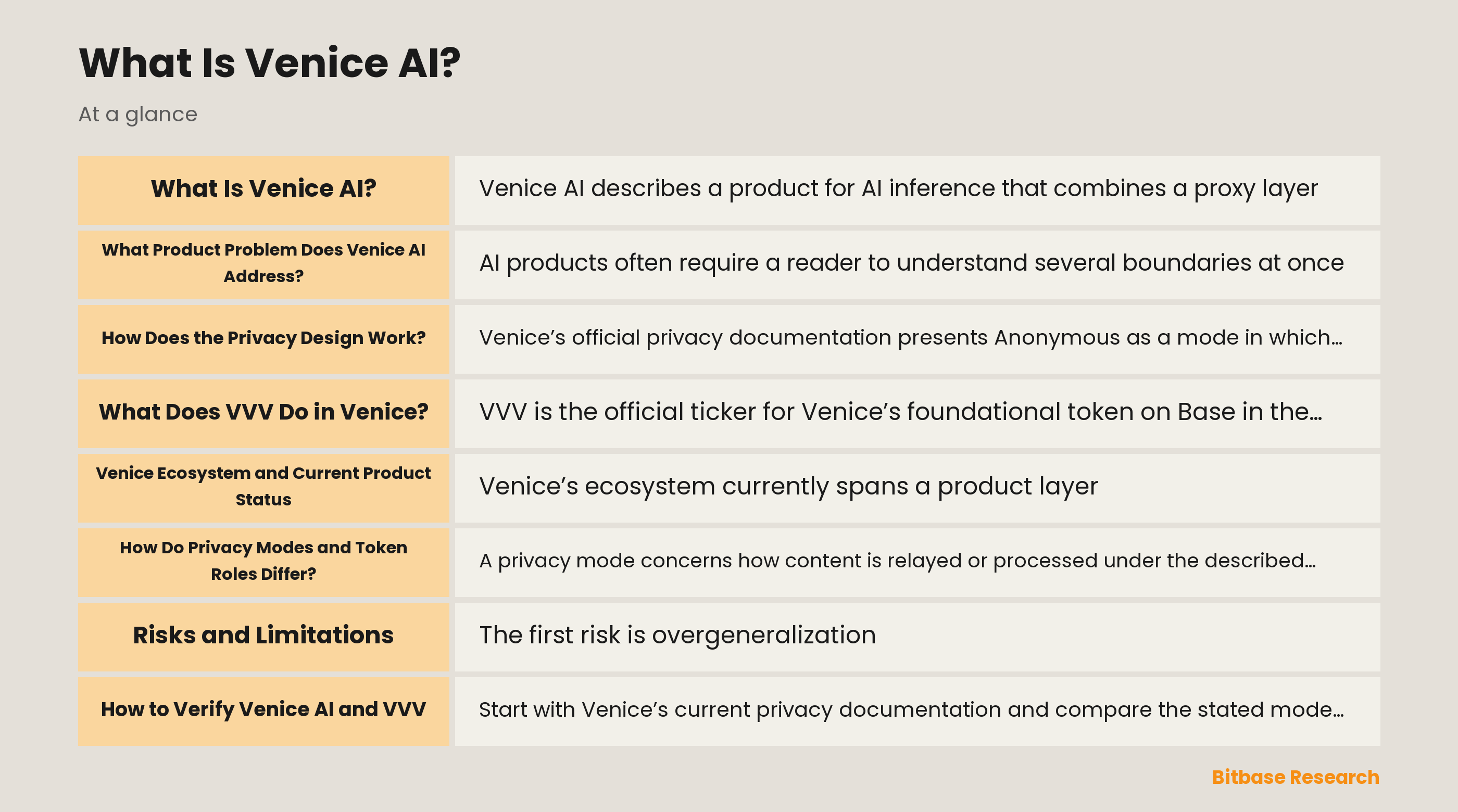
Venice’s ecosystem currently spans a product layer, model privacy modes, provider and hardware relationships described by the privacy documentation, and an onchain VVV and DIEM funding layer. This is an ecosystem map, not a statement that every external model, application, or interface has identical privacy properties or an official relationship.
The current product status should be read from Venice’s live privacy and token documentation. Those sources describe the available modes and their differing conditions, while also treating VVV and DIEM as separate parts of a funding design. Their current wording matters more than a historical announcement or an abbreviated social post.
An ecosystem discussion is most useful when it keeps categories apart: a privacy mode describes a request path, a model is a runtime choice, a provider is an operational boundary, and a token is an onchain record with a specified role. None of those categories on its own proves the properties of the others.
How Do Privacy Modes and Token Roles Differ?
A privacy mode concerns how content is relayed or processed under the described conditions. A product feature concerns what is currently enabled. A token role concerns the onchain funding design. These three ideas may be connected in Venice’s materials, but they answer different questions and should be verified with different evidence.
For example, VVV being a Base token does not make an inference request encrypted, and a privacy-mode label does not authenticate a token record. Likewise, a product description does not remove the need to review the current model conditions, operational metadata treatment, and official record for the particular claim being made.
Risks and Limitations
The first risk is overgeneralization. Venice’s own materials describe modes with different trust assumptions: Anonymous can leave content visible to a provider, Private depends on stated zero-retention commitments, and TEE and E2EE have defined technical and product constraints. It would be inaccurate to describe all modes as an absolute confidentiality or security guarantee.
A second risk is product change. Model availability, provider relationships, feature limits, privacy-mode coverage, token parameters, and onchain records can all change. A historical description can establish context, but it cannot substitute for checking the live official wording before a factual claim is published.
A third risk concerns names and records. A familiar ticker, copied contract address, or interface bearing a similar name is not proof of authenticity. The relevant official domain, the current Base record, and the scope of a claim need to agree before a reader treats a statement as verified.
How to Verify Venice AI and VVV
Start with Venice’s current privacy documentation and compare the stated mode with the specific claim under review. Confirm whether the source is describing identity masking, zero-retention commitments, a hardware-isolated environment, or end-to-end encryption. Read the limits and operational-metadata discussion instead of inferring more than the selected mode states.
For VVV, compare the official token documentation with the official contract address and the matching Base block explorer record in read-only form. Confirm that the ticker, chain context, and contract record agree. Do not treat a copied address, a token label, or an unrelated page as sufficient evidence of a current Venice record.
The Bottom Line
Venice AI is best understood as a product whose official materials distinguish multiple privacy modes and a separate onchain funding design. VVV is the official ticker used for Venice’s foundational Base token, while DIEM is described as a distinct tokenized compute unit.
The careful conclusion is conditional: private is a scoped product and runtime description, not a blanket promise. Verify the current mode, model conditions, token materials, and relevant read-only Base record before relying on a specific claim.
Related market pages
- VVV: View price · Spot market · Perpetual market
Disclaimer: This article is educational content from Bitbase Academy, provided for information only. It explains what a project does and what role its token plays in that system; it does not constitute investment, trading, tax, or financial advice, and it is neither a recommendation nor an endorsement of any project or token. Bitbase has not carried out due diligence on the project described here, and mentioning it does not mean Bitbase lists or supports the asset. Crypto assets carry significant risk, including price volatility, thin liquidity, smart-contract failure, regulatory uncertainty, and the possible loss of their entire value. Written as of August 2026; a project's status, tokenomics, team, and contracts can change at any time. Verify everything yourself through official channels, the contract address, and a block explorer, and beware of imitation sites and phishing links.
References
[1] Privacy (official Venice API documentation) docs.venice.ai
[2] Privacy in Venice (official Venice website) venice.ai
[3] VVV and DIEM (official Venice API documentation) docs.venice.ai
[4] VVV official Venice page venice.ai
[5] Venice FAQs: model privacy modes and VVV (official) venice.ai