Vertex Protocol was a documented onchain market-infrastructure project whose materials described a hybrid order-book, automated-market-maker, and settlement design; its historical token ticker was VRTX, while its later official transition notice placed the project in a changing status.
The phrase `vertex protocol` can mean the historical protocol design, its software, its former deployments, or the community and documentation around them. Those are not interchangeable. This article explains the published architecture conservatively and separates it from claims about present availability, token status, networks, contracts, or integrations.
What Is Vertex Protocol
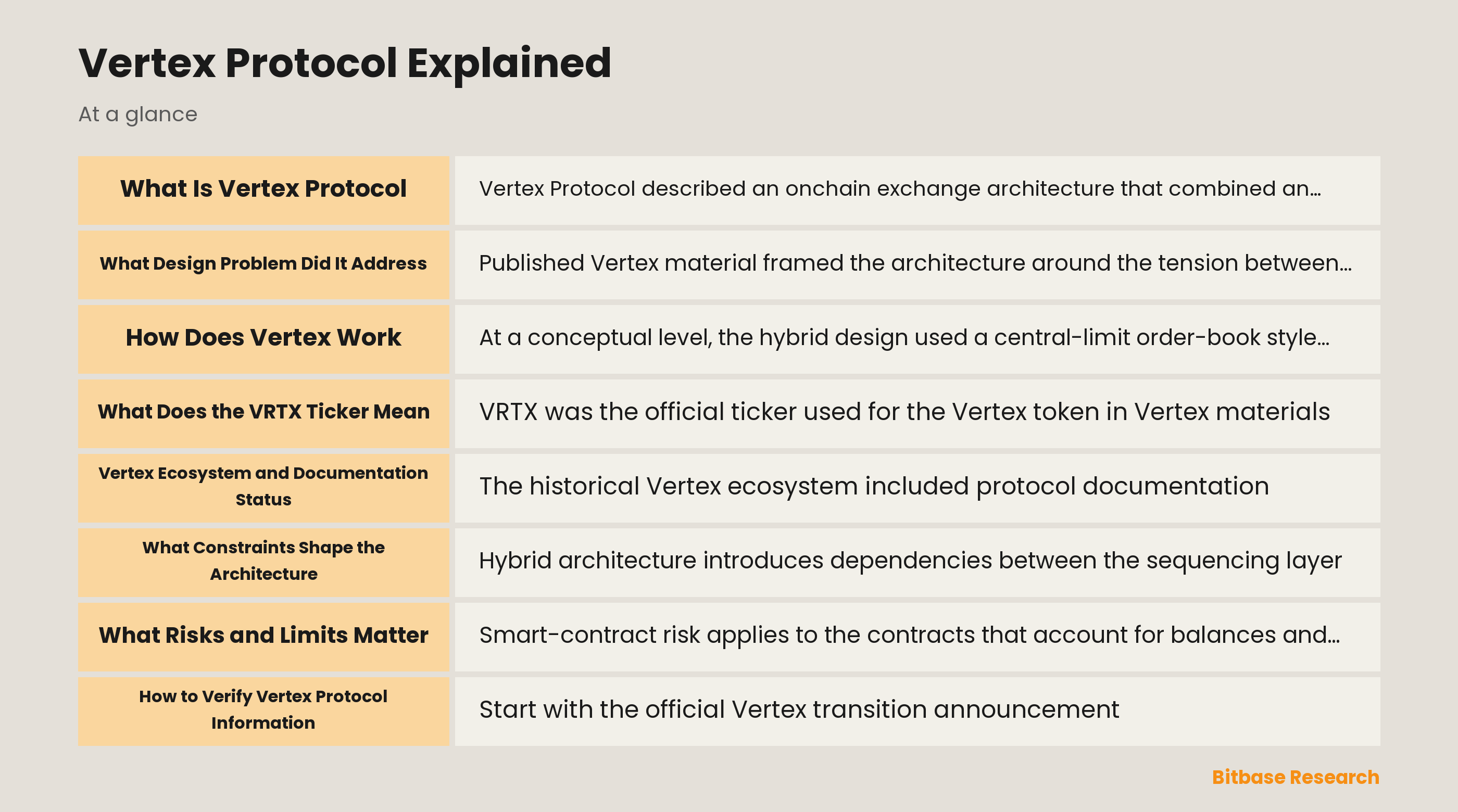
Vertex Protocol described an onchain exchange architecture that combined an offchain sequencing and order-book component with onchain risk, accounting, and settlement components. The important idea is hybrid coordination: some information can be organized quickly before the chain records final state changes, while the core rules remain tied to smart-contract accounting.
The design should not be reduced to a single interface, chain, or token. An order book is a structured record of eligible instructions and prices; an automated market maker, or AMM, is a rule-based liquidity mechanism; settlement is the process through which resulting balances and obligations are recorded. Each layer has distinct assumptions and failure modes.
What Design Problem Did It Address
Published Vertex material framed the architecture around the tension between responsive order handling and the finality, cost, and transparency characteristics of public blockchains. A purely onchain sequence can make every update wait for a block, whereas an entirely offchain venue moves more of the process outside the chain. Hybrid systems attempt to divide those responsibilities.
In this framing, a sequencer can order messages and maintain an order-book view, while contracts apply configured rules to the resulting state. The design intention does not prove that messages are always accepted, that settlement is immediate, or that an observed screen state will match an eventual onchain record.
How Does Vertex Work
At a conceptual level, the hybrid design used a central-limit order-book style of coordination alongside an AMM liquidity source. The order-book side organizes compatible intents by price and time logic. The AMM side supplies a formula-driven liquidity reference. A routing or matching layer can use the available sources under its rules rather than treating either model as the whole system.
Settlement is a separate question from matching. A system may first calculate a proposed result, then submit or record the balance changes through contracts that enforce collateral, accounting, and other configured constraints. This description does not establish the current deployment, the exact settlement path, supported assets, parameter values, or whether any historical component remains active.
What Does the VRTX Ticker Mean
VRTX was the official ticker used for the Vertex token in Vertex materials. The designation identifies the historical Vertex token and should not be confused with the name of every software component, a guarantee of utility, or a statement about a holder's rights. Token labels are identifiers, not complete descriptions of legal, technical, or economic status.
Vertex's July 2025 official transition announcement said VRTX would be sunset in connection with the project joining the Ink Foundation and stated that no further VRTX utility was planned beyond the described transition. That is a dated first-party status statement, not a permanent inference about a token's current visibility, treatment, supply, distribution, contract, or migration outcome.
Vertex Ecosystem and Documentation Status
The historical Vertex ecosystem included protocol documentation, technical explainers, interface-related material, token communications, and notices about the Vertex Edge deployments. These sources have different evidentiary roles. An architecture explainer supports an account of the intended mechanism, while a dated notice may describe a planned or historical transition rather than prove current operation.
The July 2025 Vertex announcement said the team and core infrastructure were joining the Ink Foundation, that Vertex Edge deployments would be sunset, and that a new version was planned for the Ink ecosystem. Current project identity, implementation status, any successor relationship, and all active integrations must therefore be checked directly on the publication day.
Documentation is useful for identifying what a system claimed to do, but it cannot replace a current status review. Historical pages may remain online after a service changes, and a transition announcement is not evidence that a planned successor is available, lawful in a particular place, audited for a particular scope, or suitable for any purpose.
What Constraints Shape the Architecture
Hybrid architecture introduces dependencies between the sequencing layer, smart contracts, data feeds, network conditions, and the logic that reconciles proposed results with onchain state. Delays, rejected messages, congestion, interruptions, or inconsistent data can make the observed process differ from a simplified diagram.
An order book and an AMM also encode different assumptions. Book depth may depend on posted instructions, while AMM behavior depends on a formula, reserves, and parameters. Routing rules, fee logic, market definitions, collateral treatment, and risk controls can alter outcomes and are not safely inferred from high-level descriptions.
The official materials also place the historical design in a multi-network and later transition context. Network identifiers, contract addresses, settlement configuration, interface availability, asset lists, and operational dependencies are dynamic details. They belong in a publication-day review rather than in a timeless explanatory claim.
What Risks and Limits Matter
Smart-contract risk applies to the contracts that account for balances and settle state, including possible defects, upgrades, governance changes, or unexpected interactions with dependencies. Public code, documentation, or past use does not guarantee security, correctness, availability, or any particular outcome.
Sequencer and infrastructure risk matter because a hybrid arrangement depends on communication and coordination as well as contracts. A delay or failure in one layer can affect visibility, ordering, reconciliation, or timing. Data-source and oracle risk may also matter wherever external prices or reference data influence configured controls.
Market, liquidity, and parameter risk remain conceptually separate from software risk. Volatility, thin liquidity, changing rules, and correlated failures can alter results. A historical transition adds status risk: formerly published features, token roles, or deployments may have changed, ended, or moved, and should never be presented as current without first-party confirmation.
How to Verify Vertex Protocol Information
Start with the official Vertex transition announcement, official architecture and product documentation, and official legal terms, checking each document's date and scope. Distinguish a historical overview from an announcement about closure or migration. Independent summaries can be useful leads, but they cannot substitute for the project's own dated records.
For VRTX identity, compare the exact ticker across current official Vertex or successor communications and the relevant historical materials. If an official source names a contract address for a specified network, compare that claim with the matching block explorer record. A block explorer records chain data, but it cannot by itself establish project identity, authorization, current utility, or the status of a migration.
Recheck on publication day: current project identity; VRTX and any successor-token status; chain and network identifiers; contract or mint addresses; supply and distribution; settlement parameters; availability; audit scope; geographic or legal restrictions; integrations; custody or reserve assertions; and the current status of every historical deployment. Omit a detail if the official record is missing, stale, or inconsistent.
Conclusion
Vertex Protocol is best understood as a documented historical hybrid architecture that brought order-book coordination, AMM liquidity logic, and onchain settlement into one design. The phrase `how does vertex work` is therefore answered at the level of components and boundaries, not as an instruction to use a product or a claim that any former service remains active.
VRTX is the exact historical official ticker for the Vertex token. The later official transition notice is material context: it describes a sunset of VRTX and a Vertex-to-Ink transition, so the token's current treatment and the project's current identity must be independently rechecked at publication.
The essential distinction is between a documented mechanism and a verified present state. Smart contracts, sequencing, data dependencies, parameters, liquidity conditions, legal restrictions, and transition status all carry risk. `vertex ecosystem and use cases` should be read as a research topic, not as an assurance of access, functionality, safety, liquidity, or results.
Disclaimer: This article is educational content from Bitbase Academy, provided for information only. It explains what a project does and what role its token plays in that system; it does not constitute investment, trading, tax, or financial advice, and it is neither a recommendation nor an endorsement of any project or token. Bitbase has not carried out due diligence on the project described here, and mentioning it does not mean Bitbase lists or supports the asset. Crypto assets carry significant risk, including price volatility, thin liquidity, smart-contract failure, regulatory uncertainty, and the possible loss of their entire value. Written as of August 2026; a project's status, tokenomics, team, and contracts can change at any time. Verify everything yourself through official channels, the contract address, and a block explorer, and beware of imitation sites and phishing links.
References
[1] Vertex, A New Chapter: Vertex Joins the Ink Foundation blog.vertexprotocol.com
[2] Vertex, Introducing Spot Pools blog.vertexprotocol.com
[3] Vertex, The Vertical Program: Enduring Tokenomics & Community Alignment blog.vertexprotocol.com
[4] Vertex Terms of Use vertexprotocol.com