
Crypto communities use bagholder, degen, maxi and exit liquidity as shortcuts for describing people and situations around a token or market. These terms are vivid, but they mix observable behavior with judgment, group identity and hindsight. A bagholder may be stuck, patient or simply inactive. A degen may be taking a self-aware speculative risk or ignoring basic checks. A maxi may be expressing a coherent preference or dismissing all alternatives. “Exit liquidity” may describe a real transfer of risk, but it can also be used as a slogan after any losing trade. Translate the label into facts before drawing a conclusion.
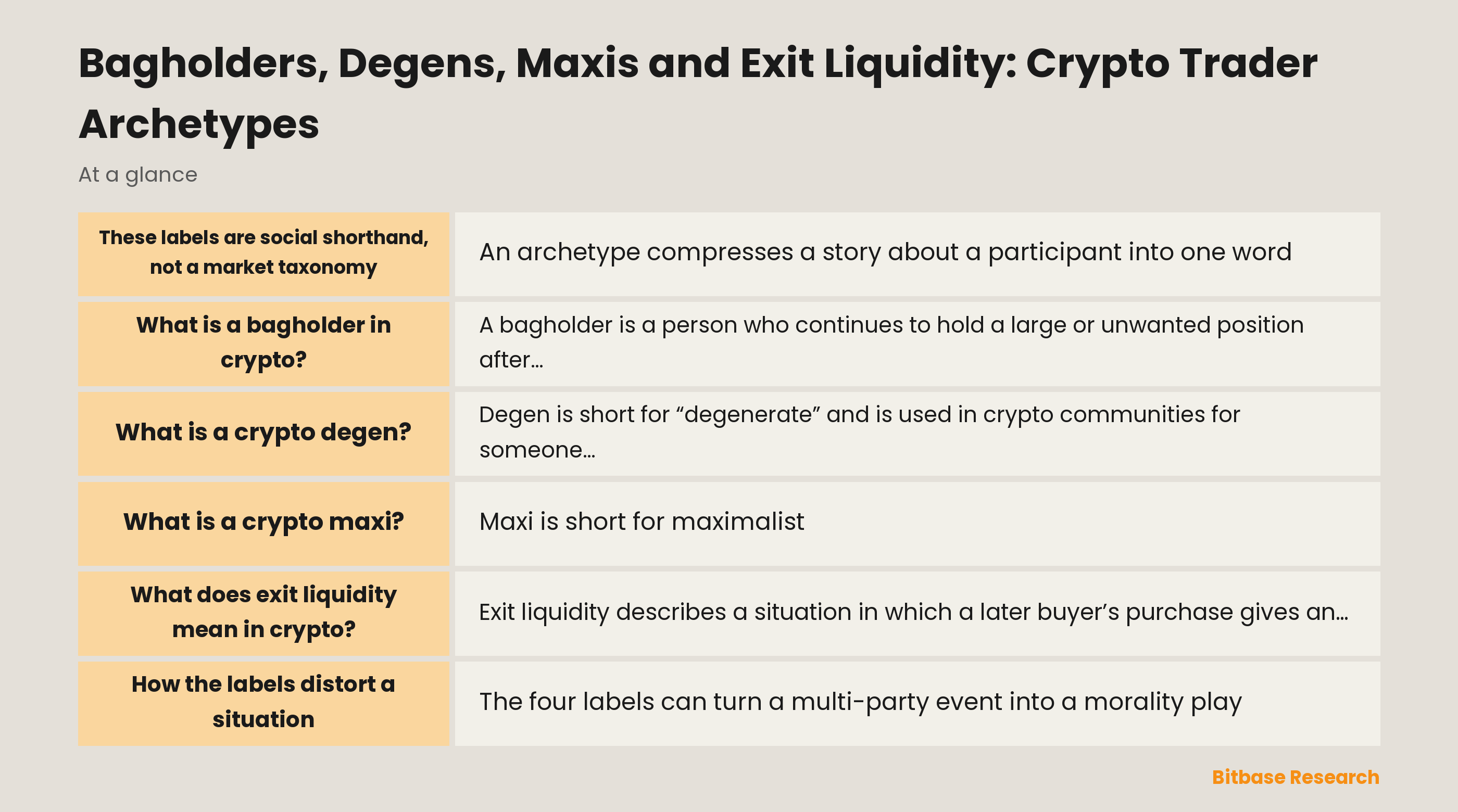
These labels are social shorthand, not a market taxonomy
An archetype compresses a story about a participant into one word. The compression is useful when newcomers need to understand a conversation quickly, but it removes details about timing, incentives and evidence. Calling someone a degen tells you how the speaker feels about the risk; it does not tell you the size of the position or the person’s financial situation.
The labels are also relational. A holder becomes a bagholder in the eyes of a critic, a trader becomes a degen in the eyes of a cautious observer, and a maxi is often defined by disagreement with another community. “Exit liquidity” describes a relationship between an earlier seller and a later buyer rather than an intrinsic identity.
These terms are informal and can be affectionate, self-deprecating or abusive. They travel between crypto, sports betting, online fandoms and traditional market slang. A careful explanation should preserve the cultural meaning while separating it from claims about value, competence or what another person should do.
What is a bagholder in crypto?
A bagholder is a person who continues to hold a large or unwanted position after the asset has fallen, the original thesis has weakened or the expected exit did not happen. The “bag” is the holding; “holding the bag” carries the older sense of being left with an unwanted responsibility. In crypto, the term is usually negative, but the exact threshold for a bag is informal.
People can become bagholders for different reasons. They may still believe the thesis, refuse to realize a loss, lose track of the position, face poor liquidity or simply decide that changing course is not worth the effort. The label does not distinguish conviction from inattention, and it does not prove that the asset is worthless.
Bagholding is often discussed alongside the sunk-cost fallacy and the disposition effect. Someone may keep a losing position because selling would make the loss feel final, while treating a gain as something to realize quickly. Those concepts describe possible decision patterns; they are not diagnoses of every holder and do not predict what an asset will do next.
The neutral translation is “a participant still holds a position after a substantial adverse change.” That wording invites better questions: what changed, what evidence remains, what liquidity is available and what would make the position no longer fit the person’s plan? The word bagholder adds social judgment but not those answers.
What is a crypto degen?
Degen is short for “degenerate” and is used in crypto communities for someone who takes high-risk, speculative or impulsive positions. The term came into crypto with an older gambling connotation, but many users reclaim it as a badge of enthusiasm, experimentation or willingness to participate before a project is mature.
The same person can use degen as self-description or as an insult. A self-described degen may be making a small, bounded experiment with full awareness of the uncertainty. Another participant may use the word for someone who relies on hype, skips research or treats a meme as evidence. Context determines whether the term signals humor, pride or criticism.
Degen is not a measure of actual risk. A polished, professional-looking decision can still carry large exposure, leverage, smart-contract risk or counterparty risk. Conversely, an unfamiliar experiment may be small and contained. The label should never replace checking the mechanism, liquidity, custody and failure modes relevant to the situation.
Translate the word into a question about process: what was known, what was checked, what could be lost and what would invalidate the idea? That question remains useful whether the speaker celebrates the risk or condemns it. It also avoids turning financial behavior into a personality type.
What is a crypto maxi?
Maxi is short for maximalist. In crypto, it commonly describes someone who believes one network, asset or design philosophy is uniquely important and treats alternatives as inferior or unnecessary. Bitcoin maxi is the most familiar example, but the broader pattern can apply to other communities without making any particular claim true.
Maximalism can have a substantive side. A participant may focus on one protocol because they understand its trade-offs, contribute to its development or prefer a clear monetary or technical philosophy. Strong specialization can make discussion more coherent, but it can also narrow the information a person is willing to consider.
The label becomes a problem when loyalty substitutes for comparison. A maxi may dismiss an alternative without examining its architecture, users, governance or failure modes. Critics may also use maxi as a shortcut to avoid engaging with a well-supported argument. The word signals the social position; it does not settle the technical question.
The neutral translation is “a participant with a strong preference for one network or thesis.” From there, ask what evidence supports the preference, what trade-offs it accepts and what observation would change the view. A preference can be strong without being universal, and disagreement does not automatically make either side irrational.
What does exit liquidity mean in crypto?
Exit liquidity describes a situation in which a later buyer’s purchase gives an earlier holder the liquidity needed to reduce or close a position. In community slang, calling someone “exit liquidity” usually implies that they bought after hype had inflated expectations and enabled someone else to leave. The phrase describes a transaction relationship, not a permanent category of person.
The phrase can point to a real asymmetry. Earlier participants may know more about their unlocks, allocations, costs or intention to sell, while later buyers see only promotional momentum. If buying demand arrives when sellable supply is concentrated, later participants can absorb that supply and bear the subsequent price and liquidity risk. This is a mechanism to investigate, not proof that every later buyer was deceived.
Exit liquidity is also used too broadly. Every buyer provides an eventual counterparty to a seller, and a later loss does not by itself establish manipulation. The relevant questions are whether information was withheld or distorted, whether supply and incentives were transparent, whether the market could absorb the orders and whether the buyer understood the risk.
For a neutral explanation, replace the slogan with “a later participant’s demand allowed an earlier participant to exit.” Then inspect concentration, liquidity, disclosures and timing without assuming intent. This keeps the warning about asymmetric information while avoiding the claim that any profitable seller or losing buyer automatically proves a scheme.
How the labels distort a situation
The four labels can turn a multi-party event into a morality play. The bagholder is blamed for staying, the degen for taking risk, the maxi for refusing alternatives and the exit liquidity for arriving late. That story may be emotionally satisfying, but it can hide the actual sequence of orders, information and incentives.
They can also produce hindsight bias. After a token falls, an earlier buyer may be called exit liquidity; after it recovers, the same person may be praised for conviction. After a speculative experiment works, a degen may be called visionary; after it fails, reckless. The label changes with the result, while the decision process may not have changed.
The search question “what is a bagholder in crypto” asks for a slang description of someone left holding a difficult position, not a verdict that every holder should exit.
The query “what is a crypto degen” asks about a self-aware or critical label for speculative behavior, not a risk score or a trading method.
The query “what is a crypto maxi” asks about strong allegiance to one network or thesis, not proof that the preferred network is objectively superior.
When someone asks “what does exit liquidity mean in crypto,” the useful answer describes later demand enabling an earlier exit and then checks information, supply, liquidity and intent.
Finally, rewrite the discussion without archetypes. State who acted, when they acted, what they could know, what they received and what risk remained. If a claim survives that rewrite, it has a factual basis. If it depends on a person being called a degen or a bagholder, it is probably doing social work rather than analysis.
The bottom line
Bagholder describes someone still carrying a difficult position, degen describes a speculative or high-risk participant, maxi describes strong allegiance to one network or thesis, and exit liquidity describes later demand that lets an earlier holder leave. None is a complete diagnosis of a person, a project or a transaction. Translate the label into timing, incentives, evidence and remaining risk before deciding what the event means.
Disclaimer: This article is educational content from Bitbase Academy, provided for information only. It does not constitute investment, trading, tax, or financial advice. Crypto assets are volatile; assess your own risk. Written as of August 2026; refer to the latest official information.
References
[1] CoinMarketCap Glossary: Bagholder coinmarketcap.com
[2] Babypips Decryptopedia: Bag holder babypips.com
[3] CryptoSlate Glossary: Bag Holder cryptoslate.com
[4] Ledger Academy: Degen ledger.com
[5] Ledger Academy: Bitcoin Maxi ledger.com
[6] CoinGecko Learn: Exit Liquidity coingecko.com
[7] Coin Bureau: Exit Liquidity coinbureau.com