A crypto ETF can place several different financial and operational layers behind one familiar name. The shares may trade on an exchange, the vehicle may hold or reference crypto assets, and a separate market may offer standardized options whose underlying is the share. In some structures, the vehicle may also be authorized to use assets it owns in a proof-of-stake network. These layers can affect one another economically, but they are not the same activity and they do not give the same rights.
The phrases bitcoin etf options explained and ethereum etf staking explained often appear together because both concern crypto-related funds. The first phrase is about a contract written on a fund share. The second is about what a fund may do with assets in its own portfolio. Keeping the two questions separate makes it easier to see who has control, where custody sits, and which document governs each event.
Two layers with similar vocabulary
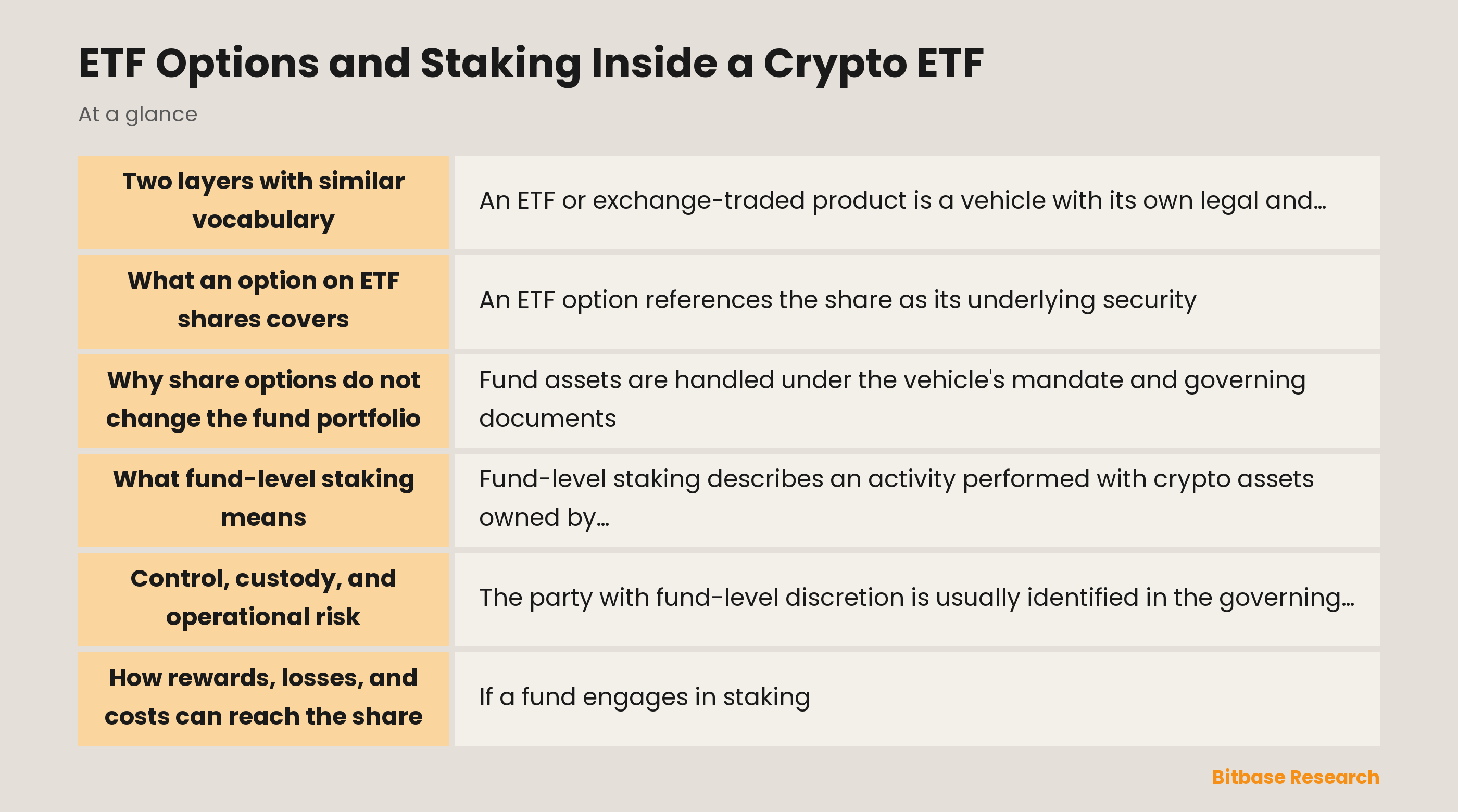
An ETF or exchange-traded product is a vehicle with its own legal and operational structure. Its portfolio, custodian, sponsor or adviser, administrator, and offering documents operate at the fund layer. A share represents an interest in that vehicle under its governing terms. The share can have a market price, and that price may be influenced by the value and design of the vehicle, but the share is not the same thing as each asset held inside the vehicle.
An option on that share adds a second layer. It is a standardized contract between market participants with terms set through the applicable market and clearing framework. The option is linked to the price and deliverable of the ETF share, not to the fund's private keys, validator credentials, or portfolio instructions. This distinction remains important even when the ETF happens to hold bitcoin, ether, or another crypto asset.
What an option on ETF shares covers
An ETF option references the share as its underlying security. Its contract terms identify such matters as the underlying share, the exercise price, expiration, multiplier, settlement treatment, and adjustment process. A standard equity option commonly uses a 100-share multiplier, although the controlling contract and applicable rules determine the actual terms. Where a contract provides for physical settlement, exercise concerns delivery of the designated ETF shares rather than delivery of crypto from the fund's portfolio.
That design explains why an option is not a side door into the fund's underlying holdings. A holder or writer of an option has rights and obligations under the option contract. Those rights do not normally include an instruction to the sponsor, an entitlement to choose a custodian, or a claim on a particular wallet or validator. The option's economic reference may be the share price, while the fund's operations remain governed by the fund documents.
Why share options do not change the fund portfolio
Fund assets are handled under the vehicle's mandate and governing documents. Creation and redemption arrangements, valuation practices, custody terms, and permitted activities belong to that operational framework. Trading or exercising an option on the shares does not by itself amend the mandate or cause the fund to acquire, sell, stake, or unstake the crypto assets it holds. It changes positions under a share-linked contract, not the instructions given to the fund.
Exchange rules provide a separate framework for whether options on ETF shares can be listed and remain listed. Those rules can address eligibility, series, trading halts, position and exercise limits, and related market safeguards. The rule framework may consider characteristics of the share and the listing market, but it is not a portfolio-management manual for the fund. A change in the availability or terms of share options therefore does not, by itself, establish a change in the fund's crypto operations.
What fund-level staking means
Fund-level staking describes an activity performed with crypto assets owned by the fund, when the network, fund structure, and governing terms allow it. In a proof-of-stake setting, assets may be committed or delegated through validator infrastructure so that the network can perform validation functions. The fund may use a specialist service provider for parts of that activity, while the fund remains the relevant vehicle whose assets and disclosures are involved.
This is different from shareholders staking personally. A shareholder owns shares under the fund's terms; the shareholder does not thereby receive a personal validator allocation, control the staking address, or direct the fund's assets. The fund documentation determines whether staking is permitted, how much operational flexibility exists, and what role the sponsor, adviser, trustee, custodian, and service providers hold. Not every crypto-focused vehicle has the same authority or uses the same terminology.
Control, custody, and operational risk
The party with fund-level discretion is usually identified in the governing documents, often a sponsor, adviser, or comparable fiduciary. That party may select or oversee providers within the stated authority and may decide how to respond to liquidity needs, technical issues, or changes in the regulatory environment. A custodian may control the fund's digital asset accounts or the key-management arrangement, while a staking provider may supply validator operations. These roles can be split among several entities rather than concentrated in the hands of shareholders.
The structure also creates operational paths that do not exist in a simple share option. Validator performance, protocol penalties, software vulnerabilities, service-provider failures, delayed unstaking, transfer controls, and custody arrangements can affect the assets held by the fund. The exact allocation of those consequences depends on the documents and the applicable law. Even if an outcome is reflected in the fund's economics, it remains a fund-level event rather than a shareholder personally operating a validator.
How rewards, losses, and costs can reach the share
If a fund engages in staking, network rewards may first accrue to the fund or its accounts according to the relevant arrangements. The offering documents can specify whether rewards are retained in the asset pool, converted or distributed under stated conditions, used to meet expenses, or treated through another disclosed method. The resulting effect, if any, can be reflected through the vehicle's assets, liabilities, net asset value methodology, or distribution mechanics. It is not automatically a separate payment to every shareholder.
Costs and losses can follow their own routes. Custody, validator, administration, sponsor, or other service costs may be charged to the vehicle or may be netted from staking-related amounts when the terms permit. A protocol penalty or operational loss may reduce assets, while liquidity rules may limit how much of the portfolio is available for staking at a given time. The fund's disclosures define the relevant calculation and allocation method; an option on the shares does not rewrite that method.
Terms, approvals, and changing boundaries
Whether an ETF share can underlie options depends on the rules and approvals applicable to the relevant exchange and jurisdiction at a particular time. Whether the fund can stake depends on the vehicle's terms, its asset and custody design, and the legal, regulatory, operational, and tax framework that applies to it. These are separate gates. A conclusion about one gate does not answer the other, and a statement accurate for one place or date may not carry over to another.
Labels also need care. A product described in ordinary conversation as a crypto ETF may be organized as a trust, an exchange-traded product, a registered fund, or another vehicle, with different documents and constraints. The durable distinction is structural: share options are contracts over shares, while staking inside a fund is an activity of the fund's portfolio and service arrangement. Clear terminology keeps the economic link visible without treating the two layers as interchangeable.
Disclaimer: This article is educational content from Bitbase Academy, provided for information only. It does not constitute investment, trading, tax, or financial advice. Crypto assets are volatile; assess your own risk. Written as of August 2026; refer to the latest official information.
References
[1] SEC notice: SR-CBOE-2025-053 sec.gov
[2] Nasdaq ISE Rule Filing SR-ISE-2024-35 listingcenter.nasdaq.com
[3] Options Clearing Corporation: Equity and ETF Options Primer theocc.com
[4] SEC EDGAR: iShares Staked Ethereum Trust ETF Form S-1/A sec.gov