Questions about source of funds and source of wealth are intended to build an evidence-based picture, not to treat two similar phrases as interchangeable. One question looks closely at the money or assets involved in a particular relationship or activity. The other looks more broadly at how a person or beneficial owner accumulated wealth over time. In a virtual-asset setting, the distinction helps explain why a review may seek context as well as transaction information.
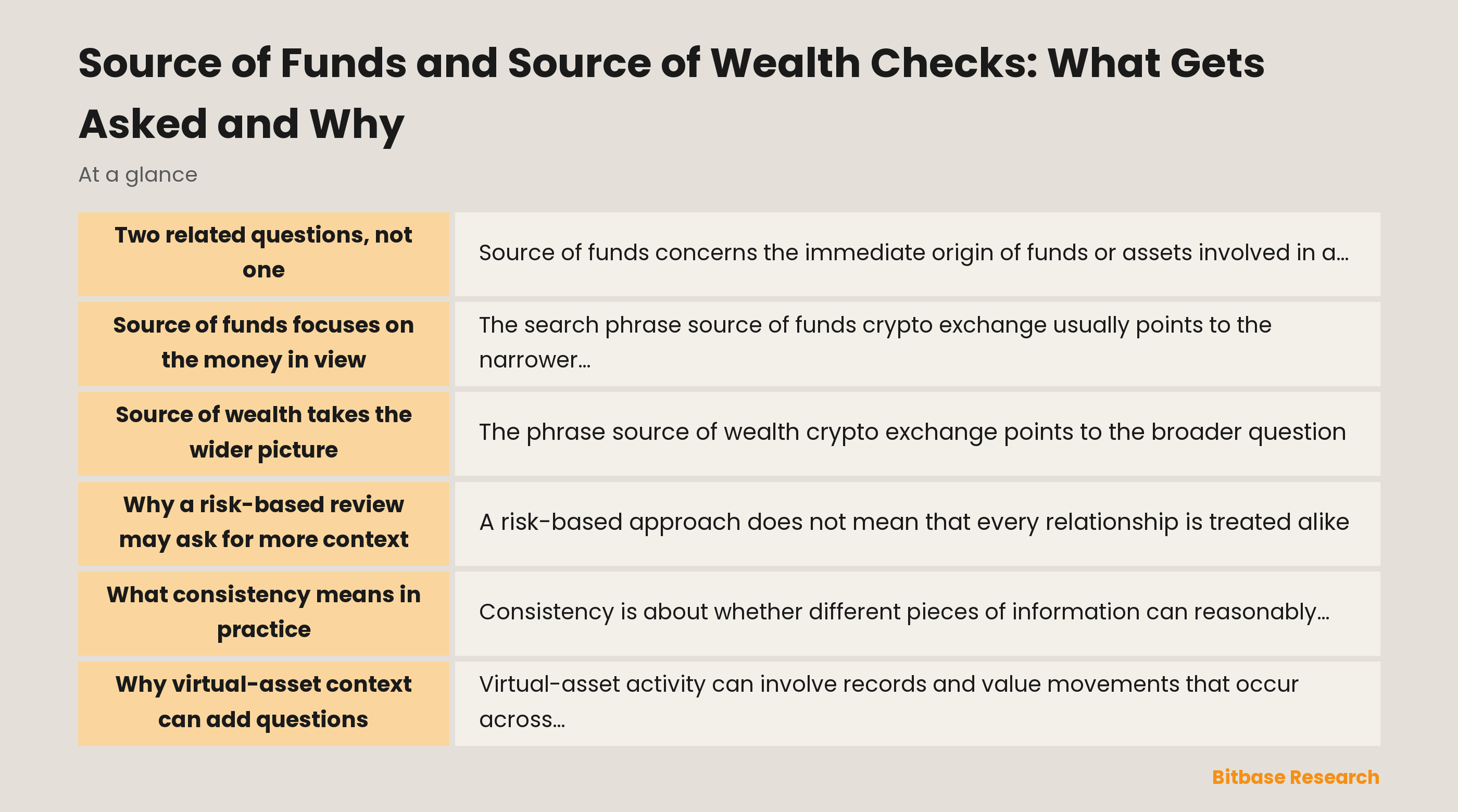
Two related questions, not one
Source of funds concerns the immediate origin of funds or assets involved in a business relationship or a particular transaction. It asks what economic activity generated the value now in view and how that value came to be involved in the relationship. The relevant period is often comparatively focused, even when the surrounding story reaches further back.
Source of wealth has a wider time horizon. It concerns how a customer or beneficial owner acquired overall wealth, which may reflect accumulated income, business activity, investment outcomes, family arrangements, or other lawful economic events over many years. It is about the broader economic picture rather than only one transfer or one asset position.
The questions can overlap without becoming identical. A sale, employment income, or a business distribution may help explain both a person’s broader wealth and the money connected with a later activity. Even so, a review can need to distinguish the immediate origin of the funds from the longer history that makes the overall financial position understandable.
Source of funds focuses on the money in view
The search phrase source of funds crypto exchange usually points to the narrower question. In plain terms, it concerns the specific value associated with the relationship or activity being reviewed, its economic origin, and the path by which it became relevant. It does not simply ask whether a person has funds; it asks how the funds now in view relate to an identifiable background.
A source-of-funds explanation therefore has a defined scope. It connects a stated event or activity with the funds or assets at issue and places that connection in time. The aim is to understand the origin of the value in context, rather than to substitute a broad label for an account of how that value arose.
This focus also explains why a transaction record and a source explanation are not the same thing. A record can show that value moved at a particular time, while the source question concerns what generated that value and whether the surrounding account is coherent. The distinction is useful because a movement by itself does not describe the economic event behind it.
Source of wealth takes the wider picture
The phrase source of wealth crypto exchange points to the broader question. It concerns whether the overall scale and pattern of a person’s wealth can be understood through a credible history of economic activity. It does not turn a review into an estimate of personal worth, and it does not collapse wealth into the funds used on one occasion.
This wider perspective can matter when the immediate funds are only one part of a much larger financial story. A person may have accumulated wealth through multiple periods or activities, while the specific funds under review derive from only one recent event. Keeping those layers separate prevents an explanation of one event from being mistaken for a complete account of wealth.
Source of wealth is also not a moral label. A larger or more complex financial history does not by itself establish a conclusion about a person or activity. The point is whether the available information gives a proportionate and intelligible account of how the broader financial position was formed.
Why a risk-based review may ask for more context
A risk-based approach does not mean that every relationship is treated alike. It means the level and type of review can reflect relevant features of the customer, the relationship, the activity, and the information already available. The purpose is to make controls proportionate to identified risk rather than to rely on a single universal script.
Additional questions can arise when the known information leaves material gaps or when the scale, timing, or nature of activity is difficult to reconcile with the existing profile. That does not itself decide that something is improper. It indicates that the picture may need more context before a reviewer can assess whether the information fits together.
National laws, regulatory expectations, and the facts of an individual relationship shape how this approach is applied. A general explanation cannot determine what will be requested in a particular review, nor can it predict an outcome. Its value is in showing why source questions sit alongside identity, relationship purpose, and ongoing understanding.
What consistency means in practice
Consistency is about whether different pieces of information can reasonably describe the same economic story. Identity information, the stated purpose of a relationship, the timing and nature of activity, and an explanation of funds or wealth may all be considered together. A single fact rarely answers every question on its own.
Records may be relevant because they can support or challenge how the account fits together. Their value comes from their relationship to the stated event, time period, and economic context, not merely from their existence. A document that confirms a movement of value, for example, may have a different role from information that explains why the value was available.
This is why consistency should not be understood as a checklist exercise. A coherent account is one in which the information does not materially contradict the relevant context and where important questions can be understood. The standard of review, the information considered, and the weight given to it remain dependent on the applicable framework and circumstances.
Why virtual-asset context can add questions
Virtual-asset activity can involve records and value movements that occur across different times, services, and counterparties. That can make the economic context important alongside the visible transaction history. A history of movements may describe what happened in a technical sense without, on its own, explaining the underlying purpose or source of value.
Risk-based guidance for virtual assets applies customer due diligence and record-keeping concepts in a sector with distinct features. The relevant question is not whether a technology label changes the need for context, but whether the available information supports a sound understanding of the relationship and its activity. The answer depends on the applicable legal framework and the facts.
The word exchange in a search phrase should not suggest that all reviews are identical or that one provider’s process defines another’s. Different jurisdictions can frame obligations differently, and individual facts can affect the questions considered. General education is most useful when it avoids turning those variable processes into a fixed prediction.
Boundaries of a useful explanation
Source-of-funds and source-of-wealth questions describe mechanisms for understanding information; they are not a finding that a person has done anything wrong. They are also not a substitute for the complete set of customer due diligence, monitoring, and legal obligations that may apply in a particular context. Keeping the terms separate makes the purpose of a question easier to understand.
The distinction does not identify a universal set of materials or a guaranteed result. What is relevant depends on jurisdiction, the relationship, the activity, the risk assessment, and the individual facts. A broad article can explain the concepts without deciding how any review should be conducted or resolved.
The most neutral takeaway is that source of funds asks about the origin of value involved now, while source of wealth asks how the broader financial position came to exist. Risk-based review considers those questions alongside other information and looks for a coherent account. That framing explains why the questions are asked without presenting them as a route around controls or as an outcome in themselves.
Disclaimer: This article is educational content from Bitbase Academy, provided for information only. It does not constitute investment, trading, tax, or financial advice. Crypto assets are volatile; assess your own risk. Written as of August 2026; refer to the latest official information.
References
[1] FATF Recommendations: Recommendation 10 fatf-gafi.org
[2] FATF: Risk-Based Approach to Virtual Assets fatf-gafi.org
[3] FCA Financial Crime Guide FCG 3 handbook.fca.org.uk
[4] FINTRAC: Money Services Business Indicators fintrac-canafe.canada.ca