
Crypto held by a pension fund, endowment, bank, corporate treasury, or public body is often described with one word: allocation. That label hides a chain of decisions. An institutional crypto allocation explained clearly is a governed exposure within a mandate, not an opinion expressed as a trade. Its significance lies in who can decide, what risks they can assume, how ownership is evidenced, and how information reaches oversight.
A sovereign bitcoin reserve explained with equal care is not simply the same idea at a larger scale. A public holding can appear on a balance sheet for several reasons, while a proposed strategic reserve can remain only a proposed legal and operational design. The terms differ in authority, purpose, governance, accounting, and public accountability. Looking at those layers makes the language more precise without treating any arrangement as a verdict on policy.
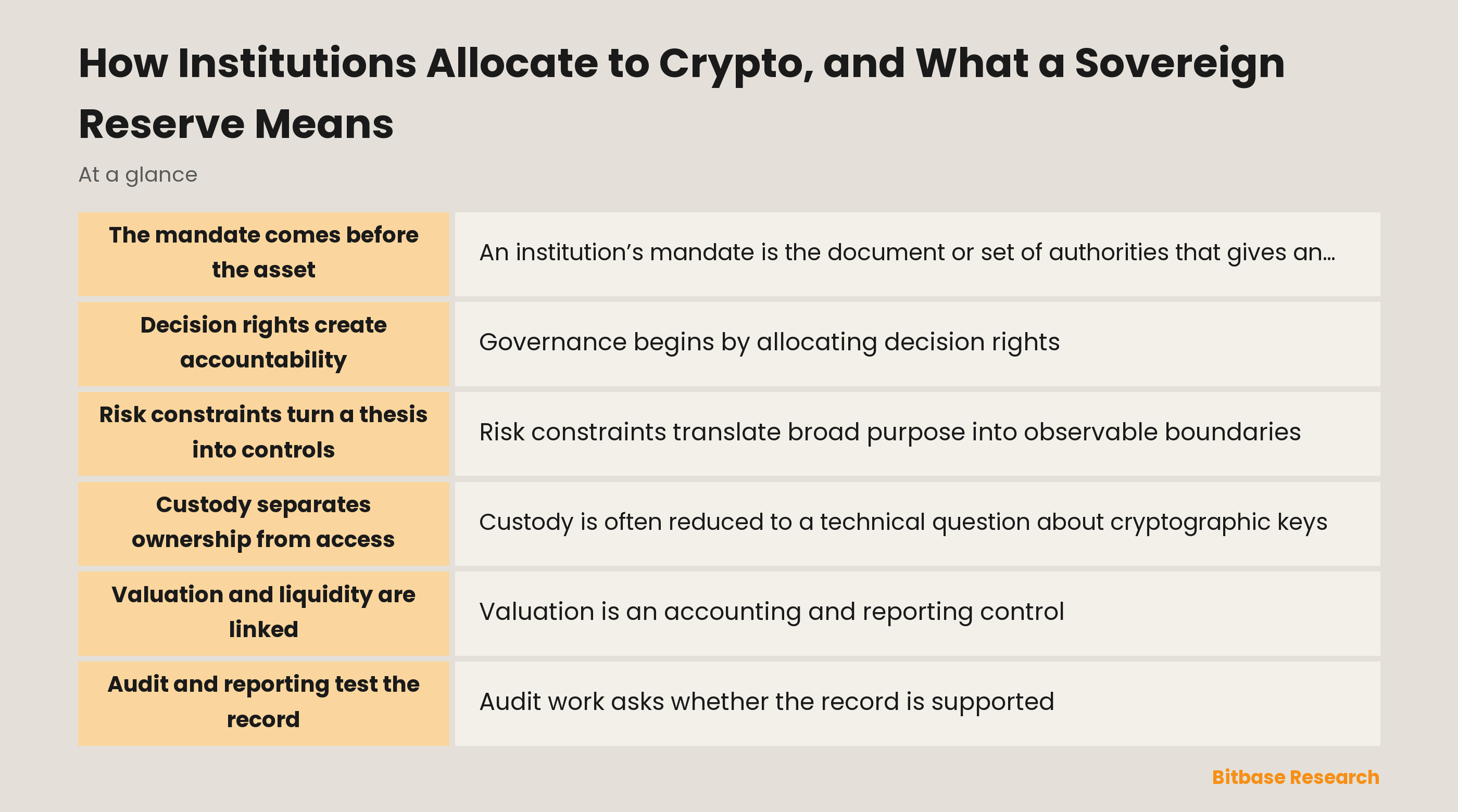
The mandate comes before the asset
An institution’s mandate is the document or set of authorities that gives an activity its purpose and limits. Depending on the institution, it may be a governing statute, charter, investment policy, treasury policy, board resolution, or delegated operating rule. It identifies the entity that owns the exposure, the objective it serves, the decision-maker with authority, and the constraints that make the activity accountable.
The mandate also separates a deliberate allocation from a holding that arrived by another route. A business may receive a crypto asset through an ordinary commercial arrangement; a public body may control an asset through a legal process; a custodian may safeguard an asset for someone else. Each situation raises different questions. Recording an asset does not by itself show that an institution selected it as part of a portfolio or reserve function.
Research about a network, an asset class, or market structure may inform a decision paper, but it does not replace a mandate. A durable record connects the stated purpose to the form of exposure, eligible counterparties or arrangements, accounting treatment, and review cycle. That connection is what lets an oversight body distinguish a bounded institutional activity from an informal preference.
Decision rights create accountability
Governance begins by allocating decision rights. A board, committee, public authority, or equivalent body may retain responsibility for the mandate, while an executive owner translates it into operating rules. Specialists may analyze risk, legal context, technology, finance, and operations. The structure matters because analysis, approval, execution, recordkeeping, and independent review are different functions even when they concern the same asset.
Clear authority also makes exceptions visible. The framework can identify who may approve a new exposure type, appoint or replace a custodian, alter a valuation method, respond to a control failure, or pause activity after an incident. Delegations have meaning only when their scope, time horizon, documentation, and escalation path are recorded. A decision made under a temporary authority is different from a permanent change in the mandate.
Conflicts of interest belong in the same map. An institution can face overlapping roles when an affiliate supplies technology, custody, pricing data, execution services, or research. The governance question is not whether a conflict can be described away; it is whether the institution can identify the role, preserve independent challenge, and document the relevant decision. That framing is useful across institutions without assuming that every organization has the same legal form.
Risk constraints turn a thesis into controls
Risk constraints translate broad purpose into observable boundaries. Crypto exposures can combine market movement, liquidity, credit or counterparty, operational, cyber, custody, legal, accounting, and reputation risks. The relevant mix depends on the form of exposure and the institution’s role. Naming those categories is not a forecast about an asset; it is a way to make uncertainty discussable before and after a holding is recorded.
An institution may express limits through eligibility rules, concentration boundaries, approved service arrangements, liquidity horizons, valuation-source requirements, or incident thresholds. The specific measure is less important here than its governance role: a limit gives an operator a rule, a risk function a monitoring reference, and an oversight body a basis for examining a breach. A limit without a measurement method or an owner remains a statement of intent rather than a control.
Stress analysis tests relationships that are easy to overlook in calm conditions. It can examine what changes if price information is interrupted, a custodian becomes unavailable, a transfer is delayed, a counterparty fails to perform, or several pressures occur at once. The result is not a prediction. It is evidence about whether the mandate, operational design, and information flows still function when ordinary assumptions no longer hold.
Custody separates ownership from access
Custody is often reduced to a technical question about cryptographic keys, but its institutional meaning is wider. It concerns who has authority to authorize movement, who maintains records, how access is controlled, what recovery arrangements exist, and which party bears responsibility when a process fails. Direct control, third-party custody, and other arrangements distribute those responsibilities differently; none of the labels alone establishes a complete control environment.
A public blockchain can show that an address moved or held units, yet that observation does not settle every ownership question. Institutional records also need to address the relationship between the address, the legal entity, the authorized persons, the custodian’s books, and any contractual or legal claims. This is why custody evidence, accounting records, and governance records need to agree while remaining independently reviewable.
Separation of duties helps preserve that independence. The person or system that prepares a transaction record need not be the same function that authorizes it, reconciles it, or reviews an exception. Recovery controls, incident response arrangements, access changes, and periodic reconciliations all produce evidence about whether the documented custody model exists in operation rather than only on paper.
Valuation and liquidity are linked
Valuation is an accounting and reporting control, not a declaration that a quoted number is universally decisive. A methodology can specify the measurement date and time, selected market data, price-source hierarchy, treatment of outliers or stale observations, foreign-exchange translation where relevant, and procedures for unavailable data. The governance value of the method lies in making the result reproducible and explainable at a stated reporting point.
Liquidity is related to valuation but answers a different question. A visible market price does not necessarily show whether an institution could meet a settlement, funding, transfer, or disposal need under its own constraints. Market depth, concentration of service providers, market hours, transfer restrictions, settlement reliability, and operational availability can all affect liquidity without changing the existence of a price observation.
The same information may serve multiple purposes, but it should not be collapsed into one conclusion. A price feed can support a valuation process while risk staff examine its resilience; a custody report can support a reconciliation while auditors assess the reliability of the evidence. Keeping those uses distinct makes it easier to trace why a reported value, liquidity assessment, or exception was accepted.
Audit and reporting test the record
Audit work asks whether the record is supported. For a crypto holding, questions commonly include existence, control or ownership, rights and obligations, valuation, presentation, and disclosure. On-chain information can be relevant evidence, but it is not automatically sufficient evidence of every assertion in financial statements or public reporting. The surrounding controls and corroborating records determine what a reviewer can conclude.
Reporting turns the governance design into an account that a board, auditor, regulator, or public audience can examine. It may connect the mandate to the recorded exposure, explain the valuation basis, identify the custody arrangement, show relevant risk information, and record material exceptions or changes. For a public entity, the audience may extend beyond internal oversight to fiscal reporting and broader accountability for controlled assets.
Independent review has a defined scope. Internal audit may examine control design and operation; an external auditor may evaluate financial reporting assertions within an engagement; a specialized attestation may test a narrower subject. These forms of work are not interchangeable. A point-in-time verification, for example, does not automatically answer all questions about liabilities, authority, valuation, or the completeness of a public balance sheet.
Three meanings of a public crypto holding
An institutional allocation is a governed decision by an entity acting within its own mandate. The key facts are the entity’s purpose, decision rights, risk boundaries, custody model, valuation method, and reporting route. It may be held by a private or public institution, but the word allocation describes a deliberate management decision rather than merely the presence of an asset.
A public-sector balance-sheet holding is a broader accounting and control concept. It describes an asset controlled by a public-sector entity and considered alongside that entity’s liabilities, other assets, and fiscal or financial reporting perimeter. The holding may be deliberate, incidental, temporary, or inherited through a defined process. Its appearance in public accounts does not by itself establish a reserve purpose, a strategic designation, or a continuing acquisition program.
A proposed strategic reserve is a further and earlier category: a stated concept for how a public authority might organize assets around a reserve purpose. Until it has a defined legal authority, accountable entity, operating mandate, custody and valuation arrangements, and reporting treatment, it remains a proposal rather than an operating reserve. The distinction is descriptive. It keeps a label, a balance-sheet entry, and a political statement from doing the work of governance.
Disclaimer: This article is educational content from Bitbase Academy, provided for information only. It does not constitute investment, trading, tax, or financial advice. Crypto assets are volatile; assess your own risk. Written as of August 2026; refer to the latest official information.
References
[1] Financial Stability Board, High-level Recommendations for Crypto-asset Activities and Markets (2023) fsb.org
[2] Basel Committee on Banking Supervision, Prudential treatment of cryptoasset exposures (2022) bis.org
[3] International Monetary Fund, Public Sector Balance Sheet Assessment imf.org
[4] Public Company Accounting Oversight Board, Auditors Must Respond to Unique Risks of Crypto Assets (2023) pcaobus.org